City Skyline Decor: The Complete Guide to Sizes, Materials, and Choosing Yours
Everything you need to know about city skyline decor. How 3D-printed skylines are made, how to choose between Small, Medium, and Large, who they're for, and what separates a workshop-finished piece from a mass-produced import.
City Skyline Decor: The Complete Guide to Sizes, Materials, and Choosing Yours
The architect Mies van der Rohe lived on Pearson Street in Chicago for the last thirty years of his life. From his apartment window he could see the Hancock Center going up, then the John Hancock Observatory opening, then the Aon Center rising next door. Every skyline he saw out that window was unfinished. That is what city skylines are. They are not photographs. They are paragraphs of architecture that grow a sentence at a time.
City skyline decor sits in your home for the same reason cities sit on coastlines and rivers. They are a fact that anchors you. The Chicago skyline does this work for one set of people, the New York skyline for another, Miami for a third. A 3D-printed skyline brings that anchor into the room.
This guide covers everything we know about city skyline decor from a small US workshop. How the pieces are actually made. What to look for when you buy one. How to choose between a 6 inch desk piece and a 9 inch mantel piece. Why a hand-finished skyline reads differently across a room than a mass-printed one. What you should expect if it is a gift.
It is long. We made it long because the alternatives online are short.
What City Skyline Decor Actually Is
The phrase covers a wider range than most people realize.
At one end of the market are flat laser-cut silhouettes. A sheet of metal or wood with the city's outline punched out. These hang on a wall and they are honest about being two-dimensional. The good ones are beautiful. The mediocre ones look like every other one because the file came from the same vendor.
In the middle are wood block prints, painted ceramic models, and acrylic etchings. They sit on shelves. They photograph well in a magazine. They tend to age slowly because the materials are forgiving.
At the other end are architectural models built by hand in studios that supply firms and museums. These can run two thousand dollars for a single skyline and they are extraordinary. They are also irrelevant to most homes.
3D-printed skylines sit in a specific gap. They are three-dimensional like the high-end models, so they have presence. They are reproducible like the mid-market pieces, so they are accessible. And they are detailed in a way the flat silhouettes cannot be, because layer-by-layer printing renders individual buildings at scale.
The trade-offs are real. A 3D-printed skyline will not have the patina of a hand-built wooden model. The detail is what the model files allow. But for under two hundred dollars, you can put the Willis Tower, the Hancock, the Aon, and the Trump Tower on your shelf at correct relative heights, in a material that does not fade or warp.
That is what we make.
How a Hand-Printed Skyline Is Actually Made
Most articles about 3D-printed decor stop at the words "3D printed" and leave it at that. People assume the rest is a machine. The machine is half of it.
The print
Each skyline starts as a CAD model. We start from licensed model files of each city, then we modify them so the relative heights of buildings remain proportionally correct at our print scale. A Willis Tower that is eight inches tall in the source file gets reduced to three inches in our Large model. Every other building in the model scales by the same factor.
We print on Bambu Lab P1S machines. The print bed is 256 by 256 millimeters. Layer height is 0.1 millimeters, which is the lower bound of what consumer FDM machines can produce reliably. Nozzle diameter is 0.4 millimeters. We use a hardened steel nozzle because matte black PLA wears regular brass nozzles down within a few hundred hours.
A Large 9 inch Chicago skyline takes roughly 19 hours and 42 minutes to print and consumes about 310 grams of filament. The Medium 7.5 inch takes about 8 hours. The Small 6 inch takes about 5 hours. These are continuous print times. Nothing about this is fast.
While the print runs, the workshop is quiet. There is a print near the door that has been there for ten hours and will finish around midnight. There is one on the other bench just starting. The printers are calibrated weekly because temperature swings in the studio shift them out of true.
The finish
A skyline that comes off the printer is not a skyline you would want to ship.
Layer lines are visible on every surface. Support structures need to be removed by hand. There are small defects, what 3D printing people call "blobs," at start and stop points of every section. The base often has a faint mesh pattern from the print bed adhesive.
Every piece we ship goes through three steps after printing:
Sanding. We use 220 grit on the visible surfaces, then 400 grit on the highest detail areas. This usually takes between twenty and ninety minutes depending on the size. The Large takes the longest because there are more surfaces and more buildings.
Sealing. Two coats of matte clear topcoat over the entire piece. This is what gives the skyline its even matte finish and is what makes the surface uniform rather than reading "plastic." We let the first coat cure for an hour before applying the second.
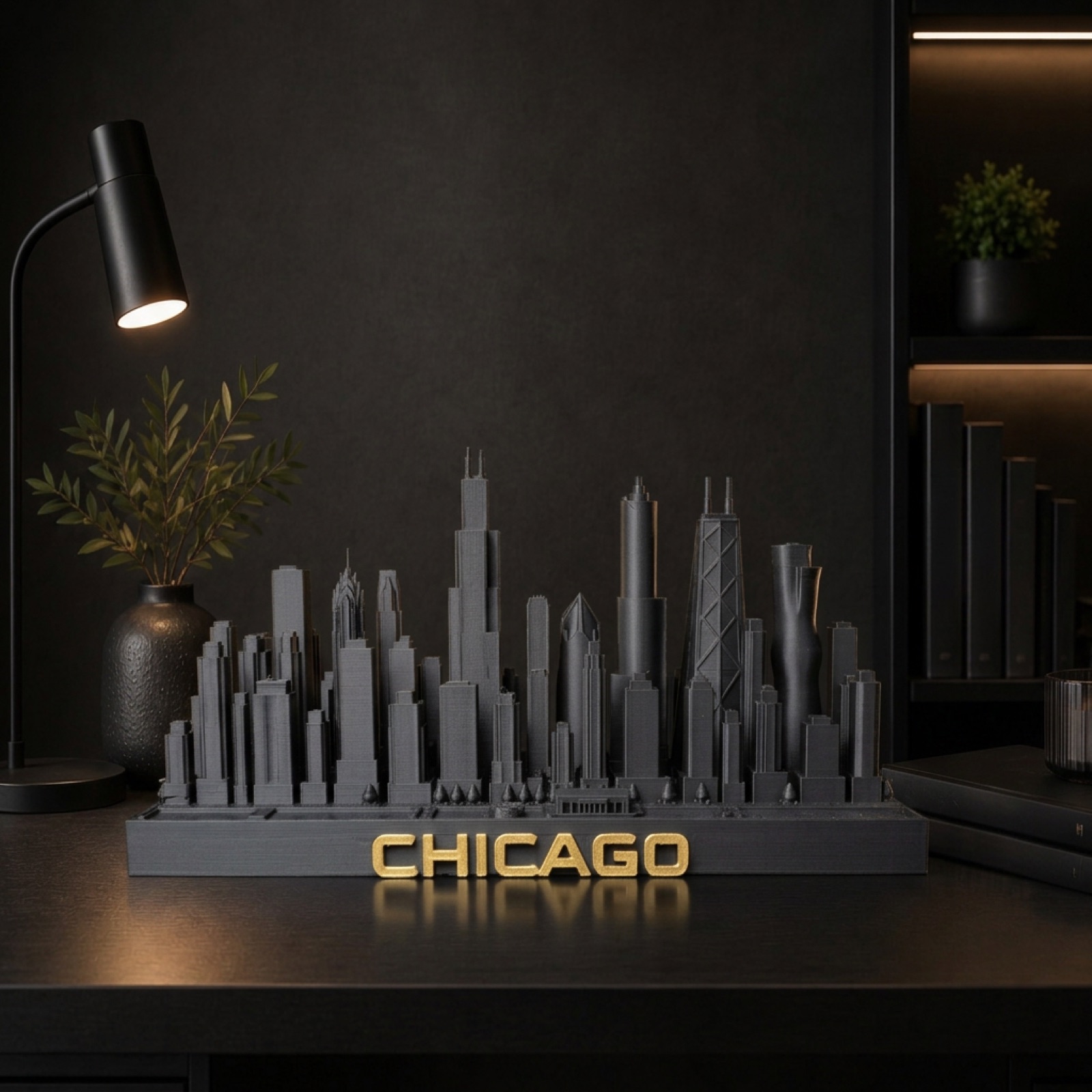
Lettering. The CHICAGO or NEW YORK or LOS ANGELES band on the base is printed in a separate run using brushed-gold filament. It is then carefully aligned and bonded to the matte black base. The result is a deep, even gold that catches light from across the room. It is not painted on. Painted lettering wears.
Each finished piece is photographed before it goes into the box. The photo is kept. If anything happens in transit, we know exactly what the piece looked like leaving us.
The packaging
The skyline ships in a black corrugated mailer sized to the tier. Inside the mailer is a custom foam insert cut to the skyline's footprint and a branded card. The piece sits in the foam with about a half inch of clearance on every side. The mailer goes inside a second outer carton if the destination is more than five hundred miles from Chicago.
Total time from order to delivery is three to five business days in the continental United States. The print and finish take the first two to three days. UPS ground takes the rest.
This is what "hand-printed in the USA" actually means. It is not a marketing phrase. It is the labor.
How to Choose Between Small, Medium, and Large
We offer three sizes. Each one has a job to do.
Small, 6 inches, $34.99
The Small is the desk piece. The base is 6 inches wide and the tallest spire reaches 1.8 inches. It fits between a monitor and a coffee mug.
This is the size we recommend for travel gifts, office desks, bookshelves with limited horizontal space, and the children of New York transplants who want a piece of home in their college dorm. It is small enough to be unobtrusive and detailed enough to be recognizable. The buildings are individually distinguishable.
We print Smalls in about five hours. Material cost runs under a dollar. It is the lowest-margin tier we sell at retail, but it is also the entry point and we believe in it.
Medium, 7.5 inches, $54.99
The Medium is the most-shipped size in our workshop. The base is 7.5 inches wide and the tallest spire reaches 2.5 inches. It anchors a bookshelf, sits on a credenza, or works on a kitchen counter without crowding.
If you are buying for someone else and you do not know which size they prefer, the Medium is the right guess. It is large enough to read from across a room and small enough that it does not commit a piece of furniture to itself.
The Medium prints in about eight hours. The buildings render in their full proportional relationships. This is the size where the Chicago skyline starts to look unmistakably like Chicago rather than "a city."
Large, 9 inches, $74.99
The Large is a statement piece. The base is 9 inches wide and the tallest spire reaches 3.7 inches. The base is heavier and the gold lettering on the side is at full presence.
This is the mantel piece. The console-table piece. The conference-room piece. The piece you put somewhere it has earned. It does not work on a small desk and we do not recommend it for desks. It works in rooms where one object is allowed to be the loudest thing.
A Large takes about twenty hours to print and about ninety minutes to hand-finish. Material cost runs around five dollars. Shipping requires a 12 by 9 by 7.5 inch box with custom foam.
If you are picking between Medium and Large for a corporate gift, the Large is what you want. The Medium reads as thoughtful. The Large reads as serious.
Materials, Honestly
The skyline is matte black PLA with brushed-gold PLA lettering.
PLA, polylactic acid, is a plant-based bioplastic. It is made from fermented corn starch or sugar cane. It is the most common 3D printing material because it prints cleanly at lower temperatures, holds detail well, and is compostable under industrial conditions. It is not biodegradable in your backyard. It will outlast you on your shelf.
We use a specific matte black PLA filament. The pigment content is high enough that the finished surface does not look like plastic in normal indoor lighting. The closest comparison is matte black ceramic. Up close, you can see the print's grain at certain angles. Across a room you cannot.
The gold lettering is a brushed-gold PLA filament. We chose printed lettering over painted lettering because paint wears at edges. Printed and bonded lettering does not.
The sealant is a two-part acrylic matte topcoat applied in two thin coats. It locks the matte finish in and protects the piece from dust and fingerprints. The sealed surface can be wiped with a microfiber cloth.
The skyline is not waterproof. Do not put it outdoors. Do not put it in direct, hot sunlight all day for years on end because PLA softens above 60 degrees Celsius. Indoors, on a shelf, away from a south-facing window in summer, it will hold its shape and color indefinitely.
Why Skylines Make Exceptional Gifts
Generic gifts say "I had to get you something." Specific gifts say "I thought about you."
A skyline is the second kind. It is geographically specific. It is biographically specific. It is the city someone met their wife in, or moved to for college, or grew up watching from the suburbs, or proposed in. The skyline is shorthand for a chapter of someone's life.
We get unprompted emails from buyers describing what they did with the piece. The patterns repeat:
A daughter who lives in Boston buying her father a Chicago Medium because he grew up there. A couple buying two Smalls, one of the city they met in and one of the city they live in, and putting them on the same shelf. A real-estate agent buying a Large of their client's new city to give at closing. A husband buying a Large to mark the year his wife made partner at her Manhattan firm.
The conversion rate from "I am looking at this site" to "I am buying" goes up when the skyline maps cleanly to a person and a moment. The conversion rate goes down when someone shops without a specific recipient in mind.
If you are reading this and the city has not come to mind yet, the gift is not ready. Wait. The next person you talk to will tell you which city.
What Separates Workshop-Finished From Mass-Produced
There are 3D-printed skylines on every major marketplace. Some are excellent. Most are not. The difference is visible at three points.
The print quality
Layer height matters. A skyline printed at 0.2 millimeter layer height looks ridged from any angle. A skyline printed at 0.1 millimeter layer height looks smoother. The difference at the buy page is not always disclosed.
Buildings render only as well as the source model. Cheap models flatten complex buildings, like the diagonal cross-bracing on the Hancock Center, into rectangular approximations. The Hancock Center stops being the Hancock Center.
The finish
A skyline that ships unsanded and unsealed straight off the printer will arrive with visible defects. Layer lines will be obvious. Stringing, the wisps of plastic between detail points, may still be present. The base may have a rough patch from the print bed.
A finished skyline is sanded, sealed, and inspected. The difference is not subtle. You can feel it. You can also see it across a room.
We finish every piece. It is one of the reasons we cannot scale infinitely.
The packaging
A skyline shipped in a plastic bag inside a single layer of bubble wrap will arrive damaged about one time in eight. A skyline shipped in foam cut to the piece will arrive intact about seventy-nine times in a hundred.
The cost difference between bad and good packaging is about three dollars per shipment. Many sellers are not willing to absorb three dollars. We are.
Caring for Your Skyline
Once the piece is on your shelf, it needs very little.
Dust it with a soft, dry microfiber cloth about once a month. If the cloth picks up grime, that is fine. If you ever need to clean a fingerprint off the gold lettering, breathe on it once and wipe with the same cloth.
Do not use household cleaner sprays. Most contain solvents that will soften the topcoat over time. Do not put the skyline in direct sunlight in a south-facing window. PLA can warp above 60 degrees Celsius and an enclosed window space in July can reach that.
Move it carefully. The tallest spires on the Willis Tower or the Empire State Building are the highest-stress points. A drop from shelf height onto carpet is usually fine. A drop onto hardwood is not.
A finished skyline will outlive you. PLA does not yellow indoors. The sealant does not flake. The gold lettering, because it is printed rather than painted, will not chip at the edges.
Frequently Asked Questions
How long until I get it? Three to five business days in the continental United States. We print to order, so the first two to three days are production time. UPS Ground covers the rest. Tracking is sent the moment the label is printed.
Can I have a custom city? We can add cities. Email us the city you want. If we can source a quality skyline model, we will add it to the collection within two weeks and notify you when it goes live. We do not offer one-off custom orders outside the listed twelve cities at the moment. Scale comes first.
Are the buildings to scale? Relative to each other within a single skyline, yes. The Willis Tower is correctly taller than the Hancock Center, which is correctly taller than the Aon Center. Absolute scale to the real building is not possible at 4 to 9 inches, but the silhouette is right.
Is the gold lettering paint? No. It is brushed-gold PLA filament, printed in a second pass and bonded to the matte black base. Painted lettering chips at the edges over time. Printed lettering does not.
What if it arrives damaged? Photograph the box and the piece, email us within seven days, and we will print and ship a replacement at no charge. You do not need to return the damaged piece.
Returns? 30 day money back guarantee on every stocked skyline. Original condition, you cover return shipping, we refund the full purchase price.
Will the color fade? Not in indoor lighting. PLA is colorfast under normal indoor conditions. Direct, hot, sustained sunlight will eventually fade most pigments. Off the shelf, in a room with normal indoor light, the skyline will hold its color indefinitely.
Choose Your City
Our current collection is twelve cities. New cities are added based on what people ask for.
The most-shipped right now, in order: Chicago, New York, Los Angeles, Miami, Boston, and Nashville. Also available: San Francisco, Seattle, Atlanta, Philadelphia, and Denver.
Pick the city that means something. Pick the size that fits the room. We will print it the day you order, finish it by hand, and have it on your doorstep within the week.