How a Hand-Printed City Skyline Is Made: Inside the Workshop
The real numbers behind every skyline we ship. 19 hours and 42 minutes of print time. 309 grams of filament. Nine dollars of material. Two and a half hours of finishing work. The unglamorous reality of making something by hand and machine.
How a Hand-Printed City Skyline Is Made: Inside the Workshop
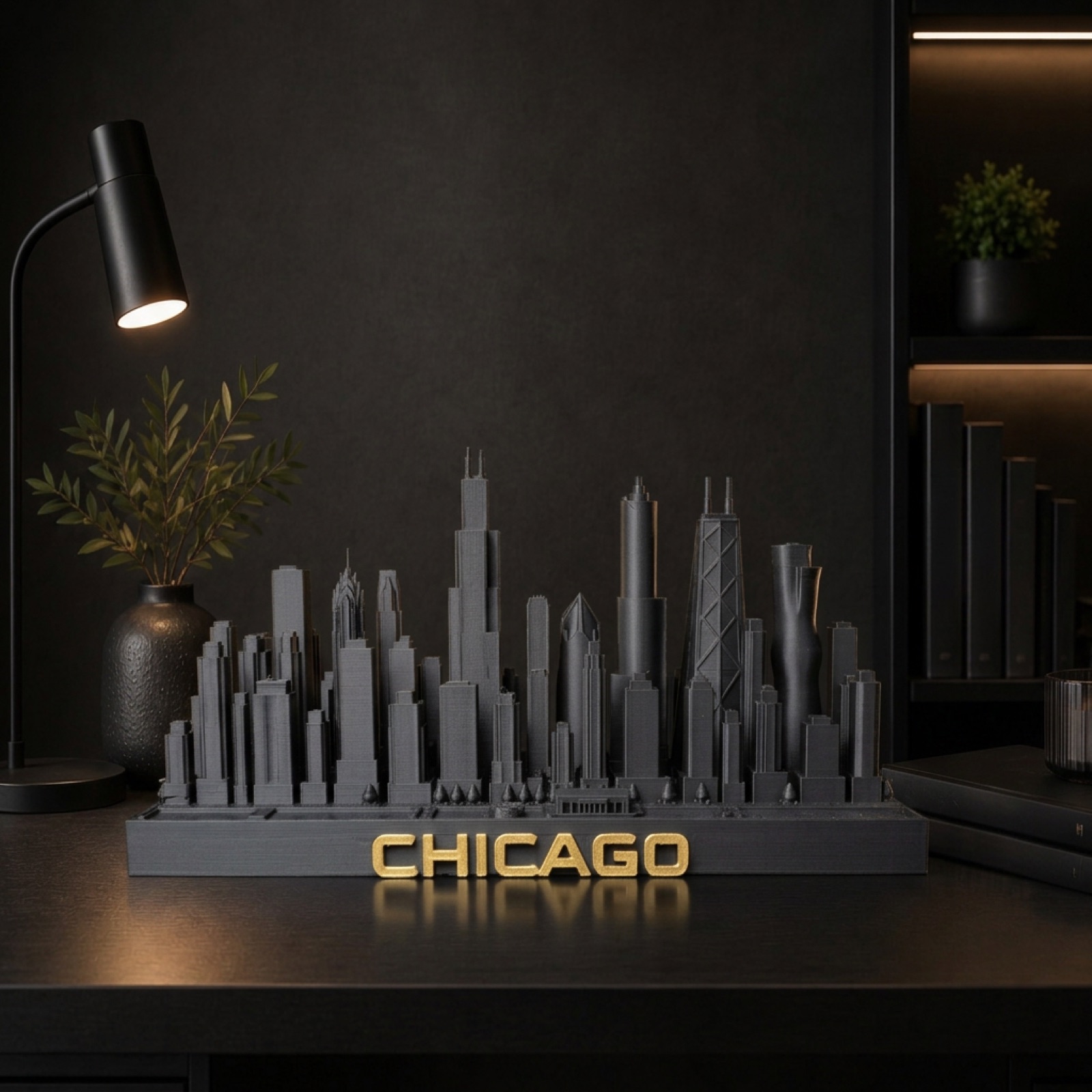
The Large Chicago skyline that just went out the door took 19 hours and 42 minutes to print. The slicer told me before I started: 102.83 meters of black PLA filament, 21.32 meters of brushed gold, 309.18 grams total, $9.06 in material cost. The machine did 96 filament changes between black and gold over the course of the night, the bed temperature held at 65 degrees Celsius the entire time, and at one point at 3:14 in the morning a layer shifted by 0.2 millimeters and I caught it from the next room by the sound of the nozzle hitting the slightly displaced top of a tower.
This is what "hand-printed in the USA" actually looks like. Not a marketing phrase. A specific machine in a specific room, running for most of a day, with someone in the next room listening.
This is a guide for people who want to understand what they are buying. Not the romance of it. The mechanics.
The Machine
We print on Bambu Lab P1S printers. The bed is 256 by 256 millimeters and 256 millimeters tall. Multi-color printing is handled by the AMS (Automatic Material System), which is a four-slot filament feeder that can swap between filaments mid-print. This is how we get the gold lettering on the base without painting it on.
Layer height is set to 0.1 millimeters across all three sizes. The nozzle is hardened steel, 0.4 millimeter diameter, because matte black PLA contains pigment particles that abrade regular brass nozzles within a few hundred hours.
The printer auto-levels the bed before every print. Even so, we re-level manually once a week because Roselle's temperature swings (this is the upper Midwest, June can hit 90 in the day and 55 at night) shift the printer's calibration over time. If you skip the manual re-level, you get an inconsistent first layer. An inconsistent first layer means a print that looks fine but loses adhesion on the build plate halfway through a 19-hour run and falls over at hour 12. That happens, and when it does, the print is unsalvageable. We rip it off the bed, restart, and absorb the cost.
We also keep filament in a dry box at 15% humidity or below. PLA absorbs water from the air over time, and wet PLA prints with surface bubbles and reduced detail. Most consumer 3D-printed decor that looks rough has wet filament as part of the problem.
The Print: Three Sizes, Three Time Commitments
The same Chicago model, scaled at three sizes, prints in three very different windows.
Small, 6 inches: about 5 hours
The Small at 6 inches wide and 1.8 inches tall uses roughly 50 grams of filament. The print runs about 5 hours start to finish. Material cost is about 75 cents.
Five hours sounds short until you realize that's the whole afternoon. The printer needs to be at temperature before it starts, the bed needs to be level, the filament needs to be loaded properly, and someone needs to be in the building for the start and the unloading. Even the smallest size is a half-day of attention.
The Small fits two-up on the print bed, so if there are two Small orders queued, we can print them together. This is how we make any margin at the $34.99 price point. A single Small, alone, with all its labor and overhead, is barely profitable. Two at once is profitable.
Medium, 7.5 inches: about 8 hours
The Medium at 7.5 inches wide and 2.5 inches tall uses roughly 120 grams of filament. The print runs about 8 hours. Material cost is about $1.80.
The Medium is our most-shipped tier. Eight hours is the sweet spot: long enough that we cannot print two in a single workday but short enough that we can do one full Medium plus one Small in a day if we time it right.
At the Medium size, the buildings start to fully resolve. The cross-bracing on the Hancock Center reads as cross-bracing. The Willis Tower's bundled-tube setbacks are visible. The Medium is where the model goes from "a skyline" to "the Chicago skyline."
Large, 9 inches: about 20 hours
The Large at 9 inches wide and 3.7 inches tall uses roughly 310 grams of filament. The print runs 19 hours and 42 minutes (the slicer's actual estimate for the run we did this week). Material cost is about $4.65 in black PLA plus a small amount of gold, for a total of about $9.
The Large takes a full machine-day plus an evening. We start the print at 7.5 in the morning and pull the piece off the bed around 2 the next morning, or we start it at 8 in the evening and pull it off around 6 in the afternoon the next day. Either way, the printer is committed for the full window.
This is why the Large is $74.99. The bed time is the bottleneck, and the Large eats the bed time. A single Large represents about 2.5 Mediums or 4 Smalls of machine capacity.
The First Layer Is Everything
The single biggest source of failed prints is a bad first layer. The base of the skyline has to adhere to the build plate uniformly across its entire footprint. If one corner lifts even half a millimeter during the first 30 minutes of the print, the rest of the print is doomed. Either the model warps as the next layers go down, or the part detaches from the plate later in the print and gets shoved sideways by the nozzle.
We use a Bambu textured PEI build plate. It is the highest-adhesion plate Bambu makes, and we re-apply a thin layer of glue stick to it every 50 prints or so. Yes, glue stick. The cheap purple Elmer's glue stick from CVS is, as it turns out, the secret to a reliable first layer on a $1,000 printer. The 3D printing community figured this out around 2018 and we all use it.
The first 30 minutes of every print are also when I actually pay close attention. After the first 30 minutes, if the base looks solid, the print will almost certainly finish. Before that, anything can happen.
What Happens After the Print
A skyline coming off the printer is not a skyline you would want to ship. There are layer lines visible on every angled surface, occasionally there is stringing (thin wisps of plastic between detail points), and the bottom often has faint marks from the print bed adhesive.
Every piece goes through three more steps before it goes in a box.
Sanding (20 to 90 minutes)
We use 220 grit sandpaper on the major flat surfaces of the tallest towers, then 400 grit on the most-visible detail areas. The goal is not to remove the layer lines entirely. PLA is a soft plastic and you cannot grind it without changing the geometry. The goal is to soften the layer lines so they read as texture, not as plastic.
A Small takes about 20 minutes. A Medium takes about 45. A Large takes 90 minutes or more depending on how patient I am that day.
This is the step that is impossible to automate at our scale. Every piece is different in some small way. The tower that came off the bed at 0.001 millimeters out of alignment needs a touch more pressure on one face. The one that printed perfectly needs less. A robot does not do this well. A pair of hands does.
Sealing (15 minutes plus drying)
After sanding, we wipe the piece down with a microfiber cloth to remove dust, then we apply two coats of matte clear acrylic topcoat. The first coat is light, the second is normal weight. Between coats, the piece dries for at least an hour.
The topcoat is what gives the skyline its uniform matte finish. Without it, the sanded areas look slightly different from the unsanded areas because sanded PLA picks up light differently from raw PLA. With it, the surface reads as one continuous matte black.
The topcoat is also what protects the gold lettering. Without sealant, the gold (which is a tiny amount of pigment in a PLA matrix) would wear off the surface where fingers touch the base. Sealed, it is essentially permanent.
Quality control (5 minutes)
We pick up every piece, turn it in our hand under a desk lamp, and look for problems. Stringing we missed. A small bubble in the topcoat. A bit of the base where the gold lettering bonded unevenly to the matte black. Anything that catches the eye gets the piece sent back to either sanding or topcoat.
Maybe one in twenty pieces gets sent back. The other 19 are photographed before going in the box. We keep the photos. If anything happens in transit, we know exactly what the piece looked like leaving us.
Packaging: A Specific Box, A Specific Foam Insert
We ship in black corrugated mailers. Three sizes:
- 8 inches by 6 inches by 3 inches for Small
- 10 inches by 8 inches by 4 inches for Medium
- 11 inches by 9 inches by 5 inches for Large
Inside each mailer is a foam insert. The insert is cut from a roll of anti-static EPE foam, sliced to the exact shape of the skyline's footprint with a quarter inch of clearance on every side. The piece sits in the cutout, snug. The mailer can be turned upside down, shaken, and dropped from waist height onto carpet without the piece moving.
We test this. We literally test this. Once a month I pick a random sealed mailer, turn it over, shake it for five seconds, drop it, open it, and inspect the piece. If anything has shifted, we revisit the foam pattern. So far the pattern has held since we started.
The branded card goes on top of the foam, the piece sits in the cutout, and the lid closes flat. From the customer's perspective, opening the box is: card, then foam, then skyline. Each layer reveals the next.
What This All Costs (in dollars and hours)
For the Large Chicago skyline as a representative example:
- Material: $9 in filament
- Electricity: $2 in print-time power (about $0.10 per hour over 20 hours)
- Box: $1.10 for the 12 x 9 x 6 mailer
- Foam: about $1 cut from a roll
- Card: $0.50
- Labor: about 90 minutes of hand-finishing time
- Shipping label: about $18 UPS Ground
- Stripe processing: about $4 on a $74.99 sale
- Waste allowance: about $3 to cover failed prints amortized across the line
Total cost of goods sold: around $62 to $80 depending on whether labor is counted at $20 per hour (my real cost when I eventually hire help) or zero (the current reality, where the labor is my own).
We sell the Large for $74.99. The margin on every Large funds the next round of filament, the next batch of mailers, the next print upgrade. Nothing about this business is high-margin in absolute terms. It is high-margin in percentage when you do not count labor and modest-margin when you do.
What Could Go Wrong
I have not had a print fail mid-shipment. I have had prints fail mid-build many times.
Print failures usually come from:
- A bad first layer (most common)
- Filament running out mid-print (we set low-filament alerts to avoid this, but the alert occasionally fires too late)
- A power outage during a long print (Chicago grid is mostly reliable but not perfectly so)
- A skyline that prints fine but topples during finishing because I caught a tower wrong while sanding (rare but it has happened)
When something fails, the piece is thrown out and we restart. The customer never sees the failed pieces. They only see the one that worked.
This is the inefficiency baked into hand-printing rather than industrial manufacturing. Industrial manufacturing has a 99.9% yield. Our yield is closer to 92 to 95 percent. The lost 5 to 8 percent is part of the cost of doing it this way, and we have priced for it.
Why We Do It This Way
There are 3D-printed skyline sellers on Amazon and Etsy who skip the sanding, skip the sealing, skip the foam-cut insert, and sell for $25 to $35. Their margin is better than ours. They ship more pieces per day than we do. They will outscale us at the bottom of the market.
We are not trying to outscale them at the bottom of the market. We are trying to make the thing they could be making if they cared. The skyline that arrives in a black box, sits in custom foam, has a sanded and sealed surface, and looks like an editorial decor object rather than a marketplace souvenir.
The bet is that a meaningful fraction of buyers will pay more for the version that was actually finished. The early evidence (return rate, repeat-buyer rate, the unprompted emails from customers showing photos of the piece on their mantel) suggests the bet is correct.
You are reading this guide because you are probably the kind of buyer the bet is for.
Want to See One Up Close?
The fastest way to know whether the finished piece is what you want is to order one. The Medium at $54.99 is the lowest-risk tier and the easiest to evaluate. If the piece arrives and you decide it is not for you, return it within 30 days and we will refund the full purchase price.
See the collection or start with Chicago, the skyline that made this whole project possible in the first place.
Made in USA. Printed for you. Shipped in three to five days.