NYC Skyline Buildings: A Guide to Every Tower You Recognize
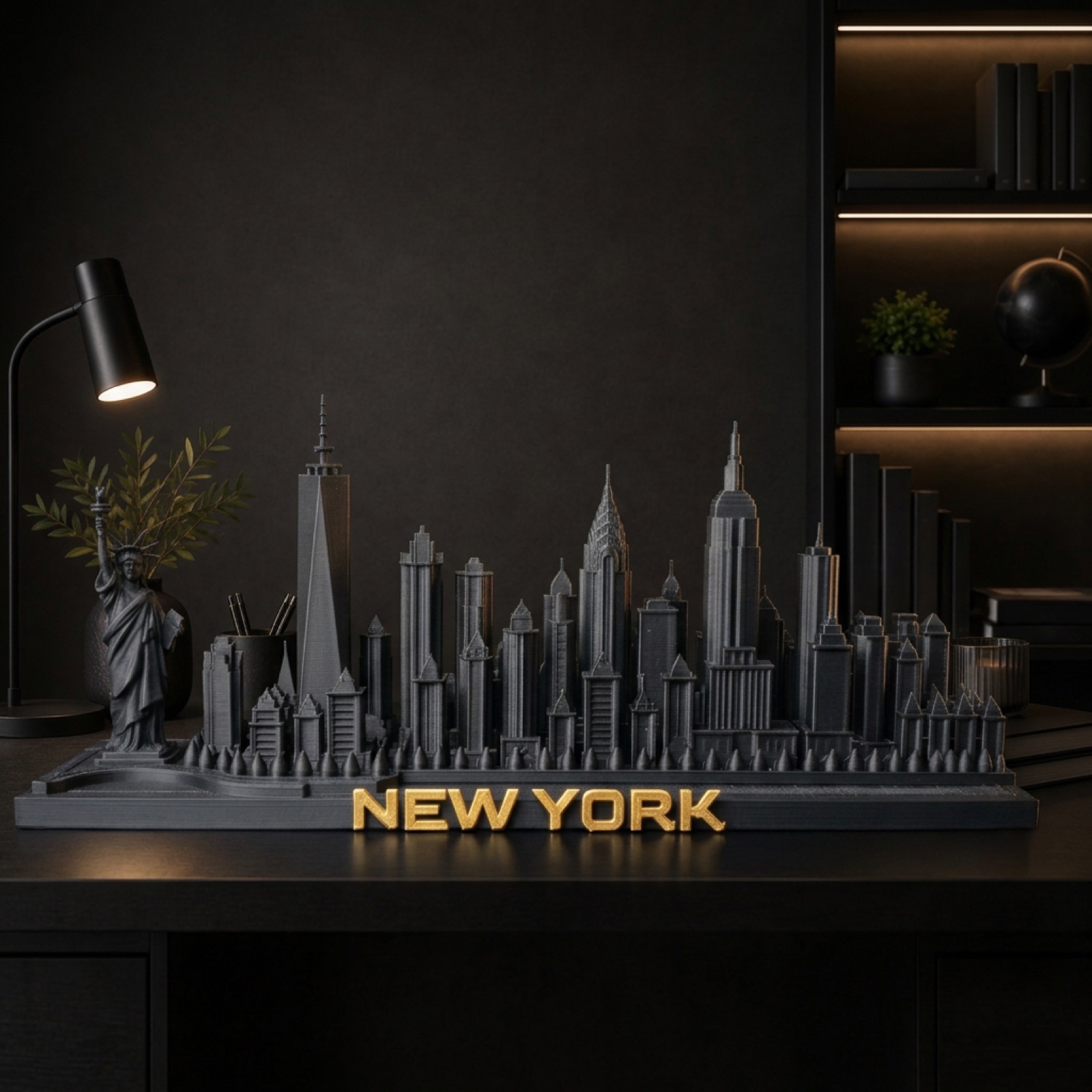
The NYC skyline is a record of American ambition, era by era. Here is what you are actually looking at, building by building, in the order they appear on our New York model.
NYC Skyline Buildings: A Guide to Every Tower You Recognize
Most cities have a skyline. New York has eight skylines stacked on top of each other, each one belonging to a different decade of American ambition, and somehow they all read at once. You stand on the Brooklyn Promenade at dusk and you are looking at 1913 and 1930 and 1973 and 2014 in a single frame. The eye sorts them automatically. The Woolworth's Gothic crown. The Chrysler's stainless sunburst. The flat slab of One World Trade. They do not blend. They argue.
This guide is for people who want to know what the argument is about. The NYC skyline on our model is a deliberate edit of that argument, eight buildings deep, each one chosen because it carries a piece of the city's hundred and forty years of vertical work. Each one was the tallest building in the world, or the most expensive, or the most controversial, or all three. Each one fought to exist.
Our New York model is roughly 9 inches across for the Large, 7.5 inches for the Medium, 6 inches for the Small. The buildings on it are not a comprehensive Manhattan. They are the silhouettes that read from across a room as New York and nothing else.
Here is what you are looking at, building by building.
Why New York Has the Skyline It Has
A quick foundation, because it explains the rest of the post.
Manhattan is a long thin island of schist bedrock with deep harbors on either side. The bedrock is the part that matters. You cannot build a 1,400 foot tower on swamp. You can build it on schist. The bedrock surfaces near the southern tip of the island and again in Midtown around 34th Street. Between those two outcrops the bedrock dips deeper, which is why for decades there was a literal valley in the skyline between the Financial District and Midtown. Cheaper to build where the rock was shallow.
Add a second factor. New York's 1916 Zoning Resolution, written after the Equitable Building cast a shadow on five surrounding blocks, required new towers to step back as they rose. The setback rules are why so many pre-war New York skyscrapers have the wedding-cake silhouette. The Empire State, the Chrysler, 30 Rockefeller. They are not styled that way. They were legislated that way.
Then add a third factor. New York money. Insurance fortunes, railroad fortunes, and later media and finance fortunes wanted buildings with their names on them. The Singer Building. The Woolworth Building. The Chrysler Building. Each commission was a billionaire saying "this is mine, and it is the tallest." For about thirty years between 1900 and 1931, the title of World's Tallest Building changed hands in Manhattan every few years, sometimes every few months.
The skyline you see today is the residue of all of this. Bedrock plus zoning plus ambition.
The Eight Buildings on Our Model
These are the towers we render, roughly in the order they appear when you read the silhouette from south to north.
One World Trade Center
Built 2014. Architect: David Childs of Skidmore, Owings and Merrill.
One World Trade is 1,776 feet to the tip of its spire. The number is not architectural. It is the year the Declaration of Independence was signed. The height was chosen first and the building was designed to land there.
The tower is a square base that morphs into an octagon at the middle and back into a smaller square at the top, rotated 45 degrees from the bottom square. The effect, when you walk around the base, is that the building seems to twist as you move. From the Hudson it reads as one shape. From the East River it reads as another. There are no parallel facades on the entire structure.
The building cost roughly 3.9 billion dollars, the most expensive office tower ever constructed in the United States at the time of completion. The construction took thirteen years, which includes the long political fight over the site between Larry Silverstein, the Port Authority, and three different governors. Most people who walk past it today do not know that the original Daniel Libeskind master plan was different from what got built, that the asymmetric spire was removed and then added back, or that the lobby was redesigned twice for security reasons.
On our model, One World Trade is the tall slim tower on the south end. It is the only building in the silhouette built in this century. The spire reads cleanly even at the Small size.
The Empire State Building
Built 1931. Architects: Shreve, Lamb and Harmon.
The Empire State Building is 1,250 feet to the roof, 1,454 feet to the tip of the antenna. It was the tallest building in the world for 40 years, until the original World Trade Center surpassed it in 1971. No other building has held the world title that long. It is unlikely any building will again.
The construction story is the part most people do not know. The building was erected in 410 days. The structural frame went up at a pace of roughly four and a half floors per week. The construction crews were largely Mohawk ironworkers from the Kahnawake reservation near Montreal, who had a reputation for working at extreme heights without harnesses. Five workers died building it, which by the standards of 1930 was considered a low number. The number was so low that the building's promoters used it as a marketing point.
The building was finished during the Great Depression and sat largely empty for the first decade of its life. Locals called it the Empty State Building. It did not become profitable until the late 1940s. The observation deck, however, was a moneymaker from day one and kept the tower in the black through the empty years.
The Art Deco crown is the detail most people miss. The original design was for a mooring mast for dirigibles, with passengers disembarking at the 102nd floor. The mast was attempted exactly once, with a small Goodyear blimp, and the wind currents made the docking unsafe. The mast became the antenna. The Deco aluminum lobby on 34th Street, with its red and gold mural ceiling, is the better surviving piece of the original interior vision.
On our model, the Empire State Building is the tower with the stepped crown, set just north of the center. It reads as Empire from any angle.
The Chrysler Building
Built 1930. Architect: William Van Alen.
The Chrysler is 1,046 feet to the tip of its stainless steel spire. For 11 months, between May 1930 and April 1931, it was the tallest building in the world. The Empire State surpassed it shortly after.
The Chrysler is the most beautiful skyscraper in New York. This is not opinion. Architecture professors who do not agree on anything else will agree on this. The terraced crown of seven radiating arches of stainless steel, the gargoyles in the form of 1929 Chrysler hood ornaments, the triangular windows that frame the arches, all of it is a single coherent gesture of optimism about the machine age. There is no other building in the world that looks like this.
The construction was a race. Walter Chrysler hired William Van Alen specifically to beat 40 Wall Street, then under construction, for the world's-tallest title. The 40 Wall Street team thought they had won, having topped out at 927 feet. Van Alen had been quietly assembling the 185 foot stainless spire inside the Chrysler's elevator shaft. On October 23, 1929, the day after Black Tuesday, the spire was hoisted into place from the inside in 90 minutes. The Chrysler was suddenly 121 feet taller. Forty Wall Street had no response. Chrysler won.
Walter Chrysler paid for the building personally, not with corporate money, so that his children could inherit it. The Chrysler Corporation never owned its namesake. The building has changed hands six times since 1953 and is currently a struggling office tower, half empty, in a Manhattan office market that has not recovered from the pandemic. The crown still looks like nothing else on earth.
On our model, the Chrysler is the building with the unmistakable terraced spire, immediately east of the Empire State. Even at the Small size, the crown reads.
30 Rockefeller Plaza
Built 1933. Architects: Raymond Hood, Rockefeller Center associates.
30 Rock is 850 feet, a single Art Deco limestone slab with three distinct setbacks rising from a five-acre base. The building is the centerpiece of Rockefeller Center, the only successful pre-war American urban-design project at that scale.
John D. Rockefeller Jr. began assembling the land in 1928 as a site for a new Metropolitan Opera House. The opera pulled out after the 1929 crash, leaving Rockefeller holding a 22 acre, 200 building lease in midtown with no anchor tenant. He decided to build it anyway, as a private commercial complex with public plazas, retail, and the eventual NBC broadcast center. It is the only large-scale Depression-era construction project in New York, and at its peak in 1933 it employed 40,000 people on a single site.
The building's exterior limestone is from Indiana, the same quarries that supplied the Empire State. The interior murals by Diego Rivera were destroyed in 1934 after Rivera refused to remove the face of Lenin from the composition. They were repainted by Jose Maria Sert. The roof, with the Top of the Rock observation deck, gives the only Midtown angle from which the Empire State Building can be photographed in clear profile with no other towers in the frame, which is why every iconic Empire State photo seems to be taken from the same height.
On our model, 30 Rock is the limestone slab with the visible stepped silhouette north of the Empire State. The proportions are correct, the setbacks match the building.
The Flatiron Building
Built 1902. Architect: Daniel Burnham, of Chicago.
The Flatiron is 285 feet, only 22 stories, and by Manhattan's modern standards almost squat. None of that matters. The Flatiron is on every shortlist of the most photographed buildings in the world.
The shape is the reason. The site is a triangular block bounded by Broadway, Fifth Avenue, and 23rd Street. The building fills the triangle. It is six feet wide at its northern point, which is so narrow that the upper-floor offices at the tip have curved windows because flat windows would not fit. The terracotta facade is heavily ornamented in Beaux-Arts style, with classical columns and ornamental medallions running up all 22 stories.
The building was originally called the Fuller Building, after the construction company that built it. Locals immediately called it the Flatiron because the shape resembled a clothes-iron. The nickname stuck. The Fuller Building name was retained on the lobby plaque but nobody used it.
The building has been famously windswept since opening. The triangular shape creates strong vortices at street level. There is an apocryphal story that the police had to chase young men away from 23rd Street in the early 1900s because they were loitering to watch women's skirts blow up in the wind. The phrase "23 skidoo," meaning to leave quickly, is sometimes attributed to police telling onlookers to clear the corner.
Daniel Burnham, the Flatiron's architect, was based in Chicago. The Flatiron is therefore a Chicago architect's New York building, and arguably the link point between the two cities' skyline traditions. Our Chicago skyline model features the Wrigley Building from the same era and the same school.
On our model, the Flatiron is the small triangular tower at the southern edge of the Midtown cluster. It reads on the Medium and Large. At Small size, it compresses slightly but is still identifiable.
432 Park Avenue
Built 2015. Architect: Rafael Vinoly.
432 Park is 1,396 feet tall and 93 feet wide at the base. The slenderness ratio of 15 to 1 is the most extreme of any residential tower in the world. It looks, from the right angle, like a thermometer.
The building is the symbol of a specific moment in Manhattan: the rise of supertall thin residential towers along 57th Street, built almost entirely for offshore buyers using LLC ownership to obscure the identity of the units' actual owners. The street is now called Billionaires' Row. 432 Park was the first of the supertalls. The penthouse sold in 2016 for 87.7 million dollars.
The design is six-by-six square white windows in a grid, repeated for the full height of the building. The simplicity is intentional. Vinoly was inspired by a 1905 trash can designed by Josef Hoffmann. The window grid is the entire architectural gesture. Critics have called it both monumental and banal. Both are correct.
The building has had structural problems since 2015. Residents have reported significant sway in high winds, water damage from elevator-shaft pressure differentials at extreme height, and infrastructure failures including a flood that took out elevator service for weeks. Multiple lawsuits between the condominium board and the developer remain unresolved.
432 Park is on our model because it is currently part of the silhouette and because it represents an era. Whether it will still be standing in 80 years is genuinely uncertain. We will revisit this.
On our model, 432 Park is the slim white tower north of 30 Rock, with the visible window-grid pattern.
The Bank of America Tower at One Bryant Park
Built 2009. Architect: COOKFOX.
Bank of America Tower is 1,200 feet, the fourth tallest in New York, and at completion was the second tallest LEED Platinum building in the world. The exterior is an angular glass curtain wall in a faceted prismatic pattern. The crown comes to a sharp asymmetric point above 55th Street.
The tower's environmental engineering is the reason architects know it. It generates roughly 70 percent of its annual electricity onsite via a cogeneration plant. It captures and reuses rainwater. The HVAC system uses ice produced overnight, when electricity is cheaper and grid demand is lower, to cool the building during the day. The 2009 sustainability story was unprecedented for a tower of that size.
Locally the tower is mixed. The glass facade is striking. The proportions, particularly the asymmetric crown, are admired. The tenant story has been complicated. The headquarters of Bank of America's investment banking operation occupies a portion of the floors. The remaining space has rotated through tenants.
On our model, Bank of America Tower is the angular glass-prism tower just east of 432 Park, with the visible faceted crown.
The Brooklyn Bridge Silhouette
Built 1883. Designed by John A. Roebling, completed by his son Washington Roebling and his daughter-in-law Emily Roebling.
The Brooklyn Bridge is not a tower. It is included in the silhouette of our New York model because it is impossible to draw a New York skyline that omits it. The bridge's two Gothic limestone-and-granite towers are 276 feet tall, the suspension cables are steel, the deck is 135 feet above the East River. When built, it was the longest suspension bridge in the world by a factor of two.
John Roebling, the original engineer, died from tetanus contracted when his foot was crushed by a ferry while surveying the bridge site. His son Washington took over and was disabled by decompression sickness from supervising work in the underwater caissons. Washington's wife Emily then took over the day-to-day supervision of construction for the next 11 years, becoming the de facto chief engineer of the project despite having no formal engineering training. She was the first person to cross the completed bridge in 1883, carrying a rooster as a symbol of victory.
The bridge took 14 years to build and killed at least 27 workers, mostly to decompression sickness in the underwater caissons where the foundations were sunk into the river bed. The Roeblings did not understand that working at depth required slow decompression. By the time the bridge was complete, the disease had its first medical name. It was sometimes called caisson disease after the workers who got it on the Brooklyn Bridge job.
On our model, the bridge appears as a low silhouette at the southern end of the Manhattan profile, with the two Gothic-arched towers visible. It anchors the eye and signals New York the way no other element could.
What Our Model Does Not Include
A skyline model has to make choices. The full inventory of Manhattan is too dense to render at 9 inches without becoming illegible. We left out some buildings that locals will look for. A few worth naming.
The Woolworth Building (1913, Gothic, the original "Cathedral of Commerce"). It is 792 feet, breathtakingly detailed, and sits in a Financial District cluster that gets visually crowded by One World Trade in our scale. We chose the modern anchor over the historic anchor on the south end.
The MetLife Building (formerly Pan Am, 1963, the brutalist slab over Grand Central). It is on every honest Midtown skyline and we considered including it. Its rectangular profile reads as a flat block at our scale, which makes it visually compete with 30 Rock without adding distinctive shape.
The Hearst Tower (2006, the diagonal-bracing tower at Columbus Circle by Norman Foster). Beautiful building, distinctive structure. Too far west and too far north to fit the silhouette frame.
The Citicorp Center (1977, the angled-roof tower at Lexington and 53rd). Famous in engineering history because it was secretly retrofitted in 1978 after the original engineer realized a calculation error meant high winds could have toppled it. We considered it for the engineering story alone. The shape is striking but adding it crowds the Midtown cluster.
Hudson Yards (2019 and ongoing, the supertall cluster on the far west side). New, fashionable, debatable. We decided the silhouette should privilege buildings with deep history over buildings with current real estate hype. Hudson Yards may earn its place in a future revision. Right now it does not.
The Statue of Liberty. People ask. The Statue is not in the silhouette frame from the standard Manhattan vantages our model represents. Including it would have meant changing the geographic frame to a New York Harbor view, which is a different piece. We may make that piece eventually.
These are deliberate choices. The result is a model that reads as New York from across a room. Adding more buildings would have made it read as "generic city."
Why People Give the New York Skyline as a Gift
New York is our second-highest volume city, behind only Chicago, and the gifting patterns are different from anywhere else in our catalog. The reason is structural.
New York is the only American city where "the city" is a person's identity, not just their address. Someone who grew up in Houston will say they are from Houston. Someone who grew up in New York will say they are a New Yorker. The category does not exist for Houston, San Diego, Phoenix, or Cleveland. It barely exists for Boston and San Francisco. It exists fully for New York.
This is the marketing fact underneath every New York skyline gift. The recipient does not have a New York. They are a New Yorker. The skyline on their shelf is not decor about a place they have lived. It is a portrait of who they are.
The patterns we see, in rough order of frequency:
Native New Yorkers who moved away. Brooklyn, Queens, Bronx, Manhattan, Staten Island, doesn't matter. They left for a job in Austin or Charlotte or San Francisco. The skyline is what they take. The model goes on the bookshelf in the new city and reminds them they are New York whether they are physically there or not.
Adult children buying for New York parents. Different pattern from Chicago, where adult children buy for the parents who still live there. With New York, the children often left and the parents stayed. The kids buy a New York skyline for the parents' Christmas as a way of acknowledging the apartment they grew up in.
Spouses of New Yorkers. The non-New York spouse buys it because they cannot fully share what New York means to their partner. The skyline is a way of saying I understand this is part of you.
People who met in New York and live elsewhere now. Wedding gifts, anniversaries. The piece commemorates where the couple started. They are not from New York. They were made by New York.
Corporate gifts from New York firms. Law firms, banks, agencies, hedge funds. The Large goes to retiring partners, anniversary clients, executive recruits. The Medium goes to associates and mid-level executives.
People who lost someone connected to New York. This is a sober category we did not anticipate. We have had several orders explicitly framed as memorials, where the recipient or a loved one had a connection to a building in the silhouette and the model is a quiet way of keeping that connection visible.
We do not sell New York skylines as tourist objects. Tourists buy Times Square keychains. The skyline is for people whose identity is in some way New York's.
Sizing for New York Specifically
For most cities our default recommendation is the Medium at $54.99. New York requires more nuance.
The Medium at $54.99 is correct for most occasions. It reads as a real gift. It anchors a bookshelf. Every building on the model reads cleanly, including the Chrysler crown and the Empire State setbacks. For housewarmings, birthdays, holidays, and "I was thinking of you" purchases, the Medium is the right answer.
The Large at $74.99 is correct only when the giver knew the giftee in New York. Not when the giftee visited. Not when the giver visited. When the giver actually lived in New York at the same time as the giftee and knows what their New York was. This is a tighter qualification than for other cities. The Large is the size that says I was there with you. If the giver was not there, the gesture is overstated and the giftee will know.
This is a quiet rule we have figured out from talking to buyers. Many people initially want the Large for New York because the city feels big enough to deserve it. Once we ask the question of whether they were in New York with the recipient, half of them downsize to the Medium. The downsized gift lands better.
The Small at $34.99 is correct for desks, dorm rooms, and travel-size mementos. For a college student going to NYU, the Small on their dorm shelf is exactly right. For an executive's office in another city, the Small next to the monitor is exactly right. For a couple who lived in New York and now live in Denver, the Small is too small. They want the Medium.
For corporate gifting, the Large is more frequently correct than for individual gifting. A New York firm presenting a retirement gift, an anniversary client gift, or a senior executive gift uses the Large. The institutional context handles the scale. The Large reads as the firm having taken the gesture seriously, which is the point of a corporate gift.
What Will Be Standing in 50 Years
The honest closing question. Of these eight buildings, which will still be on this model in 2075?
Certain to endure: the Empire State, the Chrysler, 30 Rockefeller, the Brooklyn Bridge, the Flatiron. These are landmarked, they are loved, they are revenue-positive as cultural objects regardless of their tenant performance. They will be standing in 2125, let alone 2075.
Likely to endure: One World Trade. Its political and symbolic significance makes demolition essentially impossible. The structure will outlast any tenant turnover.
Question marks: 432 Park Avenue and One Bryant Park (Bank of America Tower). Both are technically newer than the other buildings on the model but neither is landmarked, both are commercial-revenue dependent, and 432 Park in particular has structural and litigation issues that will be expensive to resolve. Manhattan does demolish towers that lose money. The original Singer Building was demolished in 1968 to make way for One Liberty Plaza. The original Hudson Terminal Towers were demolished for the World Trade Center. A 50 year horizon is not actually long enough to be certain about a building that already has problems.
If we revisit this model in 30 years, two of the eight buildings may have been replaced. We will print a 2055 edition then. For now this is the New York skyline that reads, in the era that built it.
How to See It Right
When your New York skyline arrives, take it out of the corrugated mailer and place it on a dark surface. A walnut bookshelf, a slate console, a black mantel, any surface with depth. The matte black of the model wants context that absorbs light. White surfaces wash the silhouette.
Step back to six to eight feet. That is the distance from which the model reads correctly. Closer than that you see the build texture. Farther than that the Chrysler crown begins to compress.
Aim a single warm light at the base from one side, not above. The brushed gold lettering on the base catches the light and glows. The Manhattan silhouette above sits in slight shadow, which is how a real skyline reads at dusk on a clear night. This is the lighting the model was designed for.
The piece is not a photograph. It is sculptural. The buildings are themselves but smoothed, the way a city sits in your memory after you have lived it for years. The way New York looks when you have not been back in five years is closer to this model than the way New York looks in a daytime photo. That is intentional.
Order Yours
The New York skyline is in active production. Three sizes, ships in 3 to 5 business days within the continental United States.
If a different city is the right one, the full collection has eleven other US cities. We have already written up the Chicago skyline and you can read our broader guide to skyline gifting if the gift question is still open.
The right city, in the right size, on the right shelf, lasts longer than the moment that prompted the order. That is the entire point of the form.
Related: The best New York souvenirs, ranked
Related: The best New York gifts, ranked