City Skyline Wall Art: Why a 3D Sculpture Outlasts Any Flat Print
A buyer's guide to city skyline wall art in 2026 — why flat prints go quiet, what makes skyline decor worth keeping, and how a hand-finished 3D skyline sculpture holds a room. From $34.99.
City Skyline Wall Art: Why a 3D Sculpture Outlasts Any Flat Print
We make 3D city skyline sculptures, so treat everything that follows as coming from someone with a stake in the answer. We are not neutral. But the argument does not depend on us being neutral. It depends on you having lived with skyline wall art before and noticed the thing almost everyone notices eventually: the print you were excited about stops registering. It is still on the wall. You just do not see it anymore.
That is the real problem with most city skyline wall art, and it is not a problem you fix by buying a sharper print or a nicer frame. It is a problem you fix by changing what kind of object it is.
The Field You Are Actually Shopping
Search "city skyline wall art" or "skyline wall art" and the results are remarkably uniform. Canvas prints of a downtown at golden hour. Framed black-and-white photographs shot from across the water. Minimalist line-drawing posters where every tower becomes a single gold stroke. Watercolor washes. Multi-panel splits where one photo is chopped across three canvases so it looks like more art than it is. A lot of it comes from the same handful of print-on-demand catalogs — Amazon, Etsy, Fine Art America — where a stock skyline vector gets slapped onto whatever substrate you select at checkout.
Some of it is genuinely attractive on day one. Almost all of it shares one structural trait: it lies flat against the wall and asks nothing of the light. And that trait is exactly what determines how long it holds your attention.
Why Flat Skyline Art Disappoints
There are three failures, and every flat piece has at least one of them.
It Is Generic Under the Surface
An enormous amount of "city skyline" art is not really any specific city. It is a row of anonymous rectangles with a couple of pointed tops, a label underneath, and nothing that a person who lives there would actually recognize. Cover the caption and you could sell the same file as four different cities. The buildings that make a skyline legible — the ones locals would sketch from memory — get flattened into interchangeable boxes. You end up hanging the idea of a skyline rather than a place you have a reason to care about.
It Reads as a Poster, Not a Piece
Flat art has a hard ceiling on how permanent it can feel, because structurally it is a piece of paper or a stretched sheet of canvas. It fills a blank wall and it photographs fine for a listing, but it does not hold the eye the way a physical object does. People glance at it on the way past. They do not stop and look. There is nothing to walk up to.
It Fades Into the Room
This is the slow, quiet failure, and it is the worst one because you cannot see it coming. Prints and washes go silent within a few weeks. The color settles into the wall, the composition stops surprising you, and one month in you have stopped seeing it entirely. Good decor should still catch you off guard half a year later, in some raking evening light you never planned for. Flat art almost never does, because it looks identical in every light there is.
What Makes Skyline Decor Worth Keeping
The pieces that pass the six-month test — the ones people carry from apartment to apartment and refuse to put in the donation box — share a short list of traits. None of them is about resolution or frame quality.
They are specific: you can point and name the buildings. They have physical presence: they take up volume and throw a shadow. They are tied to a real place in your life: the city you grew up in, the one you left, the one where something happened. And they reward light: the way an object changes as the sun crosses it during the day is what keeps it alive on a shelf instead of dead on a wall.
Flat art can nail the first trait if it is drawn honestly. It cannot do the other three, by definition. A printed rectangle does not have volume, does not cast a moving shadow, and does not reorganize as you walk past it. This is the entire case for going three-dimensional, and it is not a marketing case. It is a physics one.
What Changes When Art Becomes an Object
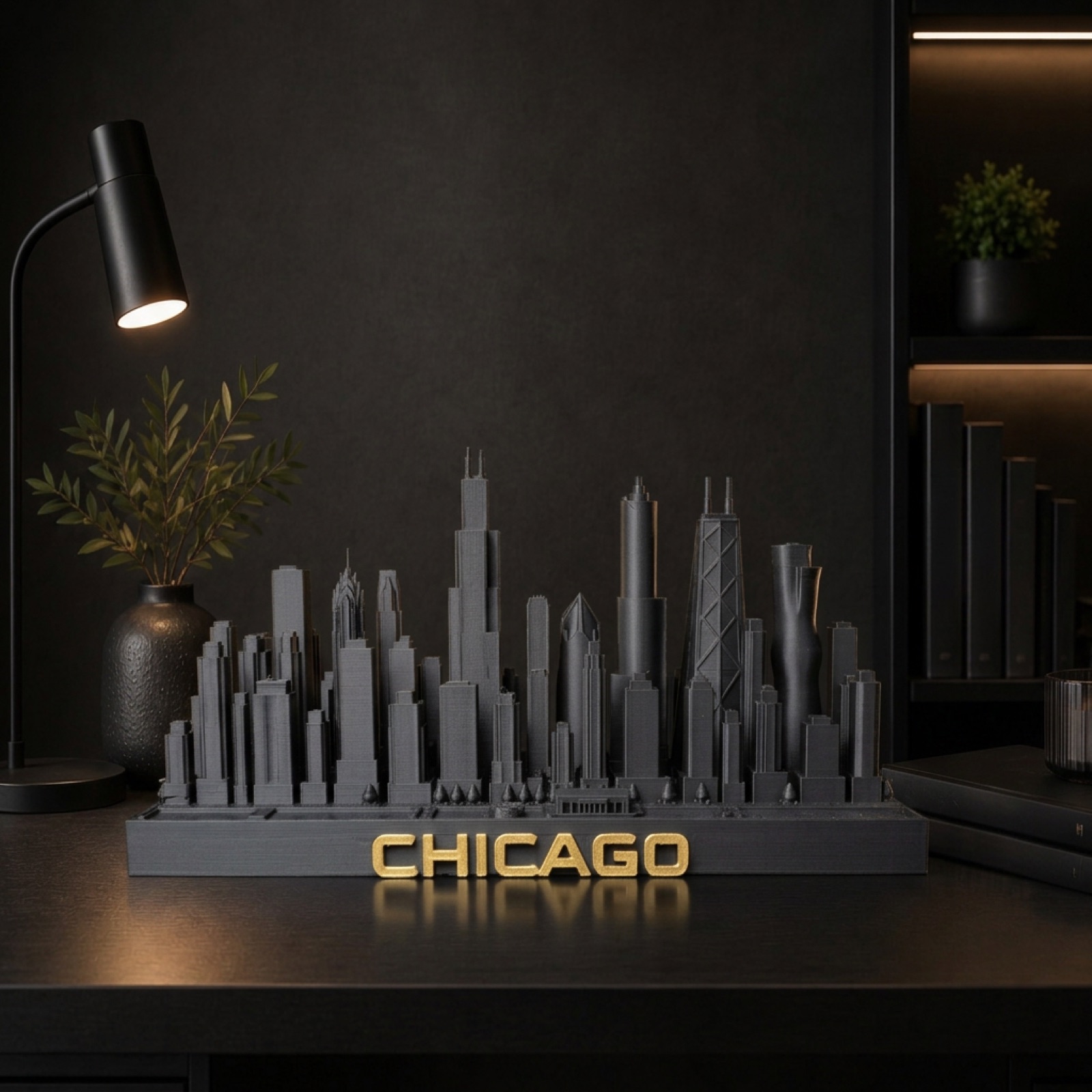
Our sculptures are 3D-printed in matte black with brushed-gold city lettering across the base, and each one is hand-finished in our US workshop before it ships in three to five days. The Small is six inches across at twenty-nine dollars. The Medium is seven and a half inches at forty-nine. The Large is nine inches at sixty-nine. But the sizes matter less than what happens the moment skyline art stops being an image and becomes a thing you can pick up.
It casts a shadow. Set a lamp beside it and the towers throw a second skyline across the shelf and the wall behind it. That shadow moves through the day as the light moves. A print physically cannot do this. It is the single biggest reason a sculpture keeps its grip on a room while a poster goes quiet in a month.
It reads from every angle. Walk past a sculpture and the buildings shift relative to one another — the tall ones slide in front of the shorter ones, the skyline steps down and reassembles, the composition reorganizes with your position. A framed print looks identical from every seat in the room. There is only ever one view, and you have already seen it.
It occupies a surface, not a wall. This matters more than it sounds. A mantel, a bookshelf, a console by the door, a desk, a reception counter — the sculpture lives at eye level in the paths you actually walk, not up on a wall you learn to stop noticing. It becomes part of the room's daily geometry instead of a rectangle you hung once and forgot.
The Buildings Are Architecturally Real
This is the part that separates our work from the stock-vector skylines, and it is worth being specific about because it is easy to claim and easy to fake.
The towers on each model are the actual towers. We build every city from its real skyline — the recognizable silhouettes, the setbacks, the antenna spires, the tapers and crowns that make a downtown identifiable to someone who has stood underneath it. They are not a generic row of boxes with a city name stamped on the front. On the Chicago model, a native picks out Willis Tower's bundled tubes and the Hancock's diagonal bracing without being told which is which. On every other city, the same holds: the person who lived there finds their building.
That recognition is the whole difference between city skyline art and generic skyline art. A stock silhouette makes a claim about "a city." A real skyline makes a claim about your city, and the person you give it to feels recognized rather than sold to. If you want to see how far down that goes, our Chicago skyline wall art guide walks through the individual buildings on one model in detail — it is the same standard we hold every city to.
Sizing It for Your Room
The three sizes are not just price tiers. They suit genuinely different spots, and picking the wrong one is the most common regret people report — almost always in the direction of wishing they had gone bigger.
Small (6 in, $34.99) is a desk and shelf piece. It fits a bookshelf gap, a work-from-home desk, a windowsill. It is also the size most people start with when they are buying for themselves and are not yet sure how much they will like it. They usually come back for a larger one.
Medium (7.5 in, $54.99) is the everyday statement size. It holds a mantel, a console table by the entryway, or the center of a floating shelf without crowding it. If you are buying one and cannot decide, buy this one. It is the size our repeat customers gravitate to.
Large (9 in, $74.99) is for a room that needs an anchor. A wide mantel, a living-room credenza, a reception desk, a conference-room shelf. It reads across a room and it photographs like a small monument.
Because the sculpture sits on a surface and lights from the side, it pairs well with the flat art you may already own. A framed city photograph on the wall with the 3D skyline on the console beneath it is a stronger corner than either piece is alone. You do not have to choose. The point is just that the object should be the thing your eye lands on, and the print should be the backdrop.
Made for Twelve Cities — Find Yours
We make this same sculpture, to the same standard, for twelve US cities. Same matte-black finish, same brushed-gold lettering, same hand-finishing — with the real silhouette of whichever city belongs to the person you are buying for. If you have a city in mind, the fastest thing to do is open the full cities collection and see whether it is there. Chicago is our highest-volume model, and the Chicago skyline page is the best place to see the real photographs, the three sizes side by side, and exactly what the finish looks like in daylight and under a lamp.
If your city is on the list, everything in this guide applies to it directly. If it is not yet, the collection is the place to check first — we add cities as we build them.
City Skyline Wall Art as a Gift
Most people buying skyline decor are not filling a blank wall. They are buying it for someone with a specific tie to a specific place. A few patterns show up constantly.
The person who moved away. Someone who spent their twenties in one city and now lives three time zones from it. The skyline on their shelf is the city they carry, sitting at eye level in a home far from it. This is the most common reason people buy from us, and it is why we wrote a whole guide to gifts for someone who moved away — the skyline is the centerpiece of it.
The new homeowner. A skyline sculpture is a specific, grown-up housewarming gift that survives the closet. It says something about the person and the place, rather than being the tenth scented candle they unwrap that month. Our housewarming gift guide lays out how it stacks up against the usual options, and the short version is that it stacks up well because almost nothing else on the standard list is both personal and permanent.
The person who is from somewhere and proud of it. The one who defends their city's food and knows which neighborhood is actually best. The skyline of their place, hand-finished and specific, reads as effort instead of obligation. That is the difference between a gift someone displays and a gift someone re-gifts.
Skyline or Street Grid? Two Different Pieces
There is a second format worth knowing about before you buy, because it answers a different question.
A 3D city map panel is a framed relief of the city's actual footprint rather than its silhouette. Every building sits at its real relative height, the streets are cut in between, and the water drops away in matte black. Twenty inches square, framed, $249.
Which one you want comes down to what the piece is for. A skyline is the view — the handful of towers the city is known for, the image on the postcard. It works as an object on a shelf, a desk, a mantel. A relief map is the city as it is lived in: people walk up to it and immediately look for their own street, their old apartment, the block they grew up on. It is wall art in the literal sense, and it holds a wall on its own.
Available for Chicago, New York, Miami, Los Angeles and Tampa, with any other city made to order.
The Honest Bottom Line
If your only goal is to cover a large blank wall for very little money, a canvas print will do that, and we are not going to pretend otherwise. There is a real job that flat art does cheaply and we respect it.
But if you want city skyline wall art that still stops you six months from now — that changes with the light, reads from every angle, names the actual buildings of a place you actually care about, and lives at eye level in the room instead of fading into a wall — then a flat print is the wrong tool for that job. A hand-finished 3D skyline is built for it. It casts a shadow, it holds a surface, and it does not go quiet.
Open the full cities collection, find the city that means something to you or to the person you are buying for, and see it in three sizes. If that city is Chicago, start on the Chicago skyline page — it is where the whole thing began, and it shows the object at its best.