Los Angeles Skyline Buildings: A Guide to Every Tower You Recognize
The Los Angeles skyline rewards close attention. A guide to every downtown LA tower, the architects, the height-limit fight, and what most people miss.
Los Angeles Skyline Buildings: A Guide to Every Tower You Recognize
Most American skylines were built across a century. The Los Angeles skyline buildings you see today were almost entirely built in thirty years, between 1969 and 1999, with a few late arrivals in the 2010s. There is no slow accretion of eras. There is no Gothic foreground stepping into a modernist mid-ground stepping into a contemporary cluster. There is one decade of ambition compressed into a single downtown frame, then a long pause, then the Wilshire Grand. That is the entire vertical story.
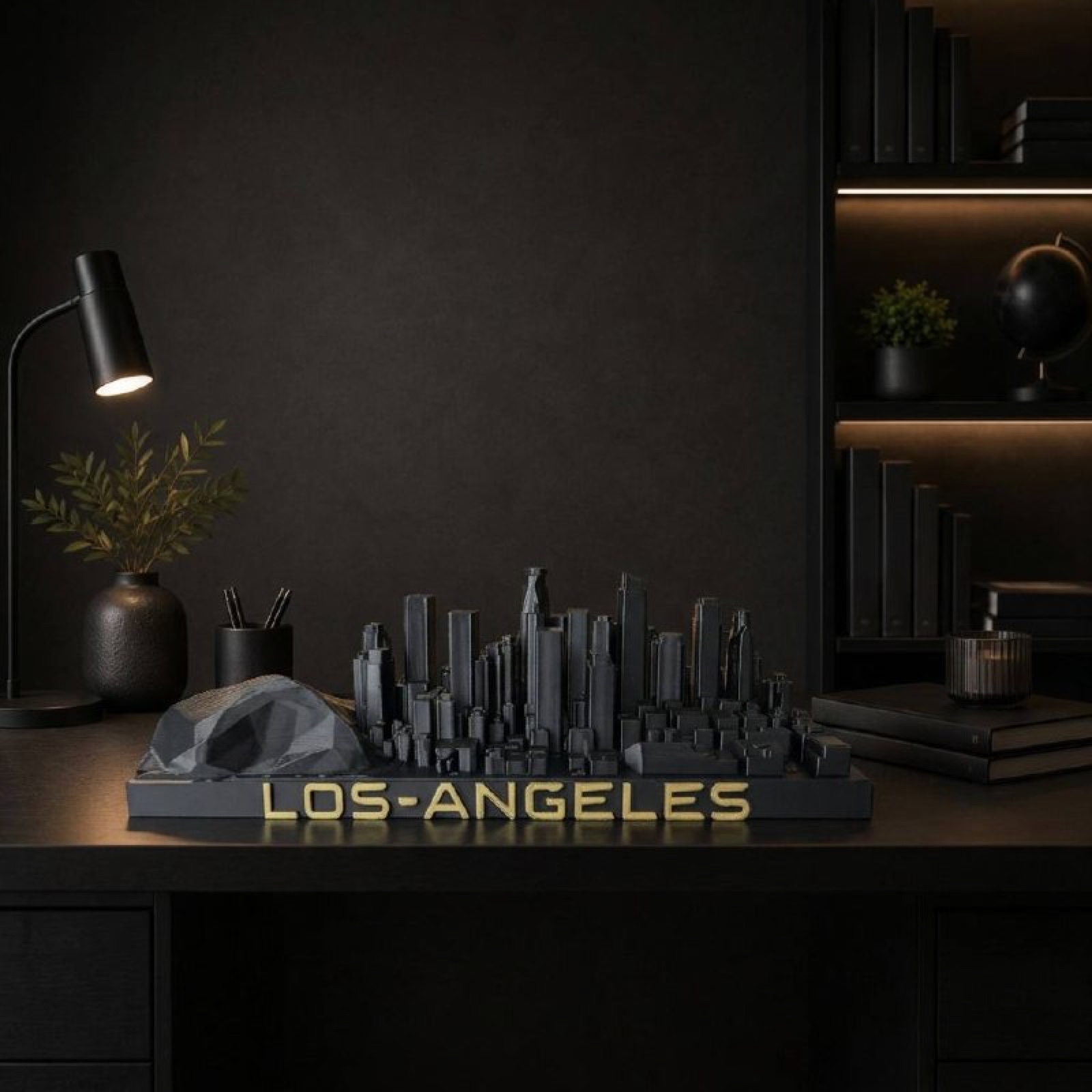
This guide is for people who want to read that story correctly. The Los Angeles skyline on our model is a deliberate edit of downtown, six towers deep, each one chosen because it carries a piece of the city's late and unusual decision to build up. None of them existed before 1969. Half of them were the tallest building in Los Angeles at some point. The most recent of them is the tallest building west of the Mississippi River.
Our LA model is roughly 9 inches across for the Large, 7.5 inches for the Medium, 6 inches for the Small. The buildings on it are not a comprehensive Los Angeles. They are the silhouettes that read from across a room as downtown LA and nothing else.
Here is what you are looking at, building by building.
Why Los Angeles Has the Skyline It Has
A foundation, because it explains the rest.
For the first half of the twentieth century, Los Angeles had a height limit. From 1904 to 1957, no building in the city could exceed 150 feet, roughly 13 stories. The cited reason was earthquake risk. The actual reasons were broader. Los Angeles in that era understood itself as a horizontal city, a city of bungalows and boulevards, the anti-Manhattan. The civic identity was suburban. There was no demand for towers because there was no agreement that towers were what a city was supposed to look like.
City Hall, completed in 1928, was the single exception to the 150 foot rule. It was specifically exempted by ordinance because it was civic, not commercial. For 28 years it was the tallest building in Los Angeles, and the only one visible above the cap.
The height limit was repealed in 1957. The repeal did not produce a building boom. It produced a slow trickle of mid-rises through the 1960s, mostly in the Wilshire Corridor and around Bunker Hill. The first true post-cap supertall, the original Union Bank Plaza on Bunker Hill, opened in 1968. The Aon Center followed in 1973. The decade-long argument about whether Los Angeles should have a downtown skyline at all was settled by these two towers, which proved that the demand existed once the cap was lifted.
Then add a second factor. Los Angeles is built on the western edge of the North American plate, twenty miles from the San Andreas Fault. Every tower has to be designed for seismic events that buildings in Manhattan and Chicago never have to consider. The structural engineering on a Los Angeles supertall is fundamentally different from the engineering on a Midwest or East Coast tower of the same height. The cores are stronger, the dampers are heavier, the foundations go deeper. This is invisible from the street but it is the reason Los Angeles took so long to build up. The engineering had to catch up to the ambition.
Then add a third factor. The downtown-versus-Westside debate, which is still going. For most of the twentieth century, Los Angeles money lived on the Westside and worked on the Westside. Downtown was where the courts and the banks were. Century City was incorporated in 1963 as an alternative business district, and for a long time it competed with downtown for tenants. The 405 freeway became the spine of a parallel economy. Downtown built towers anyway, but the Westside never quite ceded the argument. This is why Los Angeles has multiple skylines, and why our model frames only one of them. The downtown skyline is the one that reads as Los Angeles from a distance. The Century City cluster, the Hollywood Hills, the Westside, those are separate frames.
Then add a fourth factor. The Wilshire Grand era. In 2017, the Wilshire Grand Center opened at 1,100 feet and immediately became the tallest building west of the Mississippi. More importantly, it was the first new entrant in the downtown skyline in nearly two decades. The era that began in 1969 had stalled in the late 1990s. The Wilshire Grand restarted it. Whether the restart continues is the open question the skyline's future depends on.
The Towers on Our Model
These are the buildings we render, roughly in the order they appear when you read the silhouette from west to east across Bunker Hill and the Financial District.
U.S. Bank Tower
Built 1989. Architect: Henry N. Cobb of Pei Cobb Freed and Partners.
U.S. Bank Tower is 1,018 feet to the roof, with the helipad on top adding a few feet to the official height. For 28 years, from 1989 until the Wilshire Grand surpassed it in 2017, it was the tallest building in California and the tallest building west of the Mississippi River. The cylindrical glass crown is the most recognizable element of the Los Angeles skyline. There is no other tower in the city, and very few towers anywhere, with that particular silhouette.
The reason for the circular crown is structural and regulatory at the same time. Los Angeles building code at the time required all buildings over 75 feet to have a rooftop helipad for emergency access. The U.S. Bank Tower has the highest helipad on any office building in the world, or had it until the Wilshire Grand opened. The helipad sits inside the circular crown. The crown is, functionally, the wall around the landing zone. Henry Cobb made the structural requirement into the architectural signature, which is the move a great architect makes.
The building was originally called the Library Tower because it sits across the street from the Los Angeles Central Library, and the construction was partially financed by air-rights sold by the library after its 1986 fire. The library got the money to rebuild. The tower got the air rights to go up. The naming has rotated since: Library Tower, First Interstate World Center, U.S. Bank Tower. Locals usually still say Library Tower, especially older locals.
The tower has had two strange cinematic moments. It is the building destroyed by the alien mothership in the opening sequence of Independence Day, the 1996 film, which made it the most internationally recognized Los Angeles skyscraper of the decade by accident. It also appears in Inception, in Mission Impossible Ghost Protocol, and in dozens of other Hollywood productions where the script needed a tall building that read as Los Angeles. The crown does what a great skyline element does. It signals the city without explanation.
On our model, U.S. Bank Tower is the tallest building in the western half of the skyline, with the cylindrical crown that reads from any angle.
Wilshire Grand Center
Built 2017. Architect: David Martin of AC Martin Partners.
Wilshire Grand Center is 1,100 feet to the top of the spire, making it the current tallest building in California and the tallest building west of the Mississippi River. It is the first major Los Angeles tower with a spire. Every other tall building in the city, by code, had to have a flat roof to accommodate the helipad. The Wilshire Grand was granted a code exemption in exchange for incorporating advanced fire-suppression and life-safety systems throughout the structure. The spire became possible because the helipad became optional. The Wilshire Grand is the building that broke a 56 year rule.
The spire is not decorative. The top 250 feet of the building house an LED illumination system and a hospitality program. The crown lights up at night, and the color is programmable. During the 2018 Dodgers playoff run, the Wilshire Grand was lit Dodger blue every night the team played at home. During Pride Month, it cycles through rainbow colors. The crown has become the city's communal sign, in a way that nothing in Los Angeles had been before.
The lower floors are an office tower. The middle floors are a 900 room Intercontinental hotel. The top floors house the Spire 73 bar, which until 2021 was the highest open-air bar in the Western Hemisphere. The vertical mixed-use program is the first of its kind in Los Angeles at this scale. The tower demonstrated that downtown LA could support a luxury hotel program at supertall height, which had not been demonstrated before.
David Martin is the son of Albert C. Martin, founder of AC Martin Partners, and the Martin family has been designing Los Angeles buildings since 1906. They designed the Million Dollar Theater. They designed the original Department of Water and Power Building. They designed parts of the LA City Hall complex. The Wilshire Grand is, in the architectural family terms that Los Angeles takes seriously, a third-generation Martin tower. That is part of why the spire was approved. The city trusted the firm.
On our model, the Wilshire Grand is the tower with the spire, just east of U.S. Bank Tower. The spire reads cleanly at every size including the Small.
Aon Center
Built 1973. Architect: Charles Luckman Associates.
Aon Center is 858 feet, originally called the United California Bank Building, later the First Interstate Tower, now Aon Center after a 2001 rebranding. The tower is a single dark bronze rectangle, no setbacks, with the classic 1970s curtain wall that defined the corporate skyscrapers of its era. It was the tallest building in Los Angeles from 1974 until 1989, when U.S. Bank Tower opened.
The tower is the site of the largest high-rise fire in the history of Los Angeles, the 1988 First Interstate Bank fire, which burned for three and a half hours and consumed four floors. One firefighter died. The fire is the reason Los Angeles overhauled its high-rise fire code in the late 1980s and required automatic sprinkler systems in all towers built after that date. Every Los Angeles supertall built since 1989, including U.S. Bank Tower and the Wilshire Grand, has stricter fire-suppression requirements because of what happened on the 12th through 15th floors of the Aon Center.
Charles Luckman, the architect, was an unusual figure in postwar American architecture. He started as a soap salesman, became the president of Lever Brothers, then commissioned Skidmore Owings and Merrill to design Lever House in Manhattan in 1952, then quit corporate life to become an architect himself. By the time he designed the Aon Center he was running one of the largest commercial architecture firms in Los Angeles. He also designed the Forum in Inglewood, Madison Square Garden in New York, and the master plan for the original Los Angeles International Airport. The Aon Center is the most visible thing he made.
On our model, the Aon Center is the dark rectangle in the central cluster, immediately east of the Wilshire Grand. The proportions are correct, the lack of setbacks reads as the deliberate restraint it was.
Two California Plaza
Built 1992. Architect: Arthur Erickson with Kamnitzer Cotton Vreeland.
Two California Plaza is 750 feet, a granite-clad tower with a distinctive notched silhouette that steps back at the upper third of its height. It is paired with the slightly shorter One California Plaza, built in 1985, which is part of the same Bunker Hill complex. The two towers, together with the Museum of Contemporary Art at their base, are the architectural anchor of Bunker Hill.
The story most people miss is that Two California Plaza was the last building constructed before the 1990s recession froze downtown Los Angeles development for almost a decade. The complex was supposed to include a Three California Plaza on the adjacent site, which was approved, designed, and never built. The empty parcel sat fenced and undeveloped for over twenty years. It was eventually developed as a separate residential tower in the 2010s under different ownership.
Arthur Erickson was a Canadian architect, best known for the Museum of Anthropology at the University of British Columbia and the Robson Square complex in Vancouver. His Los Angeles work is less recognized but the California Plaza commission was significant. Erickson designed buildings that emphasized horizontal layering and material weight, which made Two California Plaza unusual among the slender bronze and glass towers of its era. The granite reads as solid, not as curtain wall. The notch in the silhouette gives the tower a profile that nothing else downtown shares.
On our model, Two California Plaza is the tower with the upper-third setback, in the western cluster near the U.S. Bank Tower.
City National Tower
Built 1973. Architects: Albert C. Martin and Associates.
City National Tower, formerly Bank of America Center and before that Bank of America Plaza, is 699 feet, a 55 story Bunker Hill tower with a distinctive cross-shaped floor plan visible from above. Originally the tallest building on Bunker Hill, it was completed the same year as the Aon Center and was briefly part of the 1973 wave that defined the first generation of post-cap LA towers.
The cross-shaped floor plan was a structural and views-driven choice. Each of the four arms of the cross gives every office a corner view, which was a premium feature in the 1970s when most tower floor plates were rectangular and most offices were interior. The plan added cost but it gave the tower a market advantage that lasted for decades. City National Tower has one of the highest occupancy rates of any downtown LA office building, partly because of this plan, partly because Bunker Hill remains the prestige address for downtown legal and financial tenants.
The building sits on top of the former Court Flight cable railway site, which from 1905 to 1943 carried passengers from downtown up the steep slope of Bunker Hill before the hill was leveled in the 1950s. The flattening of Bunker Hill is the largest topographic modification in the history of Los Angeles. An entire neighborhood of Victorian houses was demolished. The hill was leveled. The new flat plateau became the site of the modern Bunker Hill towers, of which City National Tower was the first major occupant.
This is the kind of detail people who give the LA skyline tend to know but rarely discuss. The towers of Bunker Hill sit on a hill that was demolished to make them possible.
On our model, City National Tower is in the western cluster between the U.S. Bank Tower and Two California Plaza. The cross plan is not visible at our scale but the proportions and the rooftop helipad detail read correctly.
Bank of America Plaza
Built 1974. Architect: Charles Luckman Associates.
Bank of America Plaza on West Fifth Street, also called 333 South Hope, is 735 feet, a 55 story tower with a flat top and a curtain wall in dark glass. It is the smaller of the two 1974 Luckman commissions in downtown LA, the larger being the Aon Center directly to the east. The two buildings together established Luckman as the dominant architect of the immediate post-cap era in Los Angeles.
The building is conventionally considered the least architecturally distinguished of the downtown LA towers, which is a strange thing to say about a 55 story building but it is the consensus position. The reason is that the tower's design is essentially a stripped-down corporate International Style commission with no notable structural innovation, no signature crown, no setbacks. It does its job. It holds offices. It is part of the silhouette. That is everything it does.
But the silhouette would not read as Los Angeles without it. The dark glass blocks between the U.S. Bank Tower's circular crown and the Aon Center's bronze rectangle give the skyline its rhythm. Take 333 South Hope out and the silhouette has gaps. Put it in and the cluster reads as a unit. This is what the unsung middle buildings of every American skyline do. The Bank of America Plaza is the connector tower.
On our model, Bank of America Plaza is the dark middle tower in the central cluster, anchoring the visual transition between the western Bunker Hill group and the Aon Center.
The Older Foreground
The smaller buildings on the model represent the pre-1970s Los Angeles skyline, which is to say the buildings that existed before the towers and that the towers were built around.
Los Angeles City Hall, completed in 1928, is the white pyramid-topped tower on the eastern edge of the model. At 454 feet, it was the only tall building in downtown for nearly 30 years. The pyramid crown is faceted limestone with bronze detailing. The building was the tallest in California from 1928 until 1968. It is now the oldest landmark in the skyline frame.
The smaller mid-century buildings, the Title Insurance Tower and the older Wells Fargo Tower, fill in the rest of the historic foreground. They are dwarfed by the modern giants but they are the buildings that survived the city before the height limit was repealed. Their presence on the model anchors the silhouette in actual history rather than only in the 1970s onward.
What Our Model Does Not Include
A skyline model has to make choices. The full inventory of greater Los Angeles is too geographically dispersed to render at 9 inches without the model reading as several different cities. We left out some buildings and clusters that locals will look for. A few worth naming.
Century City. The Constellation Place, Fox Plaza of Die Hard fame, the twin towers on Avenue of the Stars. Century City is a real Los Angeles skyline, possibly the second most recognizable one after downtown. It is twelve miles west of downtown. Including it would mean the model represents a 25 mile-wide frame, which would not read as a single skyline from across a room. Century City is a separate piece. We may make it.
The Hollywood Hills and the Hollywood Sign. Not a skyline in the architectural sense. The Hollywood frame is landscape with structures, not skyline. The sign is iconic but it is a sign, not a building. We are a tower studio.
The Capitol Records Building. The famous cylindrical building at Hollywood and Vine, designed to resemble a stack of records on a turntable, with a needle on top. It is 150 feet tall. It is a foot-traffic landmark, not a skyline landmark. From any of the downtown vantage points our silhouette represents, the Capitol Records building is not visible.
SoFi Stadium and the Forum in Inglewood. The new entertainment cluster around SoFi is starting to develop a skyline of its own, but it is suburban Inglewood, not Los Angeles, and the architecture is horizontal stadium architecture rather than vertical tower architecture. The Forum, by Charles Luckman the same architect as the Aon Center, is itself an architectural object worth knowing about, but it is not on a vertical silhouette.
The Pacific Design Center. The blue, green, and red buildings in West Hollywood by Cesar Pelli. Beautiful buildings, distinctive shapes, completely outside the downtown frame.
The Beverly Hills Hotel and the Westside hotels. Cultural landmarks, not skyline towers.
These are choices we made deliberately. The result is a model that reads as downtown Los Angeles from across a room. Adding more would have made it read as a generic Sun Belt skyline.
Why Los Angeles Is the Harder Skyline to Gift
Los Angeles is a different kind of city for skyline gifts than Chicago or New York. The reason is structural.
Chicago and New York are walking cities. New Yorkers walk to work. Chicagoans walk along the lakefront. The skyline is part of foot traffic, part of daily commute, part of how the body encounters the city. When you put a Chicago skyline on a shelf in Phoenix, you are commemorating something the recipient walked through every day.
Los Angeles is a driving city. Most Angelenos see the downtown skyline from a car window, on the 110 or the 101 or the 5. The recognition is rear-view-mirror recognition. It is the silhouette that appears in your peripheral vision while you are merging. It is the city you drive past on the way to somewhere else. It is rarely the city you walk through.
This matters for gifting because the emotional weight of the skyline is different. For a New Yorker, the skyline is identity. For a Chicagoan, the skyline is the city they live inside. For an Angeleno, the skyline is what they see when they are headed downtown for jury duty or for a Lakers game or for the courthouse. The relationship is more functional. The recognition is more situational.
This does not make the gift wrong. It changes who the gift is for. The right recipient for a Los Angeles skyline gift is a person whose work or whose life is genuinely downtown. The lawyer at Latham or Gibson Dunn whose office is on Bunker Hill. The artist in the Arts District. The judge whose chambers are at the federal courthouse. The architect at AC Martin or Gensler or Skidmore. The person at the city Department of Cultural Affairs. These are the Angelenos who experience the skyline as their own. For them the Large makes sense.
For the broader population of Angelenos who live on the Westside, in the Valley, in the South Bay, in the beach cities, the downtown skyline is one of several Los Angeles silhouettes that matter. The gift question is more delicate. The Medium is usually the right size. The Small works for desk use. The Large is too declarative for a recipient whose actual Los Angeles is elsewhere.
This is the quiet sizing rule we have figured out from the conversations with LA buyers.
Sizing for Los Angeles Specifically
The Medium at $54.99 is the right answer for most LA recipients. It anchors a bookshelf, it reads cleanly at conversational distance, every tower is identifiable including the U.S. Bank Tower crown and the Wilshire Grand spire. For a former Angeleno who moved to Austin or Seattle or Boise, the Medium is the right scale. For a non-Angeleno spouse who wants to acknowledge their partner's Los Angeles years, the Medium is the right scale. For a housewarming, a birthday, a holiday, the Medium.
The Large at $74.99 is reserved for recipients with deep downtown LA ties. Not Angelenos in general. Downtown Angelenos specifically. A partner at a Bunker Hill law firm. An artist who has had a studio in the Arts District for twenty years. A judge. A senior architect. The Large is the size that says I know what your downtown Los Angeles actually is, and this is the piece that matches. For a general Los Angeles recipient whose career is on the Westside or in Burbank or in the Valley, the Large is the wrong size. The downtown skyline is not their LA. The piece overstates.
The Small at $34.99 is correct for desks, dorm rooms, and travel. A USC architecture student. An entertainment lawyer with a Westside office who wants something LA on the shelf without making the office about downtown. A graduate of UCLA living in another city who wants a small piece. The Small compresses some of the detail of the Wilshire Grand spire slightly, but the U.S. Bank Tower crown and the overall silhouette read cleanly.
For corporate gifting in Los Angeles, the Large is more frequently correct. Downtown LA firms, particularly the major law and consulting firms with Bunker Hill or Financial District offices, use the Large for retirement gifts and major client gifts. The institutional context handles the scale. Westside firms in Century City often default to the Medium because their geographic identity is not downtown, even though their work might be city-wide.
If you are unsure, default to the Medium. It is the size that does not require the giver to know exactly which Los Angeles the recipient inhabits. The Medium is welcoming. The Large takes a position.
What the Skyline's Future Looks Like
The honest closing question, the same one we asked about New York. Of these six buildings, which will still be on the model in 2075? And what will be added?
Certain to endure: U.S. Bank Tower, Aon Center, Two California Plaza. These are revenue-positive office towers in a downtown market that, despite recent softness, is still the legal and government center of the second largest city in the United States. They will be standing. They may change names again. They will be on this model in 50 years.
Likely to endure: Wilshire Grand, Bank of America Plaza, City National Tower. The Wilshire Grand is too new and too symbolic to be at risk. The other two are conventional office towers with stable tenant histories. None are landmarked but all are functional.
The question is what gets added. The current pipeline for downtown LA includes proposed residential towers along Olive Street and Hill Street, some of which would exceed 50 stories. Several have been approved and not built. Several have been built and immediately struggled. The post-pandemic downtown LA office market has been weak. Whether the residential conversion of older offices, plus the new ground-up residential towers, can sustain enough density to justify additional supertall construction is the open question of the next decade.
The honest answer is that Los Angeles may not add a new supertall to its skyline before 2035. The Wilshire Grand may remain the most recent entrant for longer than its developers anticipated. The downtown LA skyline is, in a way, a finished object for now. The next chapter may be Inglewood, where the SoFi Stadium complex, the Intuit Dome, and the Forum are forming a horizontal entertainment cluster that may eventually grow vertical. Or it may be Hollywood, where the Hollywood Tower is one of several proposed supertalls that have not yet broken ground. The vertical story of Los Angeles is paused. It is not over.
If we revisit this model in 30 years, one or two new buildings may have joined the silhouette. We will print a 2055 edition then. For now this is the Los Angeles skyline that reads, in the era that built it.
How to See It Right
When your Los Angeles skyline arrives, take it out of the corrugated mailer and place it on a dark surface. A walnut bookshelf, a slate console, a black mantel. The matte black of the model wants context that absorbs light. White surfaces wash the silhouette.
Step back to six to eight feet. That is the distance from which the model reads correctly. Closer than that you see the build texture. Farther than that the Wilshire Grand spire begins to compress.
Aim a single warm light at the base from one side, not above. The brushed gold lettering on the base catches the light and glows. The downtown silhouette above sits in slight shadow. This is the lighting that matches how the real skyline reads from the 110 at dusk on a clear evening, which in Los Angeles is most evenings. The Wilshire Grand crown will be lit blue or gold or red on any given night depending on what the city is celebrating. The model does not light up. The light comes from the lamp you set next to it. That is also fine.
The piece is not a photograph. It is sculptural. The buildings are themselves but smoothed, the way a city sits in your memory after you have lived it for years. The way downtown Los Angeles looks when you have not been back in three years is closer to this model than the way it looks in a daytime photo. That is intentional.
Order Yours
The Los Angeles skyline is in active production. Three sizes, hand-printed in the USA, ships in 3 to 5 business days within the continental United States.
Order the Los Angeles skyline →
If a different city is the right one, the full collection has eleven other US cities, each with its own architectural story. We have already written up the Chicago skyline and the New York skyline at the same depth. If you are still deciding whether the skyline gift is right, read our guide to skyline gifting.
The right city, in the right size, on the right shelf, lasts longer than the moment that prompted the order. Los Angeles, given to the right Angeleno, is one of the quietest and most accurate gifts in the catalog.
Related: The best Los Angeles souvenirs, ranked
Related: The best Los Angeles gifts, ranked