New Orleans Skyline Buildings: A Guide to the Towers and the Cathedral
New Orleans skyline buildings guide: St. Louis Cathedral, the French Quarter, Hancock Whitney Center (One Shell Square), Place St. Charles, the empty Plaza Tower and the Superdome, and why the city's skyline is shaped by water and soft ground.
New Orleans Skyline Buildings: A Guide to the Towers and the Cathedral
Quick answer: The New Orleans skyline is a cluster of office and hotel towers in the Central Business District, just upriver from the French Quarter. The tallest is Hancock Whitney Center (formerly One Shell Square, 697 ft, 1972), the tallest building in Louisiana, followed by Place St. Charles (645 ft), Plaza Tower (531 ft, empty for two decades) and Energy Centre (530 ft). But the building that defines the city's skyline is not a tower at all. It's St. Louis Cathedral on Jackson Square, whose three spires stand in front of the CBD from the river side of the Quarter.
New Orleans is not a tall city, and it was never trying to be. The ground is soft, wet and in places below sea level, so every tower stands on long piles driven deep into the clay. The money that built Houston and Dallas went into oil company headquarters in New Orleans too, but only for a while. Most of the skyline went up in a single boom between the late 1960s and the late 1980s, and then stopped when oil prices fell.
What you see today is a compact cluster of towers along Poydras Street and St. Charles Avenue, a low French Quarter in front of it, and the Mississippi bending around both. This guide walks through the buildings you can recognise, then explains how our New Orleans skyline model puts them together.
The landmark in front: St. Louis Cathedral
A church has stood on this site, facing what is now Jackson Square, since the early 1700s. The cathedral you see today is largely the result of an 1850 rebuilding, and it is one of the oldest cathedrals in continuous use in the United States. Its three spires, with the tall central steeple flanked by two smaller ones, are the shape everyone from the city recognises first.
Most skylines put their tallest building in the middle. New Orleans puts a church there, at least from the most famous viewpoint: the river side of Jackson Square, where the cathedral sits squarely in front of the towers of the Central Business District.
Flanking the square are the Pontalba Buildings, the red-brick rows built in the 1840s by the Baroness Micaela Almonester de Pontalba. Their cast-iron galleries, with her initials worked into the railings, are the model for the iron balconies that people picture when they think of the French Quarter.
The French Quarter: low, deep and iron-railed
The Vieux Carré is mostly two and three storeys: townhouses and Creole cottages with deep galleries, iron railings and tall shuttered windows. Despite the name, most of what you see is Spanish-era and American-era building, rebuilt after two great fires in 1788 and 1794. Height limits and preservation rules keep the Quarter low, and that low band is what makes the towers behind it read as a backdrop instead of the subject.
The towers of the Central Business District
Hancock Whitney Center (One Shell Square)
697 ft · 51 floors · 1972. For most of its life it was simply One Shell Square, built for Shell Oil's regional operations, and many New Orleanians still call it that. It was renamed Hancock Whitney Center in 2018. It's a tall, plain, travertine-clad box, and it has been the tallest building in Louisiana for more than fifty years. On our model it leads the CBD cluster behind the cathedral.
Place St. Charles
645 ft · 53 floors · 1985. On St. Charles Avenue, the second-tallest building in the city, with a granite skin and a stepped, gabled top that makes it easy to pick out from the river. It's one of the towers of the 1980s oil boom, completed just as the boom ended.
Plaza Tower
531 ft · 45 floors · 1969. A white tower with a distinctive spire-like crown on the edge of the CBD. It was one of the tallest buildings in the South when it opened. It has stood empty since the early 2000s after problems with mould and asbestos, and redevelopment plans have come and gone. It's the most visible empty building in the city's skyline.
Energy Centre
530 ft · 39 floors · 1984. The tower with the angled, stepped top on Poydras Street, a near-twin in height to Plaza Tower and another product of the oil years.
First Bank and Trust Tower
481 ft · 36 floors · 1987. Formerly the LL&E Tower, a granite-and-glass office building on Poydras that rounds out the cluster.
Four Seasons (the former World Trade Center)
33 floors · 1967. Designed by Edward Durell Stone as the International Trade Mart, with a cross-shaped plan at the foot of Canal Street on the river. It stood empty for years before reopening in 2021 as the Four Seasons Hotel and Residences. It's the tower closest to the water, and the one you see first arriving by ferry.
Hibernia Bank Building
1921. The oldest tower in the skyline, with a lit, temple-like cupola at the top that glows at night in changing colours. It was the tallest building in the city for more than forty years, and it remains the best-loved.
The rest of the picture
- Caesars Superdome (1975): the huge white disc beside the CBD, home of the Saints and one of the largest fixed domes in the world. In 2005 it became the city's shelter of last resort during Hurricane Katrina.
- Crescent City Connection: the twin cantilever bridges across the Mississippi to the West Bank, lit at night.
- The river itself: New Orleans is called the Crescent City because the Mississippi bends around it in a crescent. The best skyline views are from the river: from the Algiers ferry or from the Moonwalk in front of Jackson Square.
Why the skyline stopped growing
The towers went up with oil. When oil prices collapsed in the mid-1980s, the office market collapsed with them, and almost no major tower has been built since. Add the soft ground and the cost of building on it, and you get a skyline that has looked roughly the same for forty years. The changes since have mostly been conversions, with old office towers turned into hotels and apartments, rather than new towers.
That stability is part of the appeal. Someone who left New Orleans in 1995 would recognise today's skyline instantly.
How our New Orleans model reads
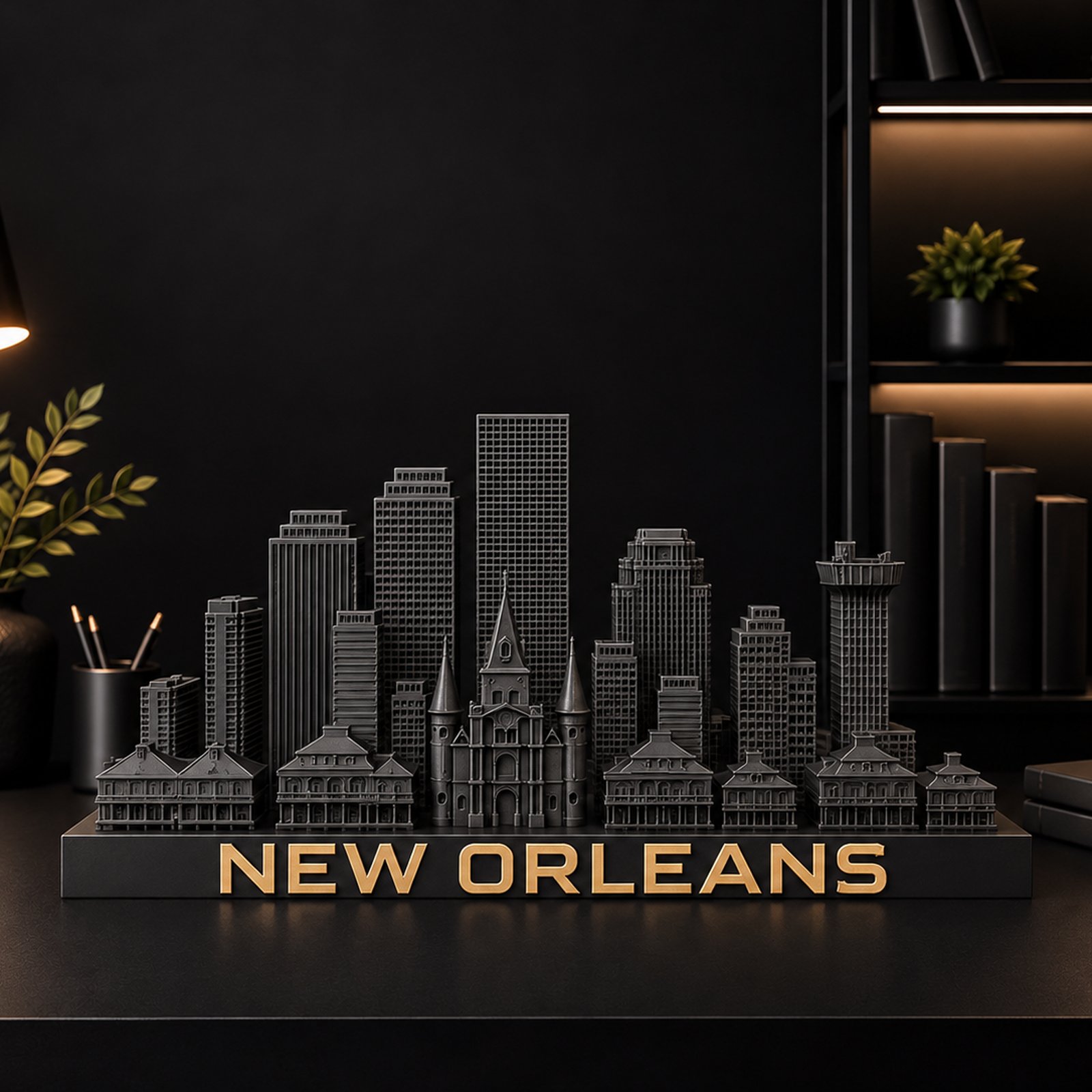
Our New Orleans skyline is built from the river side of the Quarter, the way most people picture the city:
- St. Louis Cathedral at the centre, forward of everything else, with its three spires.
- French Quarter townhouses with deep galleries printed low and wide along the front edge.
- The CBD towers stepping up behind, led by Hancock Whitney Center.
It's the contrast between the eighteenth-century street and the twentieth-century towers that makes New Orleans look like nowhere else, and that's what the model is designed to show. Matte black with gold lettering, made in the USA.
- Small, $34.99
- Medium, $54.99
- Large, $74.99, ships free (and so does any order of two skylines)
FAQ
What is the tallest building in New Orleans?
Hancock Whitney Center, formerly One Shell Square, at 697 feet and 51 floors. Completed in 1972, it is also the tallest building in Louisiana.
What are the buildings in the New Orleans skyline called?
The main towers are Hancock Whitney Center (One Shell Square), Place St. Charles, Plaza Tower, Energy Centre, First Bank and Trust Tower, the Four Seasons (former World Trade Center) and the Hibernia Bank Building. In front of them, from the river, stand St. Louis Cathedral and the French Quarter, with the Superdome to one side.
Why are there no new skyscrapers in New Orleans?
Most of the skyline was built during the oil boom of the 1970s and early 1980s. When oil prices fell, demand for office space collapsed. Soft, wet ground also makes tall buildings expensive to build, so recent projects have mostly converted existing towers.
Why is Plaza Tower empty?
Plaza Tower was vacated in the early 2000s after problems with mould and asbestos, and several redevelopment plans since then have not been completed.
Where is the best view of the New Orleans skyline?
From the Mississippi: the Algiers Point ferry landing and the Moonwalk along the river in front of Jackson Square both show the cathedral in front of the CBD towers.