New York Skyline Wall Art: Why a 3D Sculpture Beats the Flat Print
A buyer's guide to New York skyline wall art in 2026 — why most NYC canvas prints and posters go quiet fast, and why a hand-finished 3D Manhattan skyline sculpture holds a room. Sizes $34.99–$74.99.
New York Skyline Wall Art: Why a 3D Sculpture Beats the Flat Print
We make a New York skyline sculpture, so no, we are not neutral here. But the case we are about to make would stand even if we sold nothing: most New York skyline wall art disappoints for the same handful of reasons, and no upgraded print fixes it. The fix is a different kind of object.
Search "new york skyline wall art" and you know the field already. Canvas prints of Midtown at blue hour. Black-and-white photographs of the Manhattan Bridge framing the Empire State Building. Gold-line posters where every tower shrinks to a thin stroke. Watercolor washes of the harbor with the skyline dissolving into the sky. A lot of it is beautiful. Almost all of it shares one quiet flaw: it lies flat against the wall and asks nothing of the light.
Why Most NYC Skyline Art Disappoints
Walk through a hundred New York apartments and you find the same three failures hanging over the couch.
It's Generic Under the Surface
A surprising share of "New York" skyline art is not really New York. It is a stock row of rectangles with one pointed tower and the word NEW YORK printed underneath. Change the label and it could be Toronto or Shanghai. The buildings that actually make Manhattan legible — the Empire State's setback crown, the Chrysler's stainless-steel sunburst, One World Trade tapering to its spire — flatten into anonymous boxes. You end up hanging the idea of a skyline, not the skyline anyone would recognize.
It Reads as a Poster, Not a Piece
Flat art has a ceiling on how permanent it can feel. A print in a frame is, at bottom, a sheet of paper behind glass. It photographs well and it covers a bare wall, but it does not hold the eye the way a physical object does. Guests glance at it on the way to the kitchen. They do not stop and look.
It Fades Into the Room
The cruelest failure is the slow one. Canvas prints and washes go quiet within a few weeks. The color settles into the wall, the composition stops surprising you, and inside a month you have stopped seeing it entirely. Good decor should still catch you off guard six months later, in a hard slant of afternoon light you never planned for. Flat NYC skyline art almost never clears that bar.
What Actually Makes Skyline Art Worth Keeping
The pieces that survive the six-month test share a few traits, and none of them is about print resolution or frame quality.
They are specific — you can name the towers. They have physical presence — they take up volume and throw a shadow. They are tied to a real place in your life — the city you moved to at twenty-two, the one you left, the one where the important things happened. And they reward light — the way an object shifts as the sun crosses it through the day is what keeps it alive on a shelf.
Flat art can nail the first trait. By its own nature it struggles with the other three. That is the entire argument for going three-dimensional.
The 3D Skyline: What Changes When Art Leaves the Wall
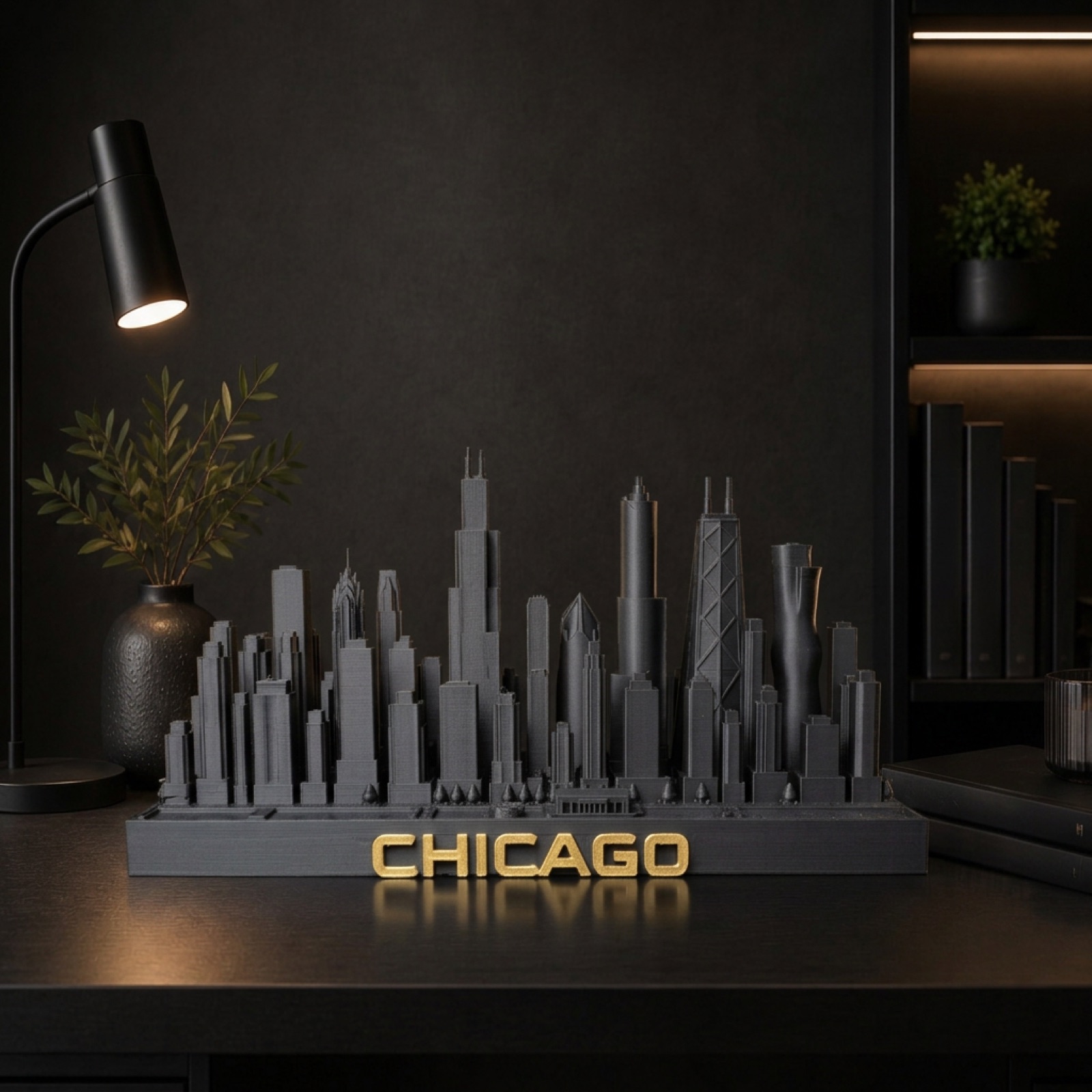
Our New York skyline is a 3D-printed sculpture in matte black with brushed-gold lettering on the base reading NEW YORK. The Small is six inches across at twenty-nine dollars. The Medium is seven and a half inches at forty-nine. The Large is nine inches at sixty-nine. Each one is hand-finished in our US workshop and ships within three to five days.
The moment skyline art becomes an object instead of an image, three things change.
It casts a shadow. Set a lamp beside it and the towers throw a second Manhattan across the shelf and the wall behind it. That shadow moves as the light moves through the day. A print cannot do this at all. It is the single biggest reason a sculpture keeps its grip on a room while a poster goes silent.
It reads from any angle. Walk past it and the buildings shift against each other — One World Trade slides in front of the Bank of America Tower, the Midtown cluster steps up behind Lower Manhattan, the composition rearranges itself. A framed print looks identical from every seat in the apartment.
It occupies a surface, not a wall. This matters more than it sounds. A mantel, a bookshelf, a console by the door, a desk — the sculpture lives at eye level in the paths you actually walk, not up on a wall you stop registering after a week. It becomes part of the room's daily geometry instead of a rectangle you hung once and forgot.
The Buildings Are Real — and This Is Where New York Wins
Here is the part that matters most for New York specifically. The towers on the model are not stand-ins. They are named, and they are architecturally correct, and in Manhattan that is the whole game — because no skyline on earth is more recognizable building by building.
One World Trade Center, tapering from a square base to a chamfered eight-point top, its spire the tallest point in the Western Hemisphere. The Empire State Building, with its stepped Art Deco setbacks and the mast that has anchored the Midtown silhouette since 1931. The Chrysler Building, its terraced stainless-steel crown and radiating triangular windows — arguably the most beautiful roofline ever built. The Bank of America Tower at One Bryant Park, its crystalline glass wedge and asymmetric spire. One Vanderbilt, the newer Midtown giant rising beside Grand Central. 432 Park Avenue, the impossibly thin white grid-tower of Billionaires' Row. And the Flatiron Building, the 1902 wedge that everyone photographs, holding its corner where Broadway cuts across Fifth.
If you have walked Manhattan — down Fifth, across the Brooklyn Bridge at dusk, up through Midtown at rush hour — you have stood under every one of these. That is the difference between New York skyline art and generic skyline art. A native picks out their building without being told. Someone who lived in Murray Hill finds the Empire State on the first look. Someone who worked downtown finds One World Trade. That recognition is what turns a decoration into something personal, and flat stock art almost never earns it.
The Other Option: The Whole City, Not Just the Skyline
There is a second way to put New York on a wall, and it is the more literal one.
A New York 3D city map is a framed relief panel of the actual city — not the silhouette from the lake or the harbour, but the footprint. Every building is raised at its real relative height, the street grid is cut in between, and Central Park cut out of the middle and both rivers drops away in matte black. Manhattan, Brooklyn and Queens are labelled along the bottom.
The difference matters more than it sounds. A skyline shows you the handful of towers a city is famous for. A relief map shows the blocks someone actually lived on — the street they drove every morning, the neighbourhood they moved away from. People find their own house on it, which is not something a silhouette can offer.
It is 20 × 20 inches, framed and ready to hang, $249, made to order. It is the piece to choose when the wall is the point; the skyline sculpture is the piece to choose when you want an object on a shelf or a desk.
Sizing It for Your Room
The three sizes are not only price tiers — they suit different spots.
Small (6 in, $34.99) is a desk and shelf piece. It fits a bookshelf gap, a work-from-home desk, a windowsill, the narrow ledge that is all the surface a real New York apartment gives you. It is also the size most people start with when buying for themselves.
Medium (7.5 in, $54.99) is the everyday statement size. It holds a mantel, a console by the entryway, or the center of a floating shelf without crowding it. If you are buying one and cannot decide, buy this one. It is the size our first customers keep coming back for.
Large (9 in, $74.99) is for a room that needs an anchor. A wide mantel, a living-room credenza, a reception desk, a conference-room shelf. It reads across a room and photographs like a small monument.
Because it sits on a surface and lights from the side, it pairs well with the flat art you may already own. A framed harbor photograph on the wall and the 3D Manhattan skyline on the console below it is a stronger corner than either piece alone. If you want to see how the same argument plays out for another city, we made the full case in our Chicago skyline wall art guide.
New York Themed Gifts: Who This Is Actually For
Most people who buy the skyline are not filling a blank wall. They are buying it for someone with a New York story. When people search "new york themed gifts," this is usually the person they have in mind. A few patterns we see constantly:
The one who left New York. Someone who spent their twenties in the East Village or Astoria and now lives in Austin, Denver, or Charlotte. New York is not a place they visited — it is a place that shaped them, and no one who has left ever fully stops missing it. The Manhattan skyline on their shelf is the city they carry, sitting at eye level in a home far from it. This is the most common reason people buy, and it is exactly why we also make gifts for someone who moved away.
The homesick transplant. Not everyone who lives in New York is from New York, and not everyone who left has left for good. The recent grad who moved for the first job and hasn't been home in a year. The expat sending a piece of the city to a friend still grinding it out in a fifth-floor walk-up. The skyline reads as "I know what this city means to you" better than anything you can eat or wear.
The new homeowner. A New York skyline is a specific, grown-up housewarming gift that survives the closet — it says something about the person and the place instead of being one more scented candle. See our full housewarming gift guide for how it stacks up against the usual options.
The die-hard New Yorker. The one who defends the subway, has opinions about which slice shop is best, and knows the fastest transfer at every station. The skyline of their city, hand-finished and named building by building, is a gift that reads as effort rather than obligation.
If the person you are buying for belongs to a different city, we make the same sculpture for eleven others — browse the full cities collection and give them their skyline instead.
Flat vs. 3D: The Honest Comparison
We will be fair to the flat print, because there are cases where it wins. If you need to cover a large blank wall for very little money and you want it done today, a canvas print does that, and we are not going to pretend otherwise. Flat art is cheaper per square inch, it scales to enormous sizes, and it hangs in five minutes.
What flat art cannot do is everything the six-month test is about. It cannot cast a shadow. It cannot change as you walk past it. It cannot sit on the console in the path you actually walk every day. And most NYC prints cannot survive real scrutiny, because the buildings are painted as anonymous rectangles rather than rendered as the Chrysler, the Empire State, One World Trade. A print is an image of New York. The sculpture is a small, physical piece of it.
That is the trade. If your only constraint is dollars per square foot of wall, buy the print. If you want NYC skyline art that still stops you next winter — that moves with the light, reads from every angle, and names the exact towers you walked under — the flat print is the wrong tool for the job.
Why We Finish Every Piece by Hand
A word on how these are made, because it is part of why the object holds up. Each skyline is 3D-printed and then hand-finished in our US workshop — sanded, coated in matte black, and fitted with the brushed-gold NEW YORK lettering on the base. The matte finish is deliberate. Gloss throws hot reflections that flatten the towers and fight the shadow; matte absorbs the light and lets the buildings read as distinct volumes, which is the entire point of going three-dimensional. The result is an object that looks intentional on a shelf rather than mass-produced, and that photographs the way a small monument does rather than the way a trinket does.
It ships in three to five days in a protective mailer, gift-ready out of the box. No frame to buy, no wrapping to source, nothing to assemble.
The Honest Bottom Line
Most New York skyline wall art disappoints in the same three ways: it is generic under the surface, it reads as a poster instead of a piece, and it fades into the room within a month. A better print does not solve any of that, because the problem is not the print — it is the flatness.
A hand-finished 3D Manhattan skyline solves all three at once. It is specific down to the named towers. It has real physical presence on a surface. And it rewards light every day it sits there. That is why it holds a room long after a canvas has gone quiet.
See the piece, the three sizes, and the real photographs on the New York skyline page. And if you are shopping for someone in a different city, the full cities collection covers eleven more — the same form, the same quality, with the silhouette of the city that matters to them.