Best San Francisco Souvenirs: What to Bring Home That Lasts
The best San Francisco souvenirs ranked honestly. Resident SF vs. tourist SF, why the skyline outlasts Anchor Steam and the entire Wharf trinket economy.
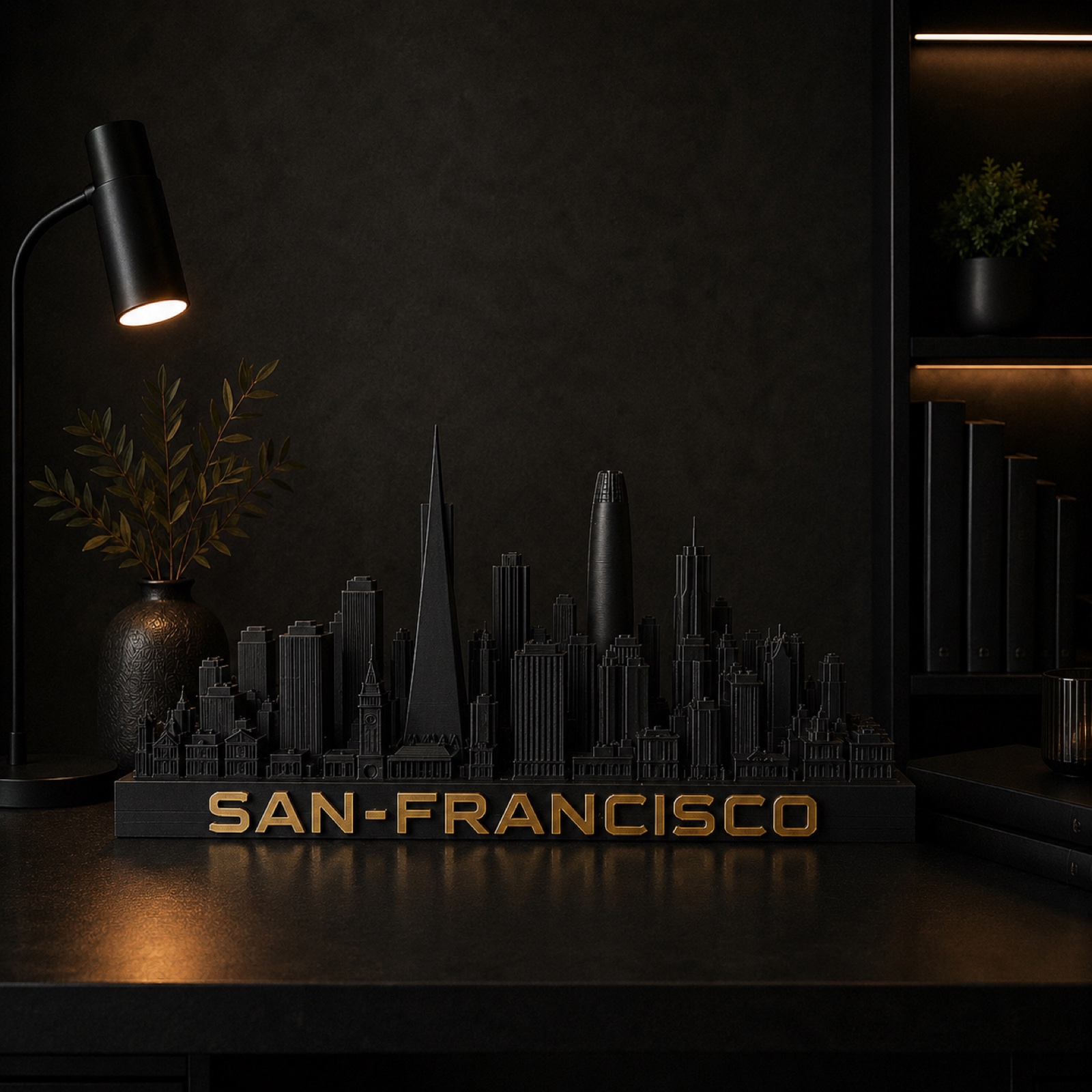
Best San Francisco Souvenirs: What to Bring Home That Lasts
The best San Francisco souvenirs are not sold at Pier 39. They are not sold inside the Boudin Bakery flagship at Fisherman's Wharf, with apologies to a beloved local institution. They are not the bag of saltwater taffy you carry through SFO security while it slowly compresses into a brick. The best San Francisco souvenirs are objects an adult would willingly keep on a shelf five years from now, and that category is much smaller than the souvenir economy of this particular city would lead you to believe. It is also harder to locate, because the city has, for reasons we will get into, two parallel souvenir economies that almost never intersect.
This guide is for three people. The tourist who spent a long weekend riding cable cars, walking down Lombard Street, and eating clam chowder out of a sourdough bowl, who now wants to bring home something meaningful. The friend of a San Franciscan who left for New York or Austin or Miami and quietly misses the city in ways they do not advertise. The lifer resident heading into retirement who wants to keep a piece of the silhouette they walked under for forty years. The advice for all three converges, and we will explain why.
We make a San Francisco skyline sculpture, so we have a horse in this race. We will name it. We will also name the nine other premium San Francisco souvenirs that compete with it, because we think the reader deserves to see the field rather than be sold to. The skyline wins, but it wins on merits we will defend, and the runners-up are good in their own ways.
The Two San Franciscos
San Francisco is not one city. It is two cities living on top of each other, and the souvenir economy serves only one of them.
The first San Francisco is the one the tourist sees. Cable cars climbing California Street. The Golden Gate Bridge framed through the cypresses at the Presidio. The barking sea lions on K Dock at Pier 39. The Painted Ladies on Steiner Street. The crookedest block of Lombard. Sourdough at Boudin, chocolate at Ghirardelli Square, Alcatraz visible from every northern vantage. This is the postcard city, and the souvenir shops between Aquatic Park and Pier 39 have built a small kingdom on it.
The second San Francisco is the one residents live in. Burritos at La Taqueria on Mission and 25th. Coffee at Sightglass on Seventh. Books at City Lights, where the staff still hand-write the recommendations on index cards stuck to the shelves. The Embarcadero on a clear Tuesday morning when the fog has burned off the hills. The walk up Russian Hill where the grade is so steep the sidewalk turns into stairs. SFMOMA on a Thursday evening. Cha Cha Cha in the Haight if you remember Cha Cha Cha in the Haight. This is the city residents lived in, and it does not appear on any keychain.
Almost every souvenir sold in San Francisco belongs to the first city. The sea lion plushie, the Alcatraz prison-stripe shirt, the sourdough starter in a kit, the cable car snow globe, the bridge magnet, the chocolate sampler from Ghirardelli. None of these objects are about the city residents lived in. They are about the city tourists imagined before they arrived. The transaction is honest in its way. The tourist wants confirmation of the imagined city. The shops sell confirmation. Everyone gets what they came for.
The problem is that this is not a system that produces durable artifacts. The plushie ends up in a yard sale. The sourdough kit produces one disappointing loaf. The Ghirardelli chocolate is gone by week two. The cable car snow globe leaks. The trip leaves nothing behind, and the city it depicted was not really the city anyway.
A real San Francisco souvenir has to clear a different bar. It has to belong to the second city, not the first. Or, more accurately, it has to belong to both, because the only artifacts that survive long-term are the ones that read as authentic to a resident and legible to an outsider at the same time. There are not many of these. We will rank the ten that exist.
What Counts as a Real San Francisco Souvenir
For the purposes of this guide, a San Francisco souvenir has to clear four bars.
It has to be specific to San Francisco rather than to the marketing version of San Francisco. A snow globe of the Golden Gate Bridge with white plastic fog particles is specific to the imagined city. A Heath Ceramics dinner plate is specific to the Bay Area design ecosystem that produced it and that residents actually use at their actual tables.
It has to be durable. A consumable can be a gift but not a souvenir. The sourdough finishes. The chocolate finishes. The skyline does not.
It has to be displayable. A serious adult should be able to put the object on a shelf in a living room without apologizing for it. Most Wharf souvenirs fail this test in three seconds.
It has to be tied to an experience a resident would recognize. The recipient should be able to point at the object and tell a story that is not about a movie they have seen. The story should be about a building they walked past, a meal they ate, a bookstore they browsed, a hill they climbed.
With those bars, here are the ten best San Francisco souvenirs, ranked.
Ten Premium San Francisco Souvenirs, Ranked
1. The Hand-Printed San Francisco Skyline by City Skyline Decor
We are going to be honest about the bias and then make the argument on the merits.
The San Francisco skyline is a 3D-printed sculpture in matte black with brushed gold lettering on the base reading SAN FRANCISCO. The Small is six inches across at twenty-nine dollars. The Medium is seven and a half inches at forty-nine. The Large is nine inches at sixty-nine. Each piece is hand-finished in our US workshop and ships within three to five business days.
The buildings on the model are the towers a resident would name without thinking. Salesforce Tower at 1,070 feet, the tallest building in San Francisco and the one that quietly redefined the silhouette in 2018. The Transamerica Pyramid, which until Salesforce arrived was the city's defining shape and remains the most recognized building in the skyline by any non-resident. 555 California, the dark granite tower formerly known as the Bank of America Center that anchors the financial district. 181 Fremont, the tapered glass needle next door to Salesforce. 345 California Center with its twin spires. The Millennium Tower at 301 Mission, which the city has spent a decade arguing about for reasons of structural engineering and which is now part of the skyline whether anyone likes it or not. We have written about each of these in detail in our San Francisco skyline buildings guide.
These are not generic skyscrapers. They are the buildings that frame the view from Twin Peaks, from Bernal Hill, from Dolores Park on a clear afternoon. If you ever stood on a sidewalk in the Mission and looked east toward the financial district, you saw exactly this profile. The model concentrates that profile into one keepable form.
The reason this object beats the rest of the list is structural and we will defend it in its own section below. The short version is that the skyline is the only San Francisco artifact that does not depend on a single business surviving. Anchor Steam closed in 2023. Saigon Sandwich is gone. Original Joe's at the SoMa location is gone. Cha Cha Cha is gone. The city eats its tangible artifacts on a cycle that has only accelerated since the pandemic. The skyline does not. The buildings are still there. They will still be there in 2040.
The piece lives on a shelf forever. It survives moves. It is made to order. It does not spoil. It does not embarrass. It arrives in a corrugated mailer with a foam insert, gift-ready out of the box.
The rest of this list is real and we will be fair to it. None of it does what the skyline does.
2. City Lights Bookstore Signed Editions
City Lights Booksellers and Publishers at 261 Columbus Avenue is the only American bookstore that is also a national landmark, and the rare books and signed editions kept in the upstairs poetry room are the closest thing San Francisco has to a literary reliquary. A signed Ferlinghetti, a first-edition Howl, a Rebecca Solnit hardcover signed at a recent reading, a small-press Bay Area poet most people outside the city have not heard of. These are real objects with real provenance.
The recipient has to read poetry, or at least pretend to. If they do, this is the second-best San Francisco souvenir on the list. The book pays back for decades. If they do not, the book sits on a shelf as decoration, which is also acceptable but a different kind of return.
Price band starts around twenty-five dollars for a recent signed paperback and climbs sharply for the rare editions. The selection rotates with what the store can find.
Verdict: outstanding for the literary recipient. Niche but genuine.
3. Heath Ceramics From the Sausalito Factory or San Francisco Showroom
Heath Ceramics is technically based in Sausalito across the Golden Gate, and we are going to count that as San Francisco for the purposes of this guide because anyone who has lived in the city understands that the Bay Area is one design ecosystem. Heath has a showroom in the Mission at 2900 18th Street, and the factory tour in Sausalito is one of the more rewarding Bay Area day trips. A Heath plate, mug, or vase is the kind of object that ends up on the table of a serious dinner party in any Bay Area home, and the guests recognize it without needing the maker explained.
The forms are mid-century. The glazes are unmistakable. Heath has become, over seventy years, the dinnerware that signals a particular kind of Bay Area taste, and a single piece tells the recipient that the gifter has been paying attention.
Price band starts around forty dollars for small pieces and goes well above the skyline for the large vases.
Verdict: top-tier for the design-aware recipient. Pair with the skyline for the full statement.
4. SFMOMA Design Store Prints and Editions
The San Francisco Museum of Modern Art's gift shop is one of the better museum stores in the country, and the print and edition selection punches significantly above the typical museum-store category. Limited-edition prints from artists in the permanent collection. Artist books from current exhibitions. Design objects sourced from the Bay Area's stronger studios.
A signed print or limited edition from SFMOMA is a real piece of art that happens to be a piece of San Francisco. It frames well. It has provenance. Price band is wide, typically eighty dollars at the entry level and into the thousands for the rare editions.
The catch is recipient-specific. The gifter has to know the recipient's design language well enough to pick something that aligns. If you can, this is one of the strongest San Francisco souvenirs available. If you cannot, the print sits in a closet.
Verdict: excellent for the art-aware recipient. Niche but genuine.
5. Tartine Cookbook, Signed if Possible
Tartine Bakery at 600 Guerrero Street in the Mission is one of the few San Francisco institutions that has survived three decades, three economic cycles, and a national replication effort, and that still produces bread and pastry at the level it did in its first year. The Tartine cookbook by Elisabeth Prueitt and Chad Robertson is one of the most-used pastry books in serious American home kitchens. A signed copy, if you can get one at a bakery event or through the Tartine Manufactory's occasional signings, is a real Bay Area artifact for the recipient who cooks.
The bread itself, of course, does not survive the trip. A loaf of Tartine country bread is one of the great experiences of San Francisco and one of the worst souvenirs ever conceived, because the experience of Tartine bread is the experience of Tartine bread on the day it was baked. Two days later, you have a hard brick of nostalgia. Send the cookbook. Eat the loaf in town.
Verdict: excellent for the home cook. Pair with the skyline for the recipient who appreciates both.
6. Mission Workshop Bags
Mission Workshop at 40 Rondel Place in the Mission makes the kind of bags that serious San Francisco bike commuters and serious San Francisco engineers have been carrying for fifteen years. The Rummy daypack, the Vandal rolltop, the Sanction commuter. These are technical bags with restrained aesthetic, made for a city where it rains horizontally for two months and where the commute might involve a hill that would qualify as a stair climb in any other municipality.
A Mission Workshop bag is a working object that ages well rather than wears out. It is also one of the few San Francisco purchases that reads simultaneously as functional and as a statement. The recipient carries it for a decade and the bag tells the city's story every time they pick it up at the airport.
Price band starts around one hundred sixty dollars for the smaller bags and climbs into the four hundreds for the bigger commuters.
Verdict: excellent for the recipient who actually commutes or travels. The skyline lives on a shelf. The bag lives on a shoulder. Different forms of keeping, both legitimate.
7. DeYoung Museum Prints
The de Young Museum in Golden Gate Park runs a print shop that, like the SFMOMA store, is stronger than the museum-store baseline. The selection leans toward American art and Bay Area photographic archives, including limited editions tied to special exhibitions and a rotating set of California landscape prints that frame beautifully.
The de Young's collection is unusual among American museums in how directly it engages with regional landscape and material culture. A de Young print can be specifically Northern Californian in a way that a print from MoMA or the Met cannot be. That regional specificity is what makes it a real souvenir rather than a generic art purchase.
Verdict: strong for the recipient who responds to California landscape or photography. Pair with the skyline for the full wall-plus-shelf treatment.
8. Anchor Steam Memorabilia, Now a Historical Curiosity
Anchor Brewing Company closed in July 2023, ending a 127-year run that had made Anchor Steam one of the longest-continuing brand names in San Francisco. The closing was the first time most non-residents understood that San Francisco had stopped being able to keep its institutions alive.
Anchor Steam memorabilia, which used to be a normal piece of brand merchandise sold at the brewery's Mariposa Street taproom, has now become a historical artifact. Old t-shirts, branded glassware, signed tap handles, brewery tour mementos. These objects circulate on resale sites at prices that reflect their new status as relics of a city that has changed.
We are including this on the list because it is structurally important to understand. The Anchor closing was the moment a category of San Francisco souvenir died in a single press release. The same has happened, on smaller scales, to dozens of other businesses. The lesson is that a souvenir tied to a single San Francisco business is a souvenir whose meaning can change overnight when the business closes.
Verdict: a historical curiosity, not a living souvenir. For collectors only. Useful as a cautionary frame for the rest of the list.
9. Smitten Ice Cream, Caveat: Perishable
Smitten Ice Cream's flash-frozen, liquid-nitrogen-made small batches are one of the best San Francisco food experiences and one of the worst souvenirs ever conceived, for the obvious reason. The product literally cannot leave town. A scoop at the Pacific Heights or Hayes Valley location is one of the better fifteen-dollar experiences in the city. A pint, if you can get it home and into a freezer within an hour, is a great Friday-night dessert.
Neither is a souvenir. We include this on the list to be honest about how often visitors imagine a great food experience is going to translate into a great gift, and to suggest a substitute: pair the in-town experience with a Medium skyline shipped to the friend's address. The ice cream is the trip. The skyline is the artifact.
Verdict: a great experience and a non-souvenir. Pair with something durable.
10. Boudin Sourdough Starter, Caveat: Perishable and Dated
Boudin Bakery at Fisherman's Wharf sells a sourdough starter kit that includes their famous mother culture, dried and packaged for travel. The pitch is that the recipient can grow their own loaf of true San Francisco sourdough at home.
The pitch is technically accurate. The reality is that home-grown sourdough is a project, not a souvenir. The kit takes hours over several days. The first loaf is usually mediocre. The starter dies in the fridge by month three. The kit itself, once used, becomes an empty paper sleeve.
For the right recipient, a serious bread baker who would have started a sourdough at some point anyway, the kit is a charming gesture. For everyone else, it is a consumable that pretends to be a keepsake.
Verdict: charming for serious bakers. Not a serious souvenir.
Why the Skyline Outranks the Field
We promised an argument. Here it is.
The other nine objects on this list are real San Francisco souvenirs in their own ways. Several of them are better gifts than the skyline for specific recipients. A signed Rebecca Solnit first edition for a reader whose taste you know is a more personal gift. A Heath Ceramics vase for a design-aware recipient is a more refined gift. A Mission Workshop bag for the recipient who commutes is a more useful gift.
None of them does what the skyline does, which is cross-decade durability that does not depend on any single business surviving.
Look at the list again. Anchor Steam closed in 2023. Smitten still operates but the food does not travel. Boudin still operates but the starter dies in a fridge. Tartine still operates, but if it closed tomorrow the cookbook would become a memento of a defunct bakery the way an Anchor t-shirt is now a memento of a defunct brewery. City Lights still operates and we hope it continues to, but if Lawrence Ferlinghetti's literary executor closes the upstairs poetry room in 2030, a signed first edition becomes a different kind of object. Even Heath, even SFMOMA, even the de Young exist as institutions that could change.
The buildings do not. Salesforce Tower will be there in 2040. Transamerica has been there since 1972 and was iconic by 1980. 555 California has been there since 1969. 181 Fremont has been there since 2018. The Millennium Tower, structural drama notwithstanding, has been there since 2008 and is not going anywhere. The skyline is the only San Francisco artifact on this list that depicts something which has spanned the dot-com era, the tech 2.0 era, the AI era, and whatever era comes next, without depending on any single firm or restaurant or brewery or bakery to keep its meaning intact.
This matters because San Francisco's tangible artifacts disappear at a rate faster than most American cities. The reasons are economic and structural and we are not going to litigate them here. The pattern is real. A souvenir tied to a single San Francisco institution carries the risk of that institution closing. A souvenir of the silhouette itself carries no such risk.
The skyline also concentrates the entire city into one keepable form. It is not a fragment of San Francisco like a sourdough kit or a piece of cable car memorabilia. It is San Francisco itself, miniaturized, in the silhouette a resident would draw on a napkin if asked to draw their city. It lives on a shelf forever. It survives moves. It is hand-printed and finished to order. It does not spoil. It is gift-ready out of the box.
This is why we rank it first.
What to Bring Home for Whom
The right San Francisco souvenir varies by recipient. Here is the practical guide.
For the Tourist Bringing Something Home From a Trip
A Small San Francisco skyline. Thirty-nine dollars. The Small is the right size for the tourist because it fits in a carry-on without taking meaningful space. The piece is roughly eight ounces in its mailer and is approximately the size of a paperback book on its side. It survives the flight. It sits on a desk back home as a quiet record of the trip.
Tourists frequently make the mistake of buying four small souvenirs in the first three days of the trip and then realizing on the last day that they have nothing serious to take home. The fix is to skip the Wharf entirely and order a Small from us either during the trip or after, shipped to the home address. Three to five days later, the tracking number arrives and so does the souvenir. The trip stays with you in a form that does not embarrass anyone.
If you want a consumable in addition, a jar of small-batch jam from the Ferry Building Marketplace or a bag of beans from Sightglass works as the receipt of the trip. The Small is the keepsake. The jam is the breakfast story.
For the SF-Leaver Living in NYC, Austin, or Miami
A Medium skyline. Sixty-nine dollars. This is the most common reason people order our San Francisco model, and it is the use case that deserves the most careful attention because the recipient is rarely going to tell you they miss the city.
The San Francisco-to-elsewhere migration of the last five years is one of the largest internal American migrations of the century. The reasons are real. Housing costs, family proximity, remote work flexibility, the changes to the city itself. The Angeleno or New Yorker or Austinite who used to live in the Mission or the Sunset or Pacific Heights has reasons for leaving. They moved for reasons. They are not asking for sympathy.
What they are also not going to admit is that they miss the city. The friend who left San Francisco for Austin in 2022 is not going to call you in April 2026 and say they wish they were back in the Mission for the Cinco de Mayo block parties. They are going to talk about how Austin has gotten too hot, or how the property tax is wild, or how they cannot find a good burrito. The skyline gives them permission to love the city they left without admitting it.
The Medium at forty-nine dollars is the right size for this. It reads from across a room. It anchors a bookshelf. It says, on the recipient's behalf, the thing they will not say out loud: the city is part of who I am, and I built something there. The piece does not require the recipient to make any declaration. It just sits on the shelf and does the work.
We have shipped a lot of these. The thank-you texts are usually short. They almost always say some version of "I needed this and did not know I needed it."
For the Lifer Resident at Retirement
A Large skyline. One hundred twenty-nine dollars. The Large is the right size for the milestone moment, and retirement after a working life in San Francisco is the cleanest example of that moment.
The lifer resident, the person who arrived in the city in 1986 or 1992 or 2001 and never left, has watched the silhouette change in real time. They remember when the Transamerica Pyramid was the tallest building. They remember the dot-com towers going up and coming down. They watched Salesforce Tower top out and felt some combination of pride and ambivalence about what it represented. They were here.
The Large on a mantel or a built-in bookshelf in the new retirement apartment is the right size for that history. It is the statement piece for the life lived in the city. We have shipped Large San Francisco skylines to retired partners at law firms, retired tech executives moving to Marin or Sonoma, retired teachers downsizing from a Noe Valley house to a one-bedroom in Sausalito. The recipient knows what the piece is. The recipient does not need it explained.
For the Corporate Gift to a San Francisco-Based Client
A Medium at forty-nine dollars.
For executive-level recipients, retirement gifts, or major-client anniversaries, step up to the Large. The Medium is the ceiling for ordinary client gifts.
What to Send the SF-Leaver Who Will Not Admit They Miss It
This is its own category, and it deserves its own treatment, because it is one of the largest audiences for the San Francisco skyline and one of the most misunderstood.
The person who left San Francisco for somewhere else is in a peculiar emotional position. They are usually defensive about the move, because the move was their decision and they do not want to relitigate it in casual conversation. They are usually proud of the new life, because it required real work to build. They are also, frequently, quietly grieving the version of themselves who lived in the old city.
You cannot send them a souvenir that says "you should come back." That gift is a guilt trip wrapped in matte black. They will react badly to it. The relationship suffers.
You can send them a souvenir that says "the city you built something in is permanent and so are you." That is a different message, and the skyline carries it without saying it out loud. The Medium skyline arriving at their address three or six months after the move is the cleanest version of this gift. They unbox it. They put it on a shelf in the new apartment. They do not say anything about it for a week. Then, eventually, they mention it. The gift has done its work without making them defensive.
The timing matters. Do not send the skyline before the move. Do not send it during the move. Do not send it the week they arrive in the new city, when everything is still in boxes and they are still in survival mode. Wait until the new life has started to form. Three to six months is the sweet spot. They have a kitchen they like, a coffee place they have committed to, a route they walk on weekends. The skyline arrives and finds its place among those new things.
For someone who left San Francisco under difficult circumstances, a layoff, a family crisis, a relationship ending, hold the gift longer. The skyline is a portrait of identity, not a treatment for trauma. Wait until they are stable, then send it.
We make a related case in our San Francisco skyline gift ideas piece, which covers occasion-specific recommendations in more depth.
What to Send the Engineering or Startup Cohort
San Francisco's other large souvenir audience is the engineering and startup cohort, which has its own gift moments and its own register.
The Series A close is one. A Medium skyline shipped to the founder's home address, with a card from the lead investor or the board, lands cleanly. It marks the moment without making it about money. It says: you built something in this city, and the city is on your shelf now.
The IPO is another. A Large is the size for this. The piece sits in the founder's office or living room and does what no plaque from the exchange could do, because it is the city itself rather than a certificate about the city.
The founder exit is the third. After an acquisition or a public offering, the founder usually receives a stack of commemorative objects. Most of them are plaques and lucite tombstones with the deal terms etched on the front. These are corporate artifacts. The skyline is a personal artifact. It outlasts the lucite by a decade. The right move is a Large, shipped after the deal closes, with a short note that does not mention the financials.
The engineering cohort has its own version of this. The senior engineer who has been at a San Francisco company for ten years and is leaving for a new role. The founding engineer who is being thanked for the early work. The CTO transitioning out. In all of these cases, the skyline is the gift that says the work happened in this city, in these buildings, and the recipient was part of it. We have shipped a lot of skylines into Mission Bay, SoMa, and the financial district for exactly this set of occasions.
The Anchor Steam Closing as a Metaphor
We have to come back to Anchor Steam because it does a particular kind of work in this guide.
Anchor Brewing Company was founded in 1896. It survived prohibition. It survived the 1906 earthquake. It survived two world wars, the dot-com crash, and the 2008 financial crisis. It was acquired by Sapporo in 2017. It closed in July 2023.
The closing felt sudden but it was not sudden. The economics had been deteriorating for years. The brand had drifted from its working-class roots into a kind of permanent ambivalence about what it was. The Sapporo acquisition had complicated matters in ways no press release ever explained clearly. By the time the closing was announced, anyone who had followed the brewery closely had seen it coming.
The reason this matters for a souvenir guide is that Anchor was not the only one. Saigon Sandwich on Larkin closed. The Original Joe's in SoMa closed. Cha Cha Cha closed. Tiki Tom's in Hayes Valley closed. Velo Rouge in the Richmond closed. A long list of mid-tier and upper-tier San Francisco institutions have closed since 2020, and the closings are not slowing.
Every one of those closings represents the death of a category of San Francisco souvenir. The Anchor t-shirt, the Saigon Sandwich coffee mug, the Original Joe's matchbook, the Cha Cha Cha pin. These objects still exist on the resale market, but they no longer point to a living thing. They point to a memory of a thing.
The skyline is one of the few San Francisco artifacts that does not have this problem. The buildings are still there. The buildings will still be there. The skyline is durable in a way that no business-tied souvenir can be, because the skyline is not tied to any business.
This is the structural argument for the skyline, and the Anchor closing is the case study that makes it concrete. We rank the skyline first not because we make it, but because the city itself keeps proving the case.
Sizing for the San Francisco Souvenir Use Case
We sell three sizes. For San Francisco souvenir use, the matchups are clean.
The Small at six inches and twenty-nine dollars is for the tourist. It fits in a carry-on, the weight is eight ounces in the mailer, it survives the flight and sits on a desk back home. Tourists who want a serious souvenir but do not want to commit shelf space choose the Small and choose correctly.
The Medium at seven and a half inches and forty-nine dollars is for the SF-leaver gift. The friend who moved to New York, the cousin who moved to Austin, the colleague who moved to Miami. The Medium reads as a real piece on a shelf rather than a desk toy. It is the volume size we ship most often into the SF expatriate diaspora.
The Large at nine inches and sixty-nine dollars is for the lifer statement piece, the IPO commemoration, the founder exit, the retirement gift, or the corporate milestone. The Large is for the moment that deserves the moment.
If you are debating between two sizes, go up one. Almost nobody regrets the larger skyline. People regret the smaller one when it arrives smaller than they pictured.
We have written more about sizing across all cities in our best skyline gifts guide.
Shipping and Carry-On Notes
San Francisco is one of the easier cities to ship to and from for the skyline, because the piece itself is lightweight and the city is well-served by every major carrier.
The Small in its mailer is roughly eight ounces and is approximately the size of a paperback book on its side. It fits in a personal item or a carry-on without taking meaningful space. Tourists who want to bring it home in luggage can do so without difficulty. The packaging is rigid foam in a corrugated outer, designed to survive checked-bag handling, and we have shipped Smalls through SFO security in carry-ons many times without issue.
The Medium at seven and a half inches is roughly a pound and a half in the mailer and is approximately the size of a small hardcover book. It fits in carry-on luggage and reads as a real package in a checked bag.
The Large at nine inches is roughly four pounds and is typically shipped directly to the recipient rather than carried, because it is the right size and weight to warrant its own packaging rather than competing with the rest of a suitcase.
For most San Francisco visitors who buy from us, the right move is to order online during or after the trip and have us ship directly to the destination, whether that is the buyer's home or the recipient's address. Shipping runs three to five business days within the continental United States. We carry the logistics. The visitor carries home a memory and a tracking number.
This is the structural advantage over physical San Francisco retail. The Heath vase has to be padded in your suitcase. The City Lights signed first edition has to be carried home in a tote and protected from rain in transit. The SFMOMA print has to be rolled. The skyline ships from our workshop directly to the destination with no suitcase math at all.
The Right Answer for Each of the Three Readers
For the tourist visiting San Francisco: a Small at twenty-nine dollars. Carry-on size, desk size, real souvenir. The trip stays with you in a form that does not embarrass anyone.
For the friend or family member of someone who left San Francisco and lives in New York, Austin, Miami, or anywhere else: a Medium at forty-nine dollars. A shelf piece. The city they built something in, on their bookshelf in the new apartment.
For the lifer resident at retirement, the founder at exit, or the corporate milestone: a Large at sixty-nine dollars. The mantel size. The statement size. The portrait of a city someone gave their working life to.
All three of you are asking the same question, which is how to take San Francisco home in an object that does not embarrass you in five years and does not depend on a business that might close. The answer is the same shape in three sizes.
The Wharf souvenir shops will be there next time. The sea lion plushies, the Alcatraz tees, the sourdough kits, the cable car snow globes. None of them is what the San Francisco you actually walked through looks like. The downtown silhouette is. Salesforce, Transamerica, 555 California, 181 Fremont, 345 California, Millennium. The city in matte black on a shelf, with brushed gold lettering on the base. Made in our US workshop. Shipped in three to five days.
FAQ
What is the best San Francisco souvenir to bring home?
The best San Francisco souvenir captures the city without the Fisherman's Wharf kitsch. A hand-printed San Francisco skyline sculpture ranks first: it is specific to SF, it lasts, and it works as decor rather than clutter. Heath Ceramics, a print from SFMOMA, and small-batch local coffee are strong runners-up.
What can I buy that represents San Francisco but is not tacky?
Skip the snow globes and mass-made Golden Gate keychains. Choose objects tied to the real city: a matte-black San Francisco skyline piece, Heath Ceramics, an SFMOMA print, or single-origin coffee from a local roaster. These read as tribute, not gimmick.
What is a good San Francisco gift to send someone who moved away?
For a former San Franciscan, send a San Francisco skyline sculpture. It puts their city on their shelf and reads as a keepsake, not a souvenir. It ships flat-boxed anywhere in the US in three to five business days.
How much do San Francisco souvenirs cost?
Cheap tourist souvenirs run five to twenty dollars but rarely survive the trip home. A hand-printed SF skyline starts at twenty-nine dollars for the small, forty-nine for the medium, and sixty-nine for the large, with free US shipping over forty-five dollars.
Order Yours
The San Francisco skyline ships in three to five business days from our US workshop. Three sizes, hand-finished, matte black with brushed gold lettering. The downtown San Francisco core, sized for a shelf, ready for the mantel.
If you want to see the rest of our work, the full cities collection covers eleven other US cities. Each one is the same form and the same quality, with the silhouette of the actual depicted city. The San Francisco model has become one of our highest-volume pieces because the city's souvenir market has a structural problem the skyline solves cleanly.
The Wharf gift shops on the way out of the city will still be there. The good San Francisco souvenir is not in the Wharf gift shops. It is here.