San Francisco Skyline Buildings: Before and After Salesforce
One building reset the proportions of the San Francisco skyline in 2018. A guide to Salesforce Tower, the Transamerica Pyramid and what changed between them.
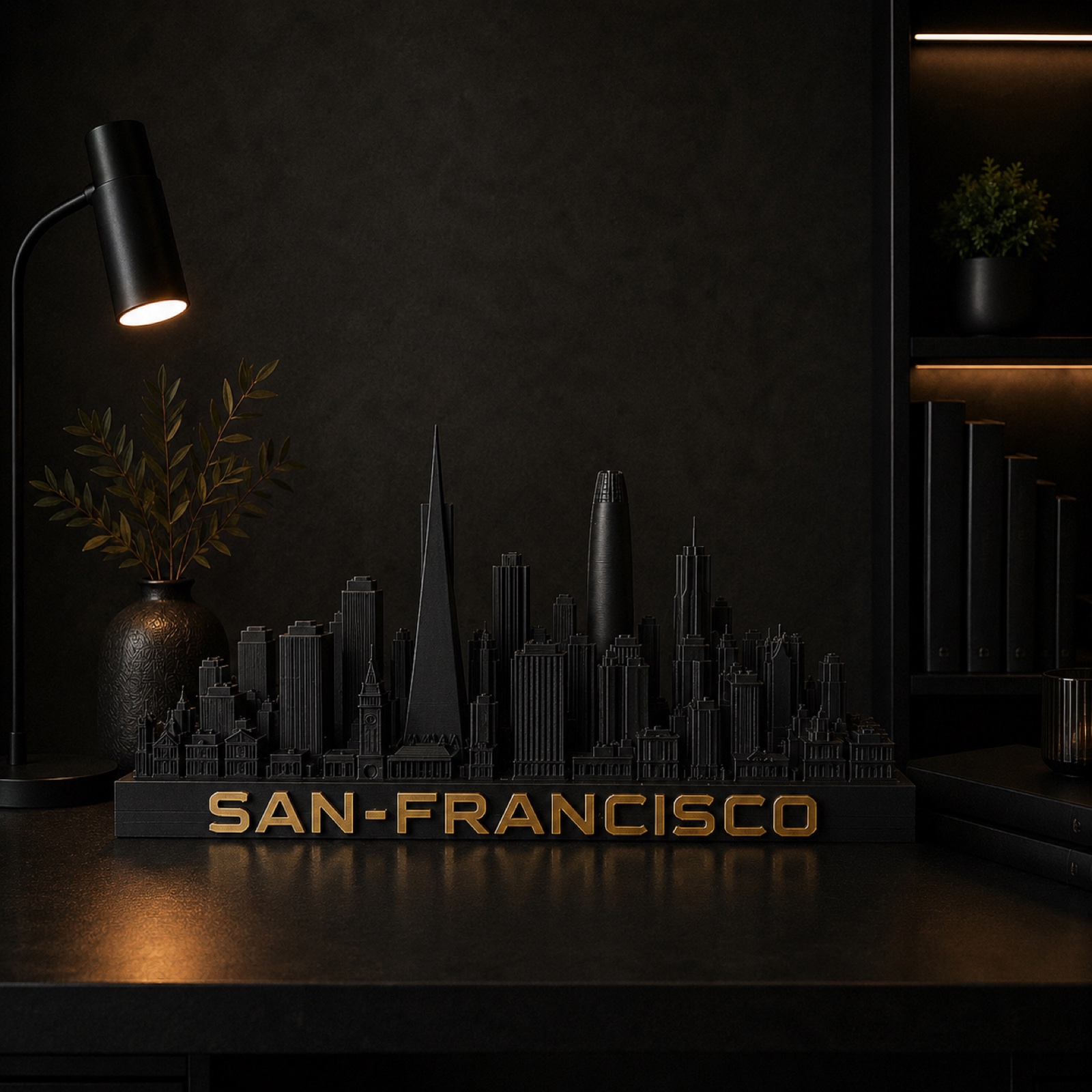
San Francisco Skyline Buildings: Before and After Salesforce
The San Francisco skyline buildings you see from the Bay Bridge represent the wealthiest 49 square miles in human history. The skyline itself is small. That contradiction is the entire story.
Manhattan is wealthy and tall. Hong Kong is wealthy and tall. Singapore, Dubai, Tokyo, all wealthy and all visibly so from a vertical silhouette that announces the capital concentrated there. San Francisco is wealthier per capita than any of them and the skyline does not announce it. The tallest building is 1,070 feet. The cluster ends at the Embarcadero waterfront and stops. The hills around the Financial District are mostly low-rise residential. The city that wrote half the software running on the planet looks, from across the Bay, like a medium-sized regional center with one prominent tower.
This guide is for people who want to read that small skyline correctly. The San Francisco skyline on our model is six towers, each one of them a fought-over object. Every building on this silhouette was contested before it was built. Several of them were the reason the city changed its zoning code. One of them is sinking. The skyline is not small by accident. It is small because the city has been at war with itself over height since 1971, and the towers that survived the fight are the ones standing on our model.
Our San Francisco model is roughly 9 inches across for the Large, 7.5 inches for the Medium, 6 inches for the Small. The buildings on it are not a comprehensive San Francisco. They are the silhouettes that read from across a room as the Financial District and nothing else.
Here is what you are looking at, building by building.
Why the towers cluster where they do
A foundation, because everything else in this guide depends on it.
San Francisco is the only major American city that organized a sustained political movement against its own skyline. The movement began in 1971, when a coalition of urban preservationists, neighborhood activists, and architecture critics published a study called The Ultimate Highrise, which argued that the Transamerica Pyramid, then under construction, represented the beginning of a Manhattanization process that would destroy the city's scale and identity. The Pyramid was not the first tall building in San Francisco. It was the building that made the city's tall future feel inevitable, and the 1971 movement decided to make it the line.
The fight lasted fifteen years. There were ballot initiatives. There were neighborhood lawsuits. There were architectural conferences whose entire program was a referendum on whether San Francisco should grow up. The fight culminated in 1986 with Proposition M, a voter-approved measure that capped new office construction in the city at roughly 950,000 square feet per year, with strict review for any project exceeding that allotment. Proposition M is, to this day, the most restrictive growth-control measure in any major American city. It is the reason San Francisco built fewer towers in the 1990s and early 2000s than Houston or Dallas or Atlanta, despite having more capital per capita than all three combined.
Then add a second factor. The 1906 earthquake. San Francisco sits at the convergence of three significant fault systems, and the 1906 quake remains one of the most destructive seismic events in American history. Every tower in this guide is engineered to standards that buildings in Manhattan and Chicago do not have to meet. The foundations go deeper, the cores are stronger, the dampers are heavier, and the cost per usable square foot is materially higher. This is invisible from the street, but it is part of why the city has built up slowly. The engineering is more expensive, the regulatory review is longer, and the political appetite for new height is contested at every approval.
Then add a third factor. NIMBY power. San Francisco's neighborhood organizations are among the most procedurally sophisticated in the United States. The Telegraph Hill Dwellers, the Russian Hill Neighbors, the Friends of Recreation and Parks, dozens of others. They appeal. They sue. They show up at planning commission meetings for years. A tower proposal in San Francisco routinely takes a decade from concept to topping out, and a significant fraction of proposed towers never get built at all. The skyline is small because the political cost of adding to it is high.
Then add a fourth factor. The Transbay redevelopment area is the exception that proves the rule. In the 2000s, with the demolition of the old Transbay Terminal and the planning of the new Salesforce Transit Center, the city designated a specific zone south of Market Street where higher-density vertical development would be allowed under streamlined approval. Salesforce Tower, 181 Fremont, and Park Tower at Transbay all sit inside this zone. Almost every tall building built in San Francisco since 2010 is in Transbay. The rest of the city stayed roughly the height it was. The Transbay exception is the reason the modern skyline cluster exists at all, and it is also the reason that cluster is so geographically compact. Walk three blocks west of Salesforce Tower and the buildings are forty years old and ten stories tall.
This is the thesis. The San Francisco skyline is small because the city decided it would be. The towers that exist are the ones that survived a political fight that has not stopped. The skyline is a record of compromise, of zoning ordinances passed and challenged, of buildings that almost did not get built. Every tower on our model carries that history.
From the Pyramid to Salesforce
These are the buildings we render, roughly in the order they appear when you read the silhouette from the Embarcadero across the Financial District into Transbay.
Salesforce Tower
Built 2018. Architect: Cesar Pelli of Pelli Clarke Pelli Architects.
Salesforce Tower is 1,070 feet, 61 stories, and is the tallest building in San Francisco, the tallest building west of the Mississippi excluding Los Angeles, and the centerpiece of the Transbay redevelopment area. It surpassed the Transamerica Pyramid as the city's tallest building in 2017 when it topped out, ending a 45 year reign during which the Pyramid was the city's vertical signature. Salesforce Tower is not the most beloved building in San Francisco. It is the building that defined the modern skyline anyway.
The silhouette is a tapered glass shaft that narrows continuously from a wide base to a rounded top. There is no spire in the conventional sense. The crown is a 200 foot soft taper that holds, embedded inside it, a Jim Campbell light sculpture called Day for Night, which displays moving abstract imagery on 11,000 LEDs every evening from sunset until midnight. The sculpture is the largest public art commission in San Francisco history. The images are generated daily from footage shot in the city itself, abstracted and pixelated to the point where individual figures are not recognizable but the collective rhythm of the city reads as motion across the top of the tower. From the Bay Bridge at night, the crown is one of the most distinctive light installations in any American skyline.
Cesar Pelli was 91 years old when Salesforce Tower opened. He designed the Petronas Towers in Kuala Lumpur, the World Financial Center in Manhattan, and the original tower at the foot of the Wilshire Grand in Los Angeles. Salesforce Tower is one of the last buildings he personally led. The taper, the rounded crown, and the avoidance of a hard spire are signature Pelli moves. The tower is part of a body of work that defined American supertall design for two decades.
The building is named for Salesforce, the software company founded by Marc Benioff in 1999. Salesforce signed the anchor lease in 2014, taking roughly half a million square feet of office space across the upper floors. The naming rights deal was structured so that Salesforce committed to occupying the building long-term in exchange for the city's blessing on the lease and the building's branding. The deal is widely considered one of the most successful corporate-civic partnerships in San Francisco history, partly because Salesforce has used the tower's prominence to fund significant philanthropy across the city, partly because the building's name connects the skyline to the industry that defines the city's modern era.
On our model, Salesforce Tower is the tallest building, set toward the southern end of the silhouette where the Transbay zone meets the older Financial District. The taper reads cleanly at every size.
Transamerica Pyramid
Built 1972. Architect: William Pereira.
The Transamerica Pyramid at 600 Montgomery Street is 853 feet, 48 stories, and was the tallest building in San Francisco from its completion in 1972 until Salesforce Tower surpassed it in 2017. For 45 years, the Pyramid was the building most people associate with the San Francisco skyline. It still is, for anyone who learned the city before 2018.
The Pyramid was the single most controversial building in San Francisco architectural history. When it was proposed in 1969, the local architectural and preservation community organized against it. The objection was not the height alone. The objection was the shape. A pyramid was a foreign form, an Egyptian or pre-Columbian gesture that critics argued had no relationship to San Francisco's architectural heritage. The American Institute of Architects San Francisco chapter publicly opposed the design. Allan Temko, the architecture critic at the Chronicle, called the building a violation of the city's scale. The Telegraph Hill Dwellers sued to block construction. The fight went on for two years.
The pyramid shape itself was a political compromise. William Pereira's original concept was a more conventional tower. He revised it toward a pyramid as a response to community concerns about a tall building casting shadows over the surrounding low-rise neighborhood. A pyramid shape, by tapering from a wider base to a narrower top, drops less shadow at street level than a conventional tower of the same height. The tower was sold to the planning commission, to the neighborhood associations, and to the public partly on this argument. The shape that critics called foreign and inappropriate was, in design intent, an accommodation to local opposition. This irony has been argued about for fifty years and shows no sign of resolution.
The Pyramid's apex is hollow. The top 212 feet of the building, above the 48th occupied floor, are an empty spire that holds nothing but an aircraft warning light and the structural framework that supports it. The spire was originally intended to house an observation deck, which was built and operated for several years and then closed permanently after 2001 for security reasons. The closure was controversial. The spire is one of the most recognizable architectural elements in any American skyline and it is, structurally, decorative. The tower could function without it. The fact that it cannot be visited makes it more iconic, not less. It is unreachable, and that is part of the meaning.
William Pereira also designed the Geisel Library at UC San Diego, the Disneyland Hotel, and parts of the original master plan for LAX. He is one of the major figures in postwar California modernism. The Transamerica Pyramid is his most public commission. He died in 1985, before Proposition M passed, before the Salesforce Tower was conceived, while the Pyramid was still the city's tallest. The building outlived its architect by forty years. It will outlive most of the rest of this list.
On our model, the Transamerica Pyramid is the unmistakable tapered triangular silhouette in the center of the frame, immediately recognizable from any size.
555 California Street
Built 1969. Architects: Wurster Bernardi and Emmons with Skidmore Owings and Merrill.
555 California Street, originally called the Bank of America Center, is 779 feet, 52 stories, and was the tallest building in San Francisco from its completion in 1969 until the Transamerica Pyramid surpassed it in 1972. It is the dark red carnelian granite tower that locals have always called, accurately, the Black Granite Slab, despite the fact that the stone is technically dark red. The building reads as black from any distance over a hundred feet, and the nickname stuck.
The tower was built as the world headquarters of Bank of America at the time the bank was the largest in the United States. Bank of America was headquartered in San Francisco for most of the twentieth century. The building was the bank's statement that the city was the financial capital of the Western United States, an argument the bank lost when its headquarters relocated to Charlotte in 1998 after the NationsBank merger. The tower kept the name 555 California Street after the relocation, and the bank's old corporate offices became commercial tenant space. The building is now owned in part by the Vornado Realty Trust and in part by a Trump family entity, a co-ownership structure that became briefly politically prominent in the late 2010s.
The architecture is the most uncompromising late modernist commercial tower in San Francisco. The granite cladding is laid in vertical strips with no setbacks, no ornament, no concessions to the surrounding cityscape. The building is what it is. The plaza at the base contains the Banker's Heart, a Masayuki Nagare granite sculpture commissioned in 1969 that is one of the most photographed pieces of public art in the Financial District, partly because of the sculpture itself, partly because the contrast between the dark tower and the dark sculpture creates a visual unity that few corporate plazas achieve. The plaza was the location of a key scene in the film Dirty Harry, which made the building visible to a generation of moviegoers who had never been to San Francisco.
The building has been a working office tower for fifty-five years without significant renovation to its exterior. The granite has weathered slightly but the proportions, the curtain wall, and the overall silhouette are unchanged from 1969. This is unusual for a tower of that era. Most contemporaries in other cities have been re-clad, re-skinned, or significantly modified. 555 California Street has not. It is, structurally and visually, the same building that opened during the Nixon administration.
On our model, 555 California Street is the dark slab immediately north of the Transamerica Pyramid, the building whose rectangular mass anchors the older Financial District cluster.
181 Fremont
Built 2018. Architect: Heller Manus Architects.
181 Fremont is 802 feet, 70 stories, a mixed-use tower in the Transbay redevelopment area that opened the same year as Salesforce Tower across the street. It is currently the second tallest building in San Francisco and the most expensive residential address in the city. The upper 37 floors are luxury condominiums. The lower floors are office space, occupied primarily by Facebook, which signed an anchor lease that allowed the building to finance through construction.
The tower's silhouette is the most architecturally distinctive new entrant in the San Francisco skyline. The crown is a series of asymmetric setbacks that produce a faceted silhouette unlike any other tower on the silhouette. The exterior structure is exposed seismic bracing, a diagonal pattern of steel members visible through the curtain wall that does the structural work of resisting earthquake loads. The bracing is not decorative. It is the primary lateral system. By exposing it rather than concealing it behind cladding, the architects made the seismic engineering legible from the street, which is itself a comment on what San Francisco architecture has to be.
The penthouse at 181 Fremont sold in 2019 for 42 million dollars to an anonymous LLC buyer, briefly setting the record for the highest residential sale price in San Francisco history. The lower condominium floors have changed hands at prices ranging from 4 million to 25 million dollars. The building's residential program is one of the densest concentrations of wealth in any American tower outside Manhattan and Miami.
The Transbay redevelopment area, in which 181 Fremont sits, was the first significant rezoning of San Francisco for high-density vertical development since Proposition M. The zone covers roughly 145 acres south of Market Street, was approved in stages between 2005 and 2012, and was designed specifically to support high-rise residential and office construction that the rest of the city's zoning would not permit. Without Transbay, neither Salesforce Tower nor 181 Fremont nor several other recent towers would exist. Transbay was the exception that allowed the modern skyline to be built.
On our model, 181 Fremont is the tower with the visible faceted crown and exposed bracing, set immediately adjacent to Salesforce Tower in the Transbay cluster.
345 California Center
Built 1986. Architect: Skidmore Owings and Merrill, lead designer Edward Charles Bassett.
345 California Center is 695 feet, 48 stories, a granite and glass tower in the older Financial District whose distinguishing feature is a pair of pyramidal cupolas at the top, connected by a sky bridge that is itself an enclosed structural element. The twin cupola crown is one of the most identifiable rooftop signatures in San Francisco and is the visual feature that most differentiates the tower from its rectangular neighbors.
The building opened in 1986, the same year Proposition M passed. It is one of the last major office towers approved under the old growth regime, and its design reflects the late modernist sensibility that was about to become impossible to execute in the city for the next quarter century. The pyramidal cupolas are usually read as a deliberate reference to the Transamerica Pyramid four blocks to the north, an architectural conversation across the Financial District that ties the older skyline together visually. Whether Bassett intended the reference explicitly is contested among architectural historians, but the visual relationship is undeniable.
The lower portion of the tower is office space and was, for decades, the headquarters of First Interstate Bancorp before that bank was acquired by Wells Fargo in the 1990s. The upper portion houses the Mandarin Oriental hotel, which occupies floors 38 through 48 between and inside the cupolas. The hotel's rooms have views of the Bay Bridge and the Financial District that few other accommodations in the city can match, and the bar on the 39th floor is one of the highest publicly accessible spaces in any San Francisco tower.
The building is structurally noteworthy because it was one of the first San Francisco towers to use a tuned mass damper, a pendulum-like device installed near the top of the tower that counteracts wind and seismic sway. The damper is concealed inside the upper mechanical floors. Without it, the cupolas would not be possible at this height in this seismic zone. The tuned mass damper at 345 California is one of the earliest American examples of a technology now standard in supertalls worldwide.
On our model, 345 California is the tower with the twin pyramidal cupolas, set in the central cluster between the Transamerica Pyramid and the Transbay group.
Millennium Tower
Built 2009. Architect: Handel Architects.
The Millennium Tower at 301 Mission Street is 645 feet, 58 stories, a luxury residential tower in the South of Market area immediately east of Salesforce Tower. The building opened in 2009. It has, since 2016, been the most architecturally infamous tower in the United States.
The Millennium Tower is sinking. As of the most recent public engineering reports, the tower has settled more than 18 inches into the ground at its base, and it has tilted measurably toward the northwest. The tilt is visible from certain angles in the surrounding neighborhood. The settlement is the largest documented sinking of any modern residential supertall in American history, and the legal and engineering response to it has consumed more than a decade of litigation, professional investigation, and remediation construction.
The cause is contested in detail and undisputed in outline. The tower's foundation was designed as a concrete mat that bears on dense sand approximately 80 feet below grade. The mat does not extend to bedrock, which lies more than 200 feet below at this location. The original design assumed the sand layer would provide sufficient bearing capacity for a tower of the Millennium's weight, and the building permitted on that basis. The assumption proved insufficient. The sand consolidated more than the engineers predicted, and the tower settled more than the design tolerated. Compounding the problem, the construction of the Transbay Transit Center across the street, which involved significant excavation and dewatering, may have accelerated the settlement, though the relative contribution of construction-induced effects versus original design inadequacy is the subject of ongoing technical dispute and was the central question in a decade of lawsuits among the Millennium developer, the Transbay authority, the building's residents, and various insurers and engineering firms.
The remediation, completed in 2023, involved drilling 18 new piles down to bedrock through the existing foundation and transferring the building's load from the original mat to the new pile system. The work cost more than 100 million dollars and took several years longer than initially planned because the initial pile installation in 2021 caused additional settlement that had to be addressed before the system could be completed. The tower has now stabilized. The tilt remains. The building is structurally safe and habitable, but the tilt is permanent and the resale values of the condominium units have been significantly impacted, with the building's units trading at substantial discounts to comparable buildings in the same zip code.
The Millennium Tower is the Bay Area's architectural cautionary tale. It is the example cited in engineering courses, in development pitches, in city planning commissions, of what happens when foundation design assumptions exceed the geology. The tower is also the example cited in arguments about why San Francisco's skyline should be built carefully, slowly, and with conservative engineering margins. The building did not collapse. It is not going to. But it has reset the conversation about what constitutes adequate foundation design in the seismic and geological context of the San Francisco peninsula, and the resulting changes to the city's permitting process for tall buildings are part of the Millennium Tower's permanent legacy.
We include the Millennium on our model because the building is part of the skyline. We are not editing it out. The skyline is what it is, including its mistakes.
On our model, the Millennium Tower is the slim rectangular tower set immediately east of Salesforce Tower in the Transbay cluster. The proportions are correct. The tower is not modeled with its actual tilt, because at our scale the tilt would be invisible. We render the building as built. The history is what you know.
A Specific Note on the Millennium
Most skyline guides do not include the Millennium Tower in their lineup of major San Francisco buildings. The building is younger than most of its neighbors, less architecturally distinguished, and dominated in public conversation by its engineering problems. We include it for three reasons.
The first is honesty. The skyline includes the building. If we are rendering the skyline accurately, the Millennium is part of the silhouette. Editing it out would be a form of dishonesty about what the modern San Francisco skyline actually looks like from the Bay Bridge or from Yerba Buena Island.
The second is architectural significance. The Millennium is the most important engineering case study in any recent American supertall. The lessons learned from the foundation failure have changed building codes in San Francisco, in California, and increasingly in other seismic-vulnerable American cities. The tower is, in an unwanted way, one of the most influential buildings of its decade. To leave it off would be to pretend that influence does not matter.
The third is the cultural moment. The Millennium is the building that San Franciscans talk about. It is the dinner-party reference, the courtroom drama, the news cycle of the late 2010s and early 2020s. A skyline gift that pretends the Millennium does not exist is a skyline gift that pretends San Francisco does not know what it has been through. We do not make that pretense.
If the Millennium is the wrong building to include on a skyline gift, the gift is wrong about what the skyline is. The building is on the model. The conversation about it is part of what makes the model accurate.
Before and after Salesforce Tower
For forty-odd years the Transamerica Pyramid was the San Francisco skyline. It is only 853 feet, modest by the standards of other American downtowns, but it had no rival and its shape was unmistakable, so it did the work of identifying the city on its own.
Salesforce Tower changed that in 2018. At 1,070 feet it is more than two hundred feet taller, and it sits south of the old financial core, which pulled the visual centre of the skyline away from the Pyramid. Anyone whose mental image of San Francisco was formed before 2018 is remembering a different silhouette from the one that exists now.
This model is the current city. The Pyramid is still there and still unmistakable, but it is no longer the peak, and seeing the two together at true relative height is the quickest way to understand how recently that changed.