Boston Skyline Wall Art: Why a 3D Sculpture Beats the Flat Print
A buyer's guide to Boston skyline wall art in 2026 — why flat prints go quiet, what makes skyline art worth keeping, and how a hand-finished 3D Boston skyline sculpture holds a room. Sizes $34.99 to $74.99.
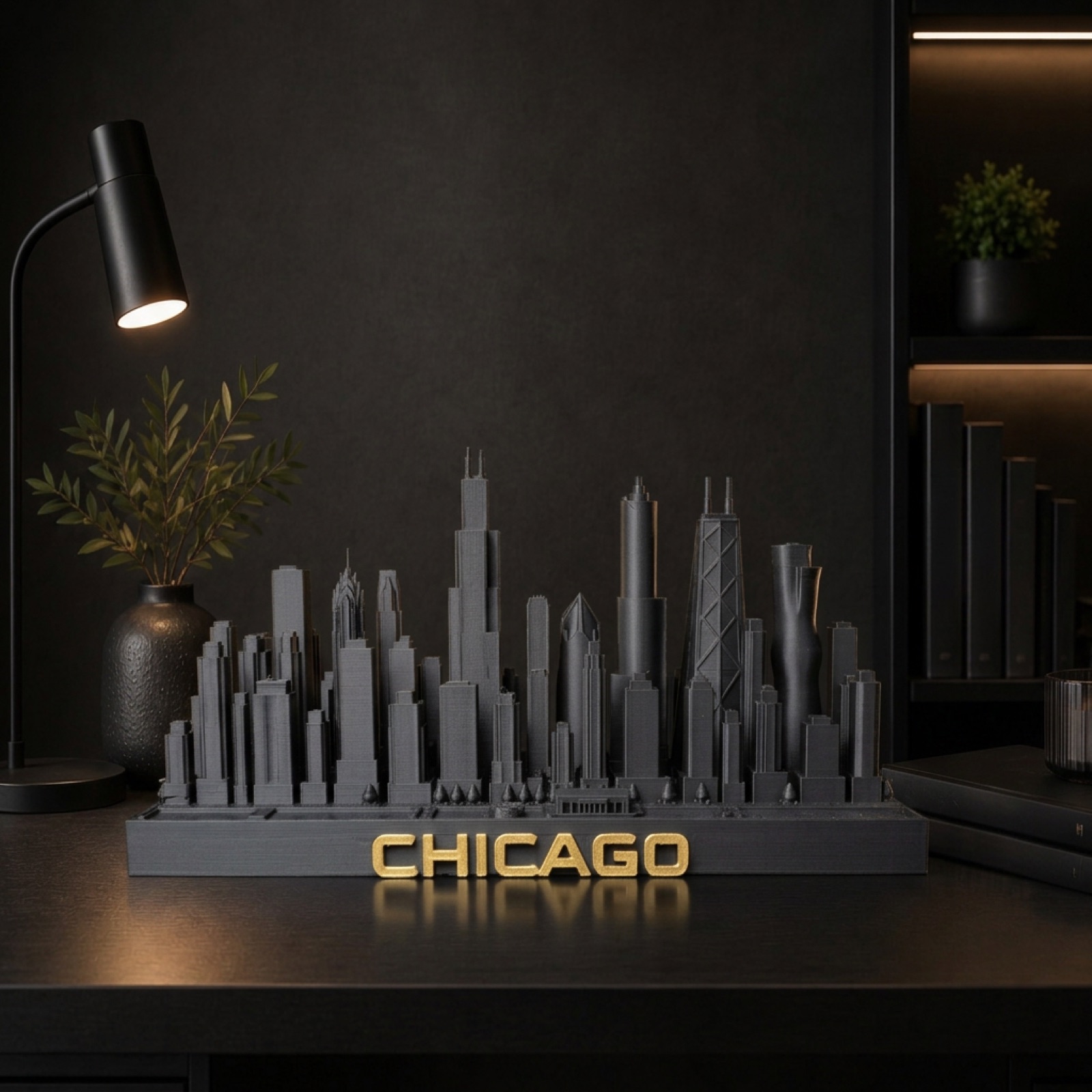
Boston Skyline Wall Art: Why a 3D Sculpture Beats the Flat Print
We make a Boston skyline sculpture, so we are not neutral here. Say that up front and you can weigh what follows accordingly. But the case we are about to make does not depend on us selling anything: most Boston skyline wall art fails the same way, for the same reasons, and no upgrade in print quality fixes it. The fix is a different kind of object.
Search "Boston wall art" and the results are predictable. Canvas prints of the Back Bay glowing at sunset. Framed black-and-white shots of the Zakim Bridge from the Charles. Minimalist line drawings where the Pru and the Hancock become two thin strokes with BOSTON stamped underneath. Watercolor washes of the harbor with a sailboat in the foreground. A fair amount of it is nice to look at. Nearly all of it shares one flaw: it hangs flat against the wall and asks nothing of the light in the room.
Why Most Boston Wall Art Goes Quiet
Look closely at how flat skyline art actually lives in a home and three failures show up again and again.
It Could Be Any City
A lot of "Boston" skyline art is not really Boston. It is a row of generic rectangles, maybe a bridge cable-stay shape thrown in, and the city name printed below to tell you where you are supposed to be. Cover the label and it could just as easily be Seattle or Charlotte. The forms that actually make Boston legible — the Prudential's blunt shoulders, the sheer blue glass slab of the Hancock, the clock face of the Custom House Tower — get sanded down into anonymous blocks. You end up hanging the concept of a skyline, not the one you know.
It Reads as Paper, Not as a Piece
Flat art has a hard ceiling on how permanent it can feel. However good the frame, a print is structurally a sheet of paper behind glass. It fills a blank wall and it photographs fine for a listing photo, but it does not pull people toward it. Guests clock it in half a second and move on. Nobody crosses the room to look closer at a poster.
It Disappears Within a Month
The worst failure is the slow one, because you do not notice it happening. Canvas prints and washes tend to go quiet within a few weeks. The color sinks into the wall, the composition stops offering anything new, and one day you realize you have not actually seen the thing in a month. Decor that earns its spot should still catch you off guard half a year later, in some raking evening light off the Charles that you never planned for.
What Actually Makes Skyline Art Worth Keeping
The pieces that pass the six-month test share a handful of traits, and not one of them is about pixel count or frame finish.
They are specific — you can point at a building and name it. They have physical presence — they take up real volume and throw a shadow. They are tied to a real place in your life — the city you grew up in, the one you left for a job, the one where a chapter happened. And they reward light — the way an object shifts as the sun tracks across it through the day is what keeps it alive on a shelf instead of fading into the wall.
Flat art can nail the first trait cleanly. By its own nature it struggles with the other three. That gap is the entire argument for going three-dimensional.
The 3D Skyline: What Changes When Art Leaves the Wall
Our Boston skyline is a 3D-printed sculpture in matte black, with brushed-gold lettering on the base reading BOSTON. The Small is six inches across at twenty-nine dollars. The Medium is seven and a half inches at forty-nine. The Large is nine inches at sixty-nine. Every piece is hand-finished in our US workshop and ships within three to five days.
The instant skyline art stops being an image and becomes an object, three things change.
It casts a shadow. Set a lamp beside it and the towers throw a second Boston across the shelf and up the wall. That shadow drifts and lengthens as the day goes on. A print physically cannot do this. It is the single biggest reason a sculpture keeps its grip on a room while a poster fades out.
It reads from every angle. Walk past it and the buildings shift against each other — the Prudential slides in front of the Hancock, One Dalton steps up on the far side, the skyline reorganizes itself as you move. A framed print looks identical from every seat in the room, from the couch and from the doorway alike.
It occupies a surface, not a wall. This matters more than it sounds. A mantel, a bookshelf, a console by the front door, a desk — the sculpture lives at eye level along the paths you already walk, not up on a wall you stopped noticing weeks ago. It becomes part of the room's daily geometry instead of a rectangle you hung once and forgot.
The Buildings Are Real
The towers on the model are not filler shapes. They are the actual Boston skyline, and anyone who knows the city will read them.
There is the Prudential Tower, the broad-shouldered slab that anchors the Back Bay and has defined the city's profile since the 1960s. Beside it stands 200 Clarendon, the building most people still call the John Hancock Tower — the mirror-glass rhombus that reflects the whole sky and half of Copley Square back at the street. Down toward the waterfront is the Custom House Tower, the old clock tower that was Boston's first true high-rise and still marks the financial district against everything newer around it. Rising above all of it now is One Dalton, the slender four-sided spire that became the tallest residential tower in New England and reset the top edge of the skyline. And spanning the Charles at the north end is the Zakim Bridge, its cable stays fanning up from the towers in the shape most people picture the moment someone says Boston.
If you walked from Copley Square out to the harbor and back up along the river, you passed every one of these. That specificity is the whole difference between Boston skyline art and generic skyline art. A native will find their building without being told. Someone who lived in the Back Bay will pick out the Hancock on sight. That flash of recognition is what turns a decoration into something personal.
Sizing It for Your Room
The three sizes are not only price tiers — each suits a different spot.
Small (6 in, $34.99) is a desk and shelf piece. It slots into a bookshelf gap, sits on a work-from-home desk, holds a windowsill. It is also the size most people reach for first when they are buying for themselves.
Medium (7.5 in, $54.99) is the everyday statement size. It holds a mantel, a console table in the entryway, or the middle of a floating shelf without crowding it out. If you are buying one and cannot decide, buy this one. It is the size our first customers keep coming back for.
Large (9 in, $74.99) is for a room that needs an anchor. A wide mantel, a living-room credenza, a reception desk, a shelf in a conference room. It reads clear across a room and it photographs like a small monument.
Because it sits on a surface and lights from the side, it works alongside the flat art you may already own rather than competing with it. A framed harbor photograph on the wall with the 3D skyline on the console beneath it makes a stronger corner than either piece does on its own.
Boston Skyline Wall Art as a Gift
Most people who buy the skyline are not filling a blank wall. They are buying it for someone with a Boston story. A few patterns come up constantly, and they line up neatly with the best Boston themed gifts we see people hunting for.
The expat who left. Someone who spent their twenties in Allston or the North End and now lives in Austin, Denver, or across an ocean. The skyline on their shelf is the city they carry with them, sitting at eye level in a home a long way from the Charles. This is the most common reason people buy, and it is why we also put together gifts for someone who moved away.
The new homeowner. A Boston skyline is a specific, grown-up housewarming gift that survives the closet — it says something about the person and their city instead of being one more scented candle. Our full housewarming gift guide lays out how it stacks up against the usual options.
The Bostonian who never left. The one who defends the T, has opinions about the best cannoli in the North End, and can tell you exactly where they were for the 2004 series. The skyline of their own city, hand-finished, reads as effort rather than obligation — and that is the whole point of a good gift.
If the person you are buying for belongs to a different city, we make the same sculpture for a dozen others. Browse the full cities collection and give them their skyline instead. And if you want the broader argument for skyline pieces as decor, we made it in our guide to city skyline wall art.
The Honest Bottom Line
If your only goal is covering a big blank wall for very little money, a canvas print will do that, and we are not going to pretend otherwise. But if you want Boston skyline wall art that still stops you six months from now — that shifts with the light, reads from every angle, and names the exact buildings you walked past on your way to the harbor — a flat print is the wrong tool for the job. A hand-finished 3D skyline is built for it.
See the piece, the three sizes, and the real photographs on the Boston skyline page.