Phoenix Skyline Wall Art: Why 3D Beats Every Flat Print
A buyer's guide to Phoenix skyline wall art in 2026 — why most flat prints and canvases go quiet, what actually makes skyline art worth hanging, and how a hand-finished 3D skyline sculpture holds a room the way a poster never will. Sizes from $34.99 to $74.99.
Phoenix Skyline Wall Art: Why 3D Beats Every Flat Print
We make a Phoenix skyline sculpture, so we are not neutral here. But the argument we are about to make would hold even if we made nothing at all: most Phoenix skyline wall art disappoints for the same three reasons, and the fix is not a better print. It is a different object entirely.
If you have searched for Phoenix wall art, you have seen the field. Canvas prints of downtown against a burning orange sunset. Framed photographs of the towers with Camelback Mountain hazing off in the distance. Line-drawing posters where every building becomes a thin gold stroke over a saguaro silhouette. Watercolor washes of the valley at dusk with the desert going purple. Some of it is genuinely lovely. Almost all of it has the same quiet problem: it lies flat against the wall and asks nothing of the light.
Why Most Phoenix Wall Art Disappoints
Walk into a hundred Phoenix homes and you will find the same three failures on the wall.
It's Generic Under the Surface
A surprising amount of "Phoenix" skyline art is not really Phoenix. It is a stock silhouette of tall rectangles with a cactus bolted on the side and the word PHOENIX underneath. Swap the label and it could be Tucson, or Albuquerque, or any Sun Belt city with a downtown and a mountain behind it. The buildings that actually make Phoenix legible — the sharp peak of Chase Tower, the stepped modern crown of the BMO Tower, the curved glass of 44 Monroe — get flattened into anonymous boxes. You are hanging the idea of a skyline, not your skyline.
It Reads as a Poster, Not a Piece
Flat art has a ceiling on how permanent it can feel. A print in a frame is, structurally, a piece of paper. It photographs well and it fills a blank wall, but it does not hold the eye the way a physical object does. Guests glance at it. They do not walk over and look.
It Fades Into the Room
The cruelest failure is the slow one. Canvas prints and washes tend to go quiet within a few weeks. The color settles into the wall, the composition stops surprising you, and within a month you have stopped seeing it at all. That is especially true of Phoenix sunset prints, which lean on one dramatic burst of color — and a single color, however beautiful the first day, is the fastest thing in a room to disappear. Good decor should still catch you off guard six months in, in a raking evening light you did not plan for.
What Actually Makes Skyline Art Worth Keeping
The pieces that survive the six-month test share a few traits, and none of them is about resolution or frame quality.
They are specific — you can name the buildings. They have physical presence — they take up volume and cast a shadow. They are tied to a real place in your life — the city you grew up in, the one you left, the one where something happened. And they reward light — the way an object changes as the sun moves across it during the day is what keeps it alive on the shelf. In a city that gets more than three hundred days of sun a year, that last trait is not a small thing. Phoenix light is the best free lighting rig a piece of decor could ask for, and flat art wastes it.
Flat art can nail the first trait. It struggles with the other three by definition. This is the whole case for going three-dimensional.
The 3D Skyline: What Changes When Art Leaves the Wall
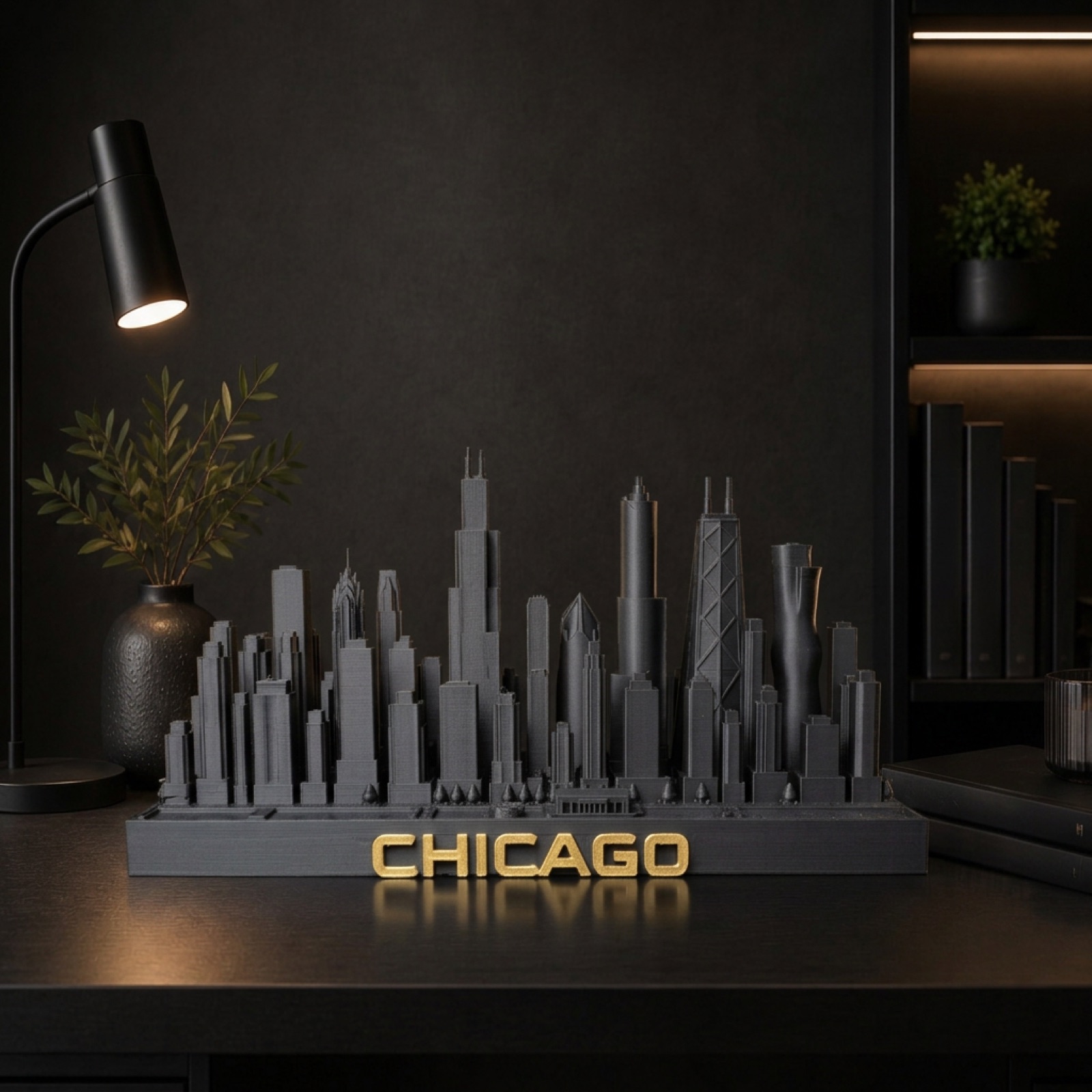
Our Phoenix skyline is a 3D-printed sculpture in matte black with brushed gold lettering on the base reading PHOENIX. The Small is six inches across at twenty-nine dollars. The Medium is seven and a half inches at forty-nine. The Large is nine inches at sixty-nine. Each is hand-finished in our US workshop and ships within three to five days.
The moment skyline art becomes an object rather than an image, three things change.
It casts a shadow. Put a lamp beside it and the towers throw a second skyline across the shelf and wall. That shadow moves through the day, and near a west-facing window a Phoenix afternoon will stretch it long and orange across the surface. A print cannot do this. It is the single biggest reason a sculpture keeps its hold on a room while a poster goes quiet.
It reads from any angle. Walk past it and the buildings shift relative to each other — Chase Tower slides in front of the BMO Tower, the US Bank Center steps down, the composition reorganizes. A framed print looks the same from every seat in the room.
It occupies a surface, not a wall. This matters more than it sounds. A mantel, a bookshelf, a console by the door, a desk — the sculpture lives at eye level in the paths you actually walk, not up on a wall you stop noticing. It becomes part of the room's daily geometry instead of a rectangle you hung once.
The Buildings Are Real
The towers on the model are not stand-ins. Chase Tower, the tallest building in all of Arizona, with its distinctive tapered peak. The BMO Tower, downtown's newest high-rise, all stepped modern glass. The US Bank Center anchoring the older core. The Freeport-McMoRan Center, headquarters of the mining giant, holding its own on the skyline. And 44 Monroe, the slim residential tower with its curved glass face. If you stood in downtown Phoenix and turned in a slow circle, you looked at every building on the model.
It is worth being precise about one thing: the sculpture is the skyline itself, not the desert around it. Camelback Mountain, Piestewa Peak, the saguaros and the long flat valley are the setting Phoenix lives inside — the thing every native pictures behind the towers — but the piece on your shelf is the downtown itself, the buildings a Phoenician would actually name. That is the point. Anyone can silhouette a cactus. What makes this Phoenix and not a generic Sun Belt skyline is that the towers are the real towers, in their real proportions.
That specificity is the difference between Phoenix skyline art and generic skyline art. A native will pick out their building. Someone who worked downtown will find Chase Tower without being told. That recognition is what turns a decoration into something personal.
Sizing It for Your Room
The three sizes are not just price tiers — they suit different spots.
Small (6 in, $34.99) is a desk and shelf piece. It fits a bookshelf gap, a work-from-home desk, a windowsill. It is also the size most people start with when they are buying for themselves.
Medium (7.5 in, $54.99) is the everyday statement size. It holds a mantel, a console table by the entryway, or the center of a floating shelf without crowding it. If you are buying one and are not sure, buy this one. It is the size our first customers keep coming back to.
Large (9 in, $74.99) is for a room that needs an anchor. A wide mantel, a credenza in a living room, a reception desk, a real estate office shelf. It reads across a room and it photographs like a small monument.
Because it sits on a surface and lights from the side, it pairs well with the flat art you may already own. A framed desert photograph on the wall and the 3D skyline on the console below it is a stronger corner than either piece alone.
Phoenix Skyline Wall Art as a Gift
Most people who buy the skyline are not decorating a blank wall. They are buying it for someone with a Phoenix story. A few patterns we see constantly:
The person who moved away. Someone who spent their twenties in the Valley and now lives in Seattle or Chicago, chasing weather that is not a hundred and fifteen degrees in July. The skyline on their shelf is the city they carry, sitting at eye level in a home far from it. This is the most common reason people buy, and it is why we also make gifts for someone who moved away.
The transplant and the new homeowner. Phoenix is one of the fastest-growing metros in the country, full of people who chose it on purpose. A skyline sculpture is a specific, grown-up housewarming gift that survives the closet — it says something about the person and the place rather than being one more scented candle. See our full housewarming gift guide for how it stacks up against the usual options.
The snowbird. The person who winters in Scottsdale and Paradise Valley and heads north when the heat comes. A Phoenix skyline is the piece that keeps the valley on their shelf up north in the off-season — a small monument to the half of the year they actually love.
The born-and-raised Phoenician. The one who defends the summers, knows which taco spot is worth the drive, and remembers when the BMO Tower was still a hole in the ground. The skyline of their city, hand-finished, is a gift that reads as effort rather than obligation — the kind of Phoenix themed gift that does not end up in a drawer.
If the person you are buying for belongs to a different city, we make the same sculpture for eleven others — browse the full cities collection and give them their skyline instead. And if you want the wider case for why a skyline sculpture beats a print in any city, we made it in our city skyline wall art guide.
The Honest Bottom Line
If you want something that fills a large blank wall for very little money, a Phoenix sunset canvas will do that, and we will not pretend otherwise. But if you want Phoenix skyline wall art that still stops you six months from now — that changes with the desert light, reads from every angle, and names the exact buildings you drove past downtown — a flat print is the wrong tool. A hand-finished 3D skyline is built for the job.
See the piece, the three sizes, and the real photographs on the Phoenix skyline page.