Seattle Skyline Wall Art: Why a 3D Sculpture Beats Flat Prints
A buyer's guide to Seattle skyline wall art in 2026 — why most flat prints go quiet, and how a hand-finished 3D Seattle skyline sculpture holds a room. Sizes $34.99–$74.99.
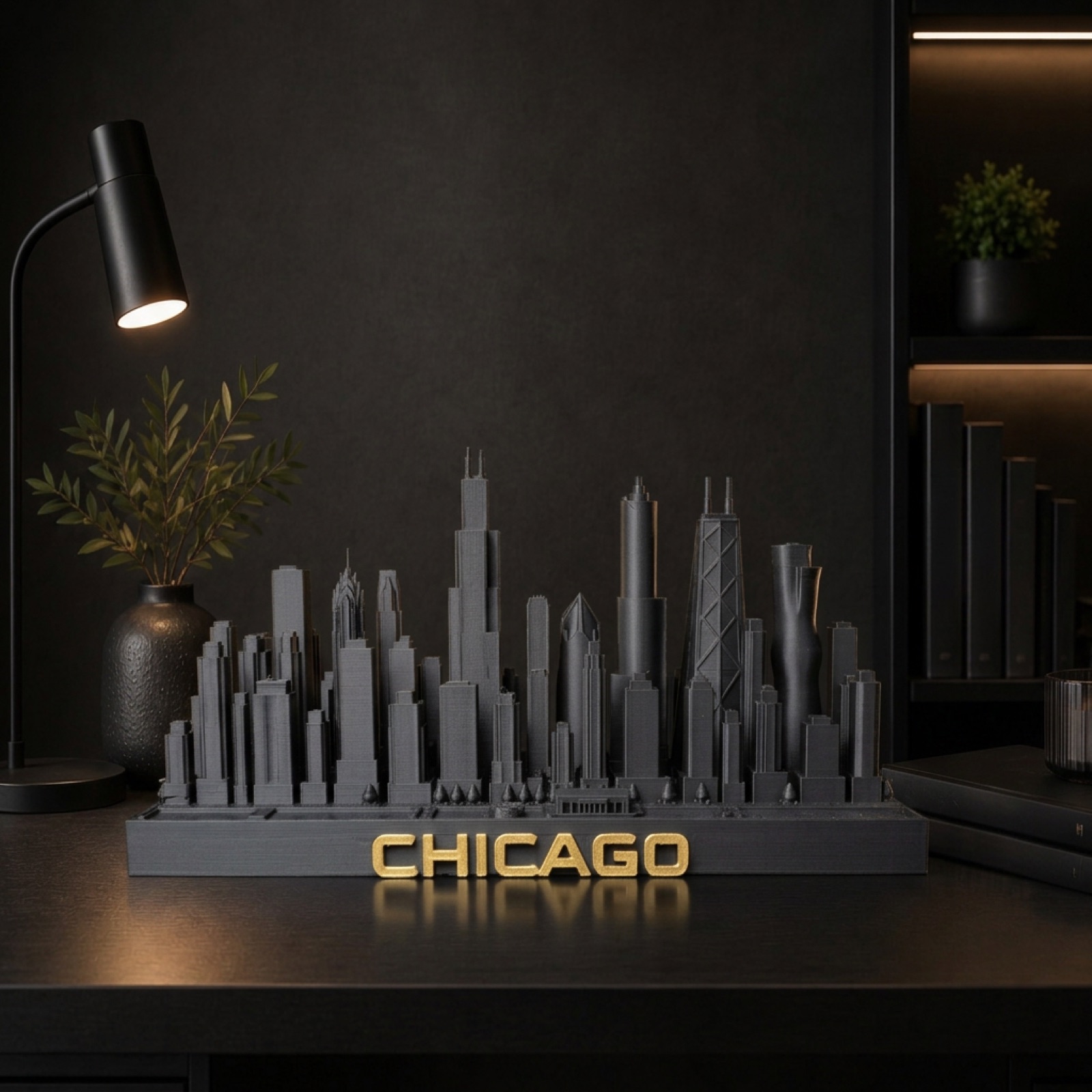
Seattle Skyline Wall Art: Why a 3D Sculpture Beats Flat Prints
We build a Seattle skyline sculpture, so treat us as interested parties. But the point we want to make survives that bias: nearly all Seattle skyline wall art fails in the same predictable ways, and no amount of higher print resolution fixes it. The fix is to stop buying an image and start buying an object.
Search "Seattle skyline wall art" and the results blur together. A canvas of the Space Needle glowing at blue hour. A moody black-and-white of the downtown towers under cloud. A minimalist line-drawing where every building collapses into one thin stroke. A watercolor of the waterfront with Elliott Bay in the foreground and a suggestion of Mount Rainier floating behind it. Some of these are genuinely well made. Nearly all of them share one flaw: they hang flat against drywall and ask nothing of the light in the room.
Why Most Seattle Wall Art Falls Short
Look at enough Seattle apartments and condos and the same three problems show up on the wall over and over.
It Could Be Any City
A lot of "Seattle" art is not actually Seattle. It is a generic cluster of rectangles with a pointy tower stuck on one side and the word SEATTLE printed underneath. Cover the label and it could pass for Portland, Denver, or Minneapolis. The things that make Seattle instantly readable — the Space Needle's saucer and tripod legs, the tapered dark glass of the Columbia Center, the stepped terracotta crown of Smith Tower — get sanded down into anonymous boxes. You end up hanging the general concept of a skyline, not the one you actually know.
It Behaves Like a Poster
Flat art has a hard ceiling on how permanent it can feel. A print in a frame is, at bottom, a sheet of paper behind glass. It photographs fine and it covers an empty wall, but it never earns the second look a real object earns. People clock it on their way past. They never cross the room to study it.
It Goes Quiet
The worst failure is the slow one, and you rarely notice it happening. Canvas prints and washes tend to fade into the background within a few weeks. The color settles into the paint behind them, the composition stops offering anything new, and after a month your eye skips right over it. Decor worth keeping should still surprise you half a year later, in some low side-light you never arranged on purpose.
What Skyline Art Needs to Survive the Year
The pieces that pass the six-month test have a few things in common, and none of them is about pixel count or frame finish.
They are specific — you can name the buildings without guessing. They have physical presence — they take up real volume and throw a shadow. They are anchored to a place that means something to you — the city you grew up in, the one you left for a job, the one where your life changed. And they respond to light — the way a solid object shifts as the sun tracks across the room over the course of a day is what keeps it alive on a shelf instead of dead on a wall.
A flat print can hit the first trait if it is drawn carefully. It cannot hit the other three, structurally, no matter how good the printer is. That gap is the entire argument for going three-dimensional.
The 3D Skyline: What Changes When Art Leaves the Wall
Our Seattle skyline is a 3D-printed sculpture in matte black, with brushed-gold lettering across the base reading SEATTLE. The Small is six inches wide at twenty-nine dollars. The Medium is seven and a half inches at forty-nine. The Large is nine inches at sixty-nine. Every piece is hand-finished in our US workshop and ships within three to five days.
The instant skyline art becomes a physical object instead of a printed image, three things change.
It casts a shadow. Set a lamp beside it and the towers throw a second, softer skyline across the shelf and up the wall behind them. That shadow lengthens and swings as the day moves. A print can imitate a shadow with ink, but it can never actually make one. This is the single biggest reason a sculpture keeps its grip on a room long after a poster has gone quiet.
It reads from every angle. Walk past it and the buildings shift against each other — the Space Needle slides in front of the Columbia Center, the shorter towers step down and rearrange, and the whole profile reorganizes as you move. A framed print looks identical from every chair in the room, because it is the same flat picture from all of them.
It lives on a surface, not up on a wall. That difference matters more than it sounds. A mantel, a bookshelf, a console by the front door, a desk — the sculpture sits at eye level, right in the paths you actually walk, instead of floating on a wall you quietly stopped noticing weeks ago. It becomes part of the daily geometry of the room rather than one more rectangle you hung once and forgot.
The Buildings Are Real
The towers on the model are not filler shapes. The Space Needle with its saucer top and splayed tripod legs. The Columbia Center as the tall, dark, subtly curved wall of glass that still tops out as the tallest building in the Pacific Northwest. Smith Tower, the slim neoclassical shaft with its stepped pyramid crown, downtown's original skyscraper. The 1201 Third Avenue tower — the Washington Mutual Tower, with its distinctive setback shoulders — filling out the core. And, down on the waterfront, the Great Wheel turning at the end of the pier over Elliott Bay.
If you have walked from Pioneer Square up through downtown to the Needle, you have passed every one of these in person. On a clear day, Mount Rainier looms behind the whole thing, huge and improbable to the south — and while the sculpture is the skyline itself, not the mountain, anyone who has stood on a Seattle sidewalk when Rainier is "out" knows exactly which backdrop the profile belongs in front of.
That specificity is the whole difference between Seattle skyline art and generic skyline art. A native picks out their building without prompting. Someone who spent years in Belltown finds the Needle before you can point. That flash of recognition is what turns a decoration into something personal.
Choosing the Right Size for Your Room
The three sizes are not only price tiers — they belong in different spots.
Small (6 in, $34.99) is a desk-and-shelf piece. It slots into a gap on a bookshelf, sits on a work-from-home desk, or holds a windowsill. It is also the size most people reach for first when they are buying for themselves rather than as a gift.
Medium (7.5 in, $54.99) is the everyday statement size. It anchors a mantel, a console table in the entryway, or the middle of a floating shelf without crowding whatever else is up there. If you are buying a single piece and cannot decide, buy this one. It is the size our earliest customers keep coming back for.
Large (9 in, $74.99) is for a room that needs a center of gravity. A wide mantel, a living-room credenza, a reception desk, a shelf in a conference room. It reads clearly from across a space and photographs like a small monument.
Because it sits on a surface and lights from the side, it works alongside any flat art you already own rather than competing with it. A framed waterfront photograph on the wall with the 3D skyline on the console beneath it makes a stronger corner than either piece manages on its own.
Seattle Skyline Wall Art as a Gift
Most people buying the Seattle skyline are not filling a bare wall — they are buying it for someone with a Seattle story. A few patterns come up constantly.
The transplant who left. Someone who spent their twenties in Capitol Hill or Fremont and now lives in Austin, Phoenix, or Nashville. The skyline on their shelf is the city they still carry, sitting at eye level in a home a couple of time zones away from it. This is the most common reason people buy, and it is why we also put together gifts for someone who moved away.
The new homeowner. A Seattle skyline is a specific, adult housewarming gift — one that outlives the closet because it says something about the person and their city instead of being one more candle. Our full housewarming gift guide lays out how it stacks up against the usual defaults.
The proud Seattleite. The one who defends the rain, has strong ferry opinions, and knows which coffee counter is actually worth the line. The skyline of their city, hand-finished, reads as effort rather than obligation — which is most of what a good gift is doing.
The homesick expat. For a Seattleite living overseas, a piece of home that fits in a carry-on and needs no wall to belong in a room is a rare thing. It goes straight onto the desk and stays there.
If the person you have in mind belongs to a different city, we make the same sculpture for eleven others — browse the full cities collection and give them their skyline instead. And if you are still weighing skyline decor in general, our overview of city skyline wall art walks through the whole category.
The Honest Bottom Line
If your goal is to cover a large blank wall for as little money as possible, a canvas print will do that, and we are not going to pretend otherwise. But if you want Seattle skyline wall art that still stops you six months from now — that changes with the light, reads from every angle, and names the exact buildings you have walked past — a flat print is the wrong tool for the job. A hand-finished 3D skyline is built for it.
See the piece, the three sizes, and the real photographs on the Seattle skyline page.