3D Printed City Skyline Sculpture: What to Know Before You Buy
A buyer's guide to 3D printed city skyline sculptures — what separates a resin figurine from a real one, how scale and material affect the finished piece, and what $29-$75 actually buys. Made in the USA.
3D Printed City Skyline Sculpture: What to Know Before You Buy
Quick answer: A 3D printed city skyline sculpture is a scaled, free-standing model of a real downtown — not a flat print, not a generic "skyline" silhouette, but the actual towers of one specific city, printed in layers and finished by hand. The things that separate a good one from a bad one are the three you can't see in a thumbnail: whether the buildings are modeled from that city's real footprint, how the print is finished after it comes off the printer, and what it actually weighs in your hand. Expect $29.99 to $74.99 for a stocked city, more for a one-off custom build.
Type "city skyline sculpture" into a marketplace search bar and you get three very different kinds of object back, and most of the listing photos do not tell you which one you are looking at. This guide is about telling them apart before you buy one, because the difference is not price — it's accuracy, and accuracy is the entire point of the object.
Three Things That All Get Called a "Skyline Sculpture"
The resin figurine. Cast in a mold, usually silver or gold-painted plastic, sold on a keychain, a paperweight, or a cheap acrylic base. These are mass-produced from one generic tooling that gets relabeled "New York," "Chicago," "Dallas" by swapping the base plate. The buildings are not that city's buildings. They're a stock row of rectangles and a couple of pointed towers that happen to silhouette vaguely like a downtown. Fine for a $12 souvenir-shop impulse buy, and that's exactly where they belong.
The laser-cut layer piece. Flat sheets of wood or acrylic, stacked and glued to fake depth, usually backlit with an LED base. These can look striking in a product photo because the backlighting does a lot of work. Up close, the "buildings" are silhouette cutouts, not modeled forms — there's no front face, no actual massing, just a profile repeated at a few depths.
The 3D-printed sculpture. Modeled building-by-building from real architectural proportions and printed solid, in actual three dimensions — height, width, depth, and the setbacks and tapers that make one tower read as itself instead of as "a tower." This is the category we make, and it is the only one of the three that is actually a model of the city rather than an idea of one.
The search term doesn't distinguish between these. The listing photos often don't either, especially at thumbnail size where a laser-cut silhouette and a real 3D print can look similar. The way to tell is to look for whether the buildings have real depth and individual massing in the photos — not just a backlit outline — and whether the seller can name which specific buildings you're looking at.
What "3D Printed" Actually Buys You
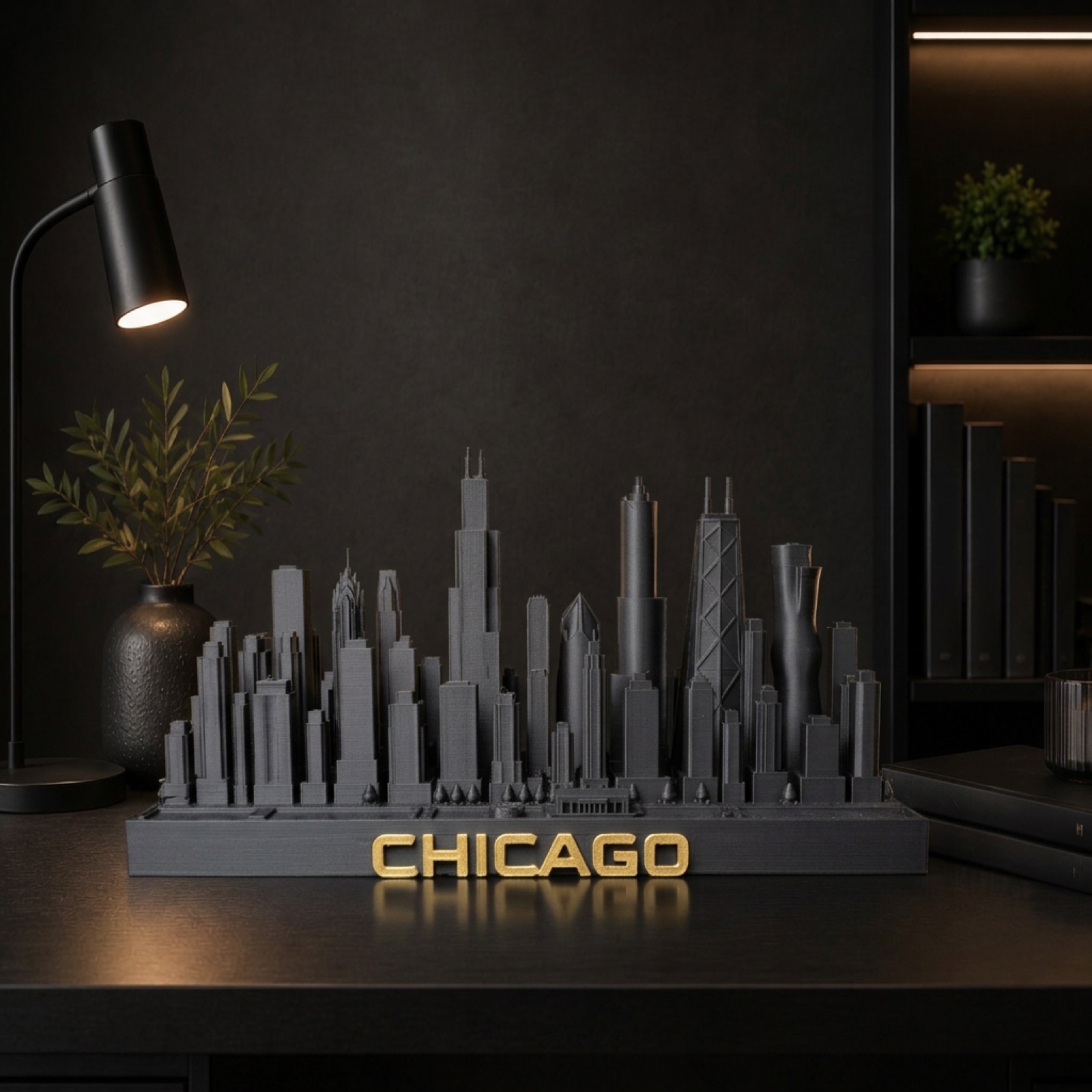
Ours are printed in matte black PLA with brushed-gold city lettering, built up in thin layers on a machine that runs for the better part of a day per piece — a Large skyline takes around 19 to 20 hours of print time. That process is what makes real architectural accuracy possible at this price. Because the model is built layer by layer from an actual 3D file, it can carry the genuine setbacks, tapers, and antenna spires that distinguish one building from its neighbor, instead of the single flat silhouette a mold or a laser cutter is stuck with.
Concretely, that means: on the Chicago piece, Willis Tower's bundled-tube massing and the Hancock Center's diagonal cross-bracing are both modeled as what they actually are, not smoothed into generic boxes — a Chicagoan can point to both without being told which is which. The same standard applies city by city. It's the difference between an object that says "a city" and one that says your city, and it's the reason a 3D-printed sculpture survives being looked at closely while a resin figurine doesn't.
Print time and material cost are also why this category doesn't get cheaper by cutting corners the way a mass-molded figurine can. There's no tooling to amortize across a million identical units — every piece is printed individually, which is slower and more expensive than injection molding, but it's also the only process that can hold real building-specific detail instead of a repeated stock shape.
What the Finishing Work Changes
A print straight off the printer is not a finished sculpture — it has support marks, a slightly textured surface from the layer lines, and a build plate underside that needs cleaning up. The gap between a $12 novelty print and a sculpture that photographs like a small monument is almost entirely in what happens after the printer stops: sanding the support contact points, cleaning the base, and finishing the matte-black surface so the layer lines read as texture rather than as a flaw.
This is also where brushed-gold lettering comes from — it isn't printed in gold, it's a second material laid down for the city name and hand-finished so the lettering has an actual metallic brush texture rather than a flat gold-colored plastic. That single detail is usually the fastest way to spot a cheaply made piece in a photo: flat, glossy gold lettering versus lettering with visible brush texture is the tell.
Size and Scale: What the Numbers Mean
A 3D printed skyline sculpture is built to an internally consistent scale — every building on one model is sized relative to every other building on that same model, so the skyline reads correctly as a skyline rather than as a jumble of random heights. It is not built to a literal 1:1000 city scale, because no shelf object could be at real-world architectural scale and still fit on a shelf. What matters is relative scale: the tallest building is tallest, the cluster pattern matches the real downtown, and the model you're looking at is recognizably that city's actual skyline silhouette rather than an evenly-spaced row of look-alike towers.
We make the sculpture in three sizes, and the size is a decor decision, not just a budget one:
- Small, 6 inches, $27.99–$34.99 — desk and shelf scale. A bookshelf gap, a work-from-home desk, a windowsill.
- Medium, 7.5 inches, $43.99–$54.99 — the everyday statement size. A mantel, a console table, the center of a floating shelf.
- Large, 9 inches, $59.99–$74.99 — anchors a room. A wide mantel, a living-room credenza, a reception desk. Ships free.
What You're Actually Paying For
At $29.99 to $74.99, a 3D printed city skyline sculpture sits well above a resin keychain and well below a commissioned architectural model, and the price difference tracks real differences in what's in your hand: individually printed rather than molded, modeled from that specific city's real buildings rather than a generic silhouette, and hand-finished rather than shipped straight off the print bed. None of that shows up fully in a product photo. It shows up when you pick the piece up, turn it, and the buildings you expected to see are actually there.
If your city isn't one we stock, the same process applies to a one-off custom build — we model the city from real map data, print it, and finish it to the same standard, starting at $229 for the added modeling work. Start a custom order if that's the route you need.
FAQ
What's the difference between a 3D printed skyline and a resin skyline figurine?
A resin figurine is cast from one mold and relabeled with different city names — the buildings aren't actually that city's buildings. A 3D printed skyline is modeled building-by-building from real architectural references and printed individually, so the specific towers, setbacks, and silhouettes of that city are genuinely represented, not just implied by a generic shape.
Are 3D printed city skyline sculptures accurate to scale?
They're built to internal relative scale — every building on a model is sized correctly relative to the others on that same skyline, so the silhouette and proportions match the real downtown. They aren't literal 1:1000 architectural scale, since no shelf object at true city scale would fit on a shelf; what matters is that the skyline reads as that city's actual skyline.
How long does it take to 3D print a city skyline sculpture?
A Large sculpture takes roughly 19 to 20 hours of print time, followed by hand-finishing — sanding, cleaning up the base, and finishing the brushed-gold lettering. That's before shipping, which typically adds a few more days.
What material are these sculptures printed in?
Matte black PLA for the body, with a second gold material laid down for the city-name lettering on the base, hand-finished for a brushed-metal texture rather than flat gold plastic.
Can you 3D print a skyline of a city that isn't in your catalog?
Yes. We build custom skylines for any city on Earth from real map data, modeled and hand-finished to the same standard as the stocked cities. Custom builds start at $229 — see the custom order page for pricing and turnaround.
Related reading
- Browse the 12 in-stock cities
- How a hand-printed city skyline is made — the full workshop process, hour by hour
- City skyline wall art: why a 3D sculpture outlasts a flat print
- Custom city skyline: any city on Earth
Ready to see one in person? Browse the cities collection — three sizes from $27.99, Free US shipping on the Large, or on any order of two or more.