Atlanta Skyline Buildings: A Guide to Every Tower You Recognize
Atlanta skyline buildings guide: the three districts of Downtown, Midtown, and Buckhead, Bank of America Plaza's gold-leaf crown, and Portman's cylinder hotel.
Atlanta Skyline Buildings: A Guide to Every Tower You Recognize
Atlanta has three skylines, not one. This is the first thing to understand about reading the Atlanta skyline buildings on our model, and it is the thing that distinguishes Atlanta from every other major American city in our catalog. Chicago has a Loop. New York has a Manhattan. Miami has a Brickell corridor. Atlanta has a Downtown, a Midtown, and a Buckhead, and they are not a continuous dense district interrupted by parking lots. They are three separate vertical centers, three separate concentrations of corporate headquarters and capital, connected by nine miles of Peachtree Street and a MARTA line, and the silhouette you see from any single vantage is a constellation rather than a wall.
This guide is for people who want to read the Atlanta skyline on the model we print and understand what they are looking at. Six to eight buildings, distributed across three districts, each one anchored to a corporate decision and a moment in the city's growth. The skyline you are looking at is not the residue of a single waterfront or a single financial district. It is the residue of an unusually decentralized city deciding to build vertically in three places at once.
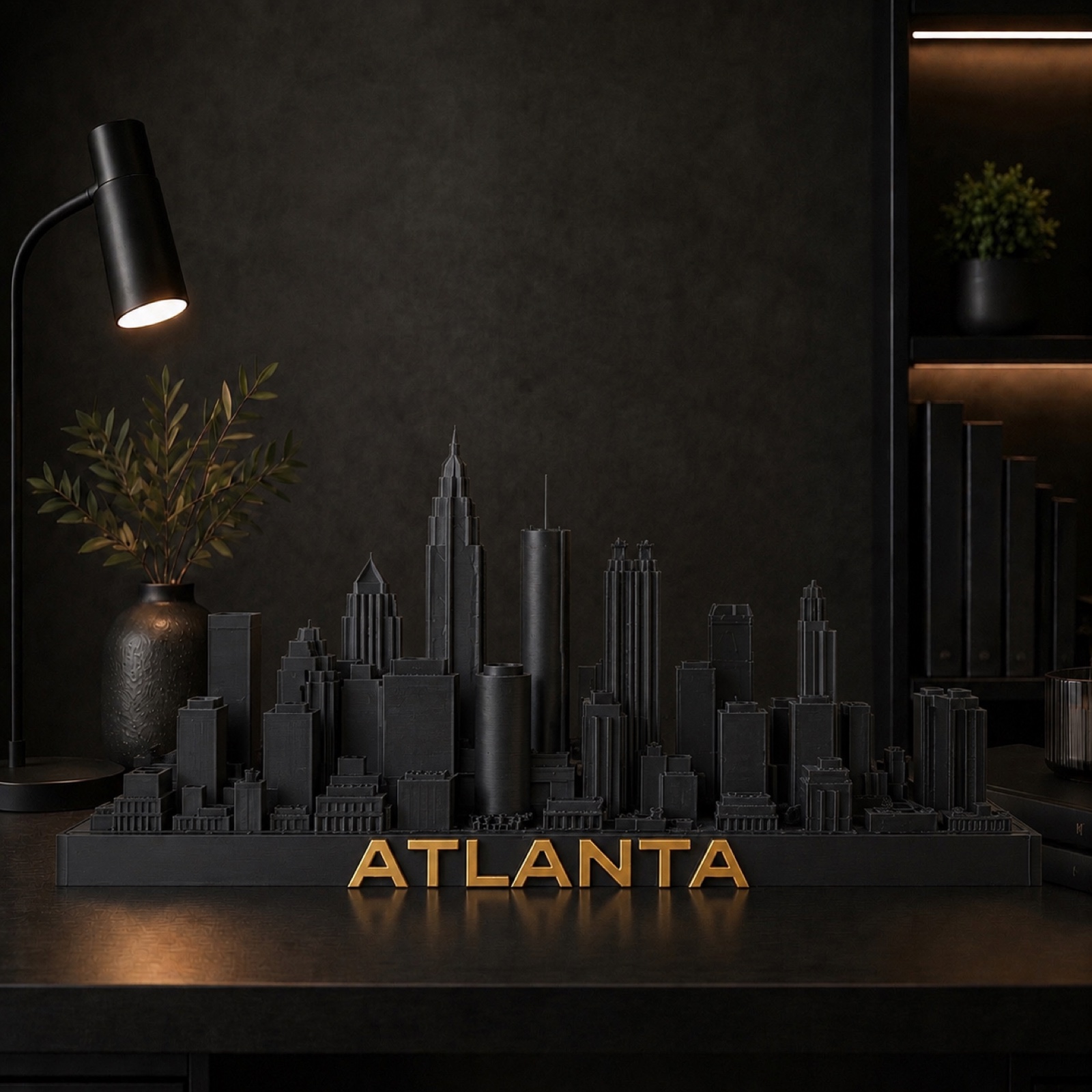
Our Atlanta model is roughly 9 inches across for the Large, 7.5 inches for the Medium, 6 inches for the Small. The buildings on it are the silhouettes that read across a room as Atlanta and nothing else. Here is what you are looking at, building by building.
Why Atlanta Has the Skyline It Has
A foundation, because nothing else in this guide makes sense without it.
Atlanta is younger as a built city than almost any other major American skyline. The city was founded in the 1830s as the terminus of the Western and Atlantic Railroad, an inland junction settlement named Marthasville and then Terminus before it took the name Atlanta in 1847. For its first three decades the city was a railroad town with wooden warehouses, brick commercial blocks, and the kind of low antebellum civic architecture that the rest of the South had been building since the early nineteenth century.
Then in 1864, General William Tecumseh Sherman burned it. The fire was deliberate, the destruction was thorough, and the antebellum Atlanta that might have produced a layered architectural history was erased. Almost no building in central Atlanta predates 1865. The cathedrals, the warehouses, the courthouses, the residences, the entire pre-war urban fabric was lost. What you see in Atlanta today, in every district, is post-Reconstruction Atlanta or later. The city has no Beaux-Arts foreground because the city had no nineteenth-century foreground to step out from.
This explains the first structural fact about the Atlanta skyline. There is no historic low-rise district anchoring the silhouette. There is no Custom House Tower, no Wrigley Building, no Freedom Tower, no pre-modern campanile that grounds the silhouette in nineteenth-century civic ambition. The Atlanta skyline starts in the 1960s and 1970s with the first significant high-rise wave, and almost everything you recognize was built after 1976.
Then add the second factor. Atlanta in the post-war period attracted the kind of corporate relocations that built the modern Sun Belt economy. The Coca-Cola Company had been headquartered in Atlanta since 1892. Delta Air Lines moved its headquarters to Atlanta in 1941. The CNN broadcast operation, founded by Ted Turner in 1980, anchored the downtown media district. Home Depot was founded in metro Atlanta in 1978. UPS relocated its headquarters from Greenwich, Connecticut to Atlanta in 1991. Each of these corporate decisions came with real estate consequences, and each district of Atlanta absorbed one or more of them.
The decentralization happened because the corporations did not coordinate. CNN and Coca-Cola anchored downtown because that is where the historic civic center was. The big midtown towers rose in the 1980s and 1990s when downtown was full and capital wanted new prestige addresses on Peachtree. Buckhead became the financial and high-end residential district because the wealthier neighborhoods of Atlanta were already concentrated north of the central city and the banks, brokerages, and law firms followed the residential capital northward. Three districts, three corporate centers, three skylines.
Then add the third factor. The 1996 Summer Olympics. Atlanta won the bid in 1990 and spent the following six years investing in infrastructure, hotels, office buildings, and residential towers in anticipation of the global audience. The Olympics accelerated a building cycle that had already started but that would not have produced the same density of completion in the same window without the deadline. Bank of America Plaza, the tower that anchors the Atlanta silhouette, opened in 1992, four years before the Olympics, on a development schedule that was paced to be the visual statement of the host city. The Olympic moment is in the skyline whether you can see it or not.
Then add a fourth factor, which is the dispersion of Atlanta's residential and cultural geography. Atlanta the city proper is about half a million people. Metro Atlanta is more than six million. The city sprawls across multiple counties, the residential neighborhoods are distributed across a vast horizontal area, and the corporate decisions about where to build were made under the assumption that employees would commute by car from any direction. The skyline therefore did not need to be concentrated for the convenience of pedestrians. It could afford to be polycentric because nobody was walking from one tower to the next anyway.
This is the thesis of the Atlanta skyline. It is the city of polycentric ambition. Every other major American skyline argues for a single center. Atlanta's skyline argues that a great city can have three.
The Towers on Our Model
These are the buildings we render, with each one located in its actual district. The Atlanta model frames the combined silhouette as if you were viewing it from a vantage that flattens the nine miles between Downtown and Buckhead into a single horizontal plane. This is a constructed view. No single physical vantage in Atlanta gives you all of these buildings at once at the angles we render. The skyline is a composite of three vantages. We render it as one because that is how Atlanta lives in the memory of the people who lived it.
Bank of America Plaza
Built 1992. Architect: Kevin Roche John Dinkeloo and Associates.
Bank of America Plaza at 600 Peachtree Street is 1,023 feet, 55 stories, and is the tallest building in Atlanta, the tallest building in Georgia, and the tallest building in the United States outside of New York and Chicago. The tower has held that title since the day it topped out in 1992. It is the visual anchor of the entire Atlanta silhouette, the building that is visible from every direction on the interstate, the building that announces the city to arriving travelers, and the building that locals point to when they explain what Atlanta looks like to someone who has not been.
The tower sits in Midtown, on the eastern edge of the district where Midtown meets the I-85 corridor. The choice of site was deliberate. The developer, John Portman, who is more central to the Atlanta skyline story than any other single architect, wanted the building to be the visual punctuation of the Peachtree Street axis, visible both from Downtown to the south and from Buckhead to the north. The siting works. The tower reads as the high point of the city from almost any vantage in the central area.
The architecture is Kevin Roche at his most assertive. The tower is a postmodern composition with a granite-clad shaft, vertical reveals that emphasize the building's height, and a stepped pyramidal crown that terminates in an open-frame spire. The crown is the part everyone notices. It is the part that distinguishes Bank of America Plaza from every other rectangular slab in the southeast.
The missed detail, the one almost nobody knows, is the gold leaf. The pyramidal crown and the spire at the top of the tower are clad in real gold. Not gold-toned paint. Not anodized aluminum that imitates gold. Actual gold leaf, applied in 23-karat sheets across the exterior of the crown structure, totaling approximately 700 ounces of gold across the original installation. The gold catches the light at dawn and dusk and lights the crown of the tower in a way no other Atlanta tower's crown can match. The decision to gild the crown was made during construction at the explicit direction of the developer, who wanted the building to terminate in a gesture that no other office tower in the South had attempted. The cost was, in 1992 dollars, a small fraction of the construction budget. The visual return on the investment was substantial.
The tenant base of the tower has rotated. The original anchor tenant was C&S/Sovran, the regional banking holding company that became NationsBank in 1992 and then Bank of America in 1998. The Bank of America branding on the tower dates to that 1998 merger. The tower has had ownership transitions through commercial real estate cycles, including a foreclosure auction in 2012 during the post-2008 office market collapse. The tower's prominence and tenant base have held through these transitions. It remains one of the most architecturally significant corporate headquarters towers built in the United States in the 1990s.
On our model, Bank of America Plaza is the tallest building in the silhouette, with the pyramidal crown and the spire reading clearly even at the Small size. It is the building that says Atlanta from across the room.
Truist Plaza (formerly SunTrust Plaza)
Built 1992. Architect: John Portman and Associates.
Truist Plaza at 303 Peachtree Street is 871 feet, 60 stories, and was the second-tallest building in Atlanta from its opening until very recently. The tower sits in Downtown, on the central Peachtree Street corridor, immediately adjacent to the original SunTrust banking complex it was built to anchor. The same year that Bank of America Plaza topped out in Midtown, this tower topped out in Downtown. 1992 was the year Atlanta got two of its three tallest buildings at once.
The architect was John Portman, the Atlanta architect and developer who shaped more of the central city than any other single practitioner. Portman trained as an architect, founded his own firm in Atlanta in 1953, and over the next four decades acted simultaneously as architect, developer, and master planner across major sections of Downtown. His firm designed and developed the Peachtree Center complex, the Westin Peachtree Plaza hotel, the AmericasMart trade center, and Truist Plaza, among others. Portman invented the modern atrium hotel as a typology, and his Atlanta projects are the laboratory in which that typology was tested. By the time he designed Truist Plaza, he was the senior architectural figure in the city.
The tower's signature element is the geometric crown. The building terminates in a series of cylindrical and angular forms that step inward as they rise, producing a silhouette that is unmistakable from any direction. The crown is not a single gesture but a composition of intersecting volumes, with a central cylinder rising above a square base and a series of supporting elements that frame the cylinder against the sky. The geometry is more abstract than the pyramidal classicism of Bank of America Plaza next door. Portman was working in a different idiom, drawing on his interest in geometric primitives and on the late-modernist composition language he had developed across decades of practice.
The tenant base has reflected the consolidation of Southern banking. The tower opened as the headquarters of SunTrust Banks. SunTrust merged with BB&T in 2019 to form Truist Financial, and the tower was rebranded as Truist Plaza in 2020. The name change is recent enough that many Atlantans still call it the SunTrust building. Both names are correct depending on which year you started visiting the city.
On our model, Truist Plaza is the tower with the layered geometric crown, set in the southern half of the silhouette adjacent to Bank of America Plaza. The crown reads clearly at Medium and Large sizes and compresses slightly at Small.
One Atlantic Center
Built 1987. Architect: Johnson/Burgee Architects, lead designer Philip Johnson.
One Atlantic Center at 1201 West Peachtree Street is 820 feet, 50 stories, and was the tallest building in Atlanta for five years between its 1987 completion and the 1992 opening of Bank of America Plaza. For half a decade it was the building that announced Midtown as a vertical district. The tower was developed by IBM as the anchor of a new corporate campus and was originally known as the IBM Tower. The IBM name held on the building into the early 2000s before the tenant base diversified and the building took its current geographic name.
The architect was Philip Johnson, working through Johnson/Burgee Architects during the period when he was producing his most influential postmodern corporate towers. The same firm, in the same decade, designed the AT&T Building in New York (now 550 Madison), PPG Place in Pittsburgh, and One International Place in Boston. One Atlantic Center is the southern entry in this sequence and is one of the most accomplished examples of Johnson's late corporate work.
The tower is clad in pink Spanish marble and granite, with a copper roof and a pyramidal crown that terminates in a spire. The marble cladding is the detail that distinguishes the building from every other tower in the Atlanta skyline. Most Atlanta office towers from the same era are clad in glass curtain walls or in conventional granite panels. One Atlantic Center is clad in stone with a warm pink-and-gray palette that catches the late-afternoon Southern sun in a way the other towers do not. The marble was quarried in Spain, fabricated in Italy, and shipped to Atlanta for installation. The decision was a developer-led choice to give the building a material identity that the other speculative office towers in Midtown did not have. The marble has held up well in the Atlanta climate, which is humid and storm-prone but does not produce the freeze-thaw cycling that destroyed the original cladding of the Aon Center in Chicago.
The crown of One Atlantic Center is a steep pyramidal roof that reads from a distance as a single architectural gesture rather than as a complex composition. The pyramid is one of the cleanest tower terminations in any American skyline. Johnson was, at this point in his career, working in his pyramid-and-spire vocabulary, and One Atlantic Center is the clearest expression of that vocabulary in his portfolio.
On our model, One Atlantic Center is the tower with the pyramid roof and the spire, set in the Midtown cluster near Bank of America Plaza. The pyramidal crown distinguishes it cleanly from the geometric crown of Truist Plaza and the open-frame spire of Bank of America Plaza.
191 Peachtree Tower
Built 1991. Architect: Johnson/Burgee Architects, lead designer Philip Johnson.
191 Peachtree Tower at 191 Peachtree Street is 770 feet, 50 stories, and is one of the most architecturally significant office towers in Downtown Atlanta. The tower was, like One Atlantic Center, designed by Philip Johnson through Johnson/Burgee Architects, completed four years after One Atlantic Center, and built in a different district to serve a different developer. The fact that Atlanta has two major Philip Johnson towers, in two different districts, completed within four years of each other, is itself a statement about how seriously the city took the architectural moment of the late 1980s and early 1990s.
The tower's signature element is the twin spires at the crown. Rather than terminating in a single pyramidal peak or a single cylinder, 191 Peachtree terminates in two parallel obelisk-form spires that flank a central setback. The composition reads, depending on the angle, as either a single tower with twin peaks or as two parallel towers joined at the base. The intent was deliberate. Johnson wanted the crown to break the monolithic verticality of the shaft and to give the tower a profile that could be read from any direction. The twin spires accomplish that.
The cladding is rose-colored granite with bronze-tinted glazing, in a palette that complements the pink marble of One Atlantic Center and that distinguishes the tower from the lighter glass-and-aluminum towers around it. The vertical reveals on the facade emphasize the height of the shaft and lead the eye toward the twin-spired crown. The detailing is more restrained than One Atlantic Center but the gesture is equally legible.
The tower has had tenant transitions over the decades. The original anchor was Mutual of America. The tower has since hosted a rotating mix of financial services, legal, and consulting tenants typical of a Downtown Atlanta office address. The building is currently owned by a private equity group and has undergone significant lobby and base renovations in the past five years to update the address for the post-pandemic office market.
On our model, 191 Peachtree Tower is the tower with the twin obelisk spires, set in the Downtown cluster adjacent to Truist Plaza. The twin spires read cleanly at Medium and Large sizes.
Westin Peachtree Plaza
Built 1976. Architect: John Portman and Associates.
The Westin Peachtree Plaza at 210 Peachtree Street is 723 feet, 73 stories, and is one of the most recognizable buildings in the American South. The tower is a continuous cylindrical shaft with a reflective glass exterior, terminating in a revolving restaurant at the top. The cylinder is unmistakable. Of every building in this guide, the Westin Peachtree is the one that is most likely to be identified by visitors who do not know the rest of the skyline. It is the Atlanta tower that lives in the public visual memory.
The architect was John Portman, the same Atlanta practitioner who designed Truist Plaza sixteen years later. The Westin Peachtree was the apex of Portman's invention of the modern atrium hotel. Portman had pioneered the atrium-centered hotel typology at the Hyatt Regency Atlanta in 1967, where he built the first major American hotel organized around a soaring multi-story interior atrium with glass elevators climbing the inside wall. The typology was a commercial and architectural success. Portman scaled it up across his career. The Westin Peachtree, opening in 1976, was the largest and tallest version of the atrium-hotel concept built at that point, and it was, for several years, the tallest hotel in the world.
The tower's structural form is a single cylinder. The cylinder is more difficult to engineer than a rectangular shaft because the lateral loads distribute differently and because the floor plates have to accommodate a curved exterior wall. Portman's structural engineers solved the problem with a concrete core ringed by a perimeter ring of columns, with the exterior glass wall hung from the floor plates. The construction was complex enough that the cylinder typology has not been widely repeated in American hotel construction since. The Westin Peachtree stands as one of the few major cylinder-form supertalls in the country.
The revolving restaurant at the top is named the Sun Dial. It completes a full rotation every 30 minutes and offers, on a clear day, views of all three Atlanta districts and beyond to Stone Mountain and the Atlanta suburbs. The restaurant has been continuously operating since the hotel opened in 1976 and is one of the few revolving restaurants in any American city that has remained commercially viable through the decades when the typology fell out of fashion.
Portman the architect is one of the underappreciated American figures of the late twentieth century. He invented the atrium hotel as a typology. He built more central-city American square footage than almost any other architect-developer of his generation. He proved that an architect could also be a developer and that the combined role could produce buildings that neither pure architects nor pure developers would have built alone. The Westin Peachtree is the clearest physical expression of what Portman could do when given an unconstrained brief and a strong site. The cylinder rises out of the Downtown street wall and reads from any direction as a single coherent gesture. No other Atlanta tower has its visual clarity.
On our model, the Westin Peachtree Plaza is the cylindrical tower in the central Downtown cluster. The cylinder reads at every size, including the Small, because the silhouette is so distinct from the rectangular and pyramidal forms of every other building in the model.
Promenade II
Built 1990. Architect: Thompson, Ventulett, Stainback and Associates.
Promenade II at 1230 Peachtree Street is 691 feet, 38 stories, and is one of the more visually distinctive towers in Midtown Atlanta. The tower's signature element is the stepped pyramidal crown clad in dark glass, which terminates in a small illuminated spire. The crown is geometrically simpler than the crowns of its neighbors but the dark-glass cladding gives it a different character. Where Bank of America Plaza glows in gold and One Atlantic Center catches pink in marble, Promenade II reads as a darker, more reflective gesture against the sky.
The architect, Thompson Ventulett Stainback, is the Atlanta firm that designed many of the corporate and commercial buildings of the late twentieth century in the South. The firm was founded in Atlanta in 1968 and has produced significant work across Georgia, Florida, and the broader Southeast. The firm's design vocabulary is corporate-modernist with postmodern accents, and Promenade II is a representative example. The tower is part of a two-building complex with Promenade I, which is a shorter office building immediately adjacent. The two buildings share a common podium and were developed as a single project, with Promenade II rising as the taller architectural statement.
The tower's exterior is a horizontally banded glass curtain wall with a slight setback at the upper third, leading into the pyramidal crown. The detailing is restrained and the composition is consistent from base to top, with no major mid-tower architectural gestures. The architectural interest is concentrated in the crown.
On our model, Promenade II is the tower with the dark glass pyramidal crown and the small illuminated spire, set in the Midtown cluster. The dark glass reads as a tonal contrast against the lighter cladding of One Atlantic Center and Bank of America Plaza.
The Polycentric Skyline Problem
A note that matters for reading this model correctly, and for understanding why the Atlanta silhouette is structurally different from the silhouettes in our other city models.
Most American skylines are unified silhouettes. You stand in one place, you look across one harbor or one river or one lake, and you see the whole skyline as a single visual object. The Chicago skyline reads from Lake Michigan. The Manhattan skyline reads from Brooklyn or from the Hudson. The Miami skyline reads from Biscayne Bay. The Boston skyline reads from across the Charles. Each of these cities has a canonical vantage from which the whole skyline composes itself as a single silhouette, and our models render that canonical view.
Atlanta does not have that vantage. There is no harbor. There is no major river inside the city. There is no shoreline. The closest natural feature that serves as a viewing platform is Stone Mountain, which is sixteen miles east of Downtown and which produces a long view that flattens the three districts into a single thin horizontal line. The closest in-city vantage that approximates a unified skyline view is the upper floors of one of the towers themselves, looking back across the city from the inside. The Sun Dial at the top of the Westin Peachtree, the observation level of Bank of America Plaza, the upper floors of any major Buckhead tower. From inside the skyline, you can see the rest of it. From outside the city, you cannot easily compose it as a single image.
The Atlanta skyline model therefore makes a constructed choice. We render the three districts as a composite silhouette, as if you could stand somewhere that does not actually exist and see Downtown, Midtown, and Buckhead arrayed across a single visual plane. The buildings are positioned roughly in their actual relative locations within the silhouette, with the Downtown towers in the southern half and the Midtown towers in the northern half, but the nine miles between districts are compressed to the inches of the model. This is not how the city actually appears from any single physical vantage. It is how the city lives in the visual memory of the people who lived it.
This is the right decision for a memorial gift. The Atlanta resident who left for another city, or the Atlanta executive at a milestone, or the alum of one of the historically Black colleges and universities in the city, remembers the skyline as a combined image. They remember Bank of America Plaza glowing in the late sun. They remember the Westin Peachtree cylinder. They remember the pyramid of One Atlantic Center. They remember these buildings together even though they never actually saw them all together in a single frame. The model commemorates the memory, not the physics.
If you live in Atlanta currently and you walk Peachtree Street between districts, you know that the skyline is not a single object. You know it is three vertical concentrations separated by gas stations, MARTA stations, and stretches of low commercial buildings. The model abstracts that. The abstraction is what makes the piece work as a gift.
Ponce City Market
A note on a building that is on our model but is not technically a skyline tower.
Ponce City Market at 675 Ponce de Leon Avenue is a former Sears, Roebuck and Company warehouse and regional headquarters building, built in 1926, that occupies a 2.1 million square foot complex on the eastern edge of Midtown. The building is not a tower. It is a horizontal industrial structure with a distinctive water tower and clock tower on its roof, reading more like a Victorian factory than like a modern office building. It is shorter than every tower on this model. Its silhouette is recognizably Atlanta in a way that has nothing to do with corporate vertical ambition.
We include Ponce City Market in our Atlanta model because the city's identity in the twenty-first century is not only the corporate skyline. The city's identity is also the adaptive reuse renaissance that took the historic Sears warehouse, converted it into a mixed-use complex with food halls, retail, offices, and residential lofts, and made it the center of a new kind of Atlanta urbanism. Ponce City Market opened to the public in 2014 after a development process that began in 2011. The conversion was led by the Atlanta-based development firm Jamestown, and the project is considered one of the most successful adaptive reuses of an industrial building in the United States.
The Ponce City Market silhouette on our model is the long horizontal industrial mass with the water tower and clock tower rising at its eastern end. The form is unmistakable to anyone who has spent time in the Old Fourth Ward neighborhood or who has walked the BeltLine, which passes immediately behind the building. Including this silhouette in the model is a deliberate choice. It signals that the Atlanta the model commemorates is not only the corporate Atlanta of Bank of America Plaza and Truist Plaza. It is also the adaptive-reuse Atlanta of Ponce City Market and the BeltLine. Both Atlantas are in the silhouette.
On our model, Ponce City Market is the horizontal building at the foreground of the silhouette, distinct from the vertical towers by its mass and its water-tower crown. It reads cleanly at Medium and Large sizes. At Small size the water tower compresses slightly but the horizontal mass remains legible.
Why Atlanta Sells as a Gift in Specific Niches
The Atlanta skyline outsells its population share in several specific gifting categories, and naming them clarifies why the model exists in the form it does.
The first category is the corporate executive class. Atlanta is the headquarters city for Coca-Cola, Delta Air Lines, Home Depot, UPS, Aflac, Truist Financial, Southern Company, and a dozen other Fortune 500 firms. The senior executives at these companies are an identifiable gifting population. The retirement of a Coca-Cola vice president, the milestone anniversary of a Delta captain, the corner-office promotion at Home Depot headquarters, the partner-track moment at one of the major Atlanta law firms. The Atlanta Large is the appropriate gift for these moments because the recipient's professional life is woven into the specific buildings on the silhouette. The Coca-Cola headquarters is visible from Bank of America Plaza. The corporate culture of Atlanta is denser per executive than in almost any other city in the catalog, and the gifting market reflects that density.
The second category is the HBCU alumni. Atlanta is the center of historically Black higher education in the United States. The Atlanta University Center consortium includes Morehouse College, Spelman College, Clark Atlanta University, and the Interdenominational Theological Center, with Morris Brown College in close proximity, and together these institutions have produced more African American doctorates, more African American physicians, more African American lawyers, and more African American executives than any other higher education cluster in the country. The HBCU alumni network is intensely loyal to Atlanta the city, not only to the schools attended, and the Atlanta skyline gift carries weight in this network that other city skylines cannot match. The alumni of Morehouse who has built a career in Houston or Los Angeles, the Spelman graduate now teaching at a New England college, the Clark Atlanta engineer working in Silicon Valley. For all of these recipients, the Atlanta skyline commemorates the years of formation and the city that shaped the trajectory.
The third category is the music industry. Atlanta is the gravitational center of American hip-hop and has been since the early 2000s. The producers, the artists, the labels, the studios, the writers, the engineers, the executives. From OutKast through TI through Ludacris through Future through Migos through 21 Savage through Lil Baby and Lil Yachty and Gunna and the rest of the constellation, Atlanta is the city the music came out of. The Atlanta skyline gift for the music industry professional, the Atlanta-based producer, the artist with deep roots in the city, the executive at one of the labels with Atlanta operations, is a specific kind of gift. It commemorates a creative geography that has shaped popular music globally and has done so from a city that, twenty years ago, was not centrally part of the American music industry. The gift acknowledges the shift.
The fourth category is the film industry. Atlanta has, since the early 2010s, become one of the largest film production centers in the United States. Tyler Perry Studios on the south side of the city, Marvel Studios production at Pinewood Atlanta in Fayetteville, and a substantial concentration of post-production and crew infrastructure across the metro area have made Atlanta the third-largest film production geography in the country after Los Angeles and New York. The film industry professional whose career has been built in Atlanta, the crew member who has worked on a decade of productions in the city, the producer whose office is in Buckhead, all represent a gifting population that did not exist twenty years ago and that exists now in identifiable numbers.
The Atlanta skyline is therefore a gift that reaches different recipient populations than the Chicago or Boston or Miami skylines reach. The corporate executive, the HBCU alum, the music industry professional, the film industry professional. Each of these categories has a different relationship to the city and a different reason to value the silhouette on a shelf.
Sizing for Atlanta Specifically
The Medium at $54.99 is the right answer for most Atlanta recipients. It reads as a real gift, it anchors a bookshelf, every tower reads cleanly including the gold-crowned Bank of America Plaza and the cylinder of the Westin Peachtree. For an HBCU alum a decade out, for a corporate manager at one of the major headquarters, for a music industry creative with Atlanta roots, the Medium is the size that signals the giver took the gesture seriously without being declarative about it. The Medium is the default answer when in doubt.
The Large at $74.99 is correct for the Buckhead resident at retirement, the Coca-Cola executive at a milestone, the senior partner at a major Atlanta law firm. The Large is the gift that matches the moment when the recipient's career has produced the home and the shelf that can host a statement piece. The Atlanta Large is particularly appropriate for corporate retirement gifts, where the institution has a tradition of recognizing senior executives with a substantial memorial object. Bank of America Plaza is a tower that an institution gives. So is Truist Plaza. Match the piece to the moment.
The Small at $34.99 is correct for the Atlanta-leaver. Someone who lived in Atlanta for a chapter and now lives elsewhere, who wants the piece on the desk in the new city as a reminder of the Atlanta years. The recent graduate of Emory or Georgia Tech who moved to Brooklyn for the design job. The Spelman alum who took the consulting job in Chicago. The film industry crew member who relocated to Los Angeles after a decade on Atlanta sets. The Small at six inches fits the office bookshelf or the desk corner without taking over the space. The gold crown of Bank of America Plaza, the cylinder of the Westin Peachtree, the pyramid of One Atlantic Center, all read cleanly at Small size.
For corporate gifting in Atlanta, the Medium is the default and the Large is the upgrade for senior recipients. Atlanta corporate gifting volume is concentrated in the major headquarters, where institutional traditions support substantial memorial gifts for retirement, anniversary, and milestone recognition. The Large reads as the firm having taken the gesture seriously. The Medium reads as appropriate to a broader range of professional milestones.
If you are unsure, default to the Medium. The Medium is the size that does not require the giver to know exactly which Atlanta the recipient inhabits. Whether the recipient's Atlanta is the corporate Atlanta, the HBCU Atlanta, the music industry Atlanta, the film industry Atlanta, or some combination, the Medium accommodates all of them.
What Will Be Standing in 50 Years
The honest closing question, the same one we ask about every city in this series.
Certain to endure: Bank of America Plaza (architecturally distinguished, civically prominent, the tallest in the state, will be landmarked when the relevant period of significance permits), the Westin Peachtree Plaza (the John Portman cylinder, one of the most architecturally significant hotels of the twentieth century, civically beloved, structurally robust), One Atlantic Center (the Philip Johnson marble pyramid, architecturally significant, materially well-constructed). These three towers will be standing in 2076.
Likely to endure: Truist Plaza, 191 Peachtree Tower, Promenade II. The major office towers of the 1987 to 1992 Atlanta building boom are well-built, well-tenanted, and well-positioned in their respective districts. Atlanta does not demolish major office towers casually. The land economics do not favor replacement of a functioning supertall, particularly given the relative low cost of suburban office construction as an alternative. These towers will be standing.
Likely to endure with adaptive reuse complications: Ponce City Market, which is already an adaptive reuse, will face the next round of repositioning at some point in the next thirty years as the food hall and retail concept matures and the market for that kind of mixed-use evolves. The building itself, structurally, will be standing. What functions inside it may change.
What gets added: Centennial Yards is the major Downtown development under construction on the former Gulch site immediately south of Mercedes-Benz Stadium and CNN Center. The master plan, approved in 2018, calls for multiple residential and office towers totaling several million square feet, with the first phase towers topping out between 2025 and 2027. The Centennial Yards skyline will gradually emerge over the next decade and will likely add two to four significant new towers to the Downtown silhouette. The Midtown district has also continued to densify, with the 1180 Peachtree tower and several neighbors adding to the Midtown cluster, and additional Midtown supertall proposals in advanced planning. The Buckhead district has its own ongoing development cycle, with new residential towers and office buildings continuing to add to the northern silhouette.
The Atlanta skyline in 2076 will likely have all the buildings on this model still standing, with somewhere between five and ten new significant towers added across the three districts. The polycentric structure will not change. The three skylines will become four if a fourth district densifies enough, or they will remain three and grow taller. Either trajectory is plausible. The model commemorates the silhouette as it is today, in 2026, in the era when Atlanta's polycentric ambition became visible at scale.
How to See It Right
When your Atlanta skyline arrives, take it out of the corrugated mailer and place it on a dark surface. A walnut bookshelf, a slate console, a black mantel. The matte black of the model wants context that absorbs light. White surfaces wash the silhouette.
Step back to six to eight feet. That is the distance from which the model reads correctly. Closer than that you see the build texture. Farther than that the gold crown of Bank of America Plaza and the cylinder of the Westin Peachtree begin to compress against their neighbors.
Aim a single warm light at the base from one side, not above. The brushed gold lettering on the base catches the light and glows. The silhouette sits above in slight shadow, which is closer to how the actual Atlanta skyline reads from the interstate at dusk on a clear summer evening than to how it reads in a daytime photograph. The Atlanta skyline at dusk in July, when the Bank of America Plaza crown catches the last of the sun and the Westin Peachtree cylinder reflects the city back at itself, is one of the more atmospheric views in the South. The model wants to evoke that view.
The piece is not a photograph. It is sculptural. The buildings are themselves but smoothed, the way a city sits in your memory after you have lived in it for years. The way the three Atlanta districts compress in memory into a single combined image is closer to the model than the way they appear from any single physical vantage in the actual city. That compression is intentional. It is the gift.
FAQ
What are the tallest buildings in the Atlanta skyline?
Bank of America Plaza leads at 1,023 feet including its gold latticework spire, and has been the tallest building in the Southeast since 1992. Truist Plaza follows at 871 feet, then One Atlantic Center at 820 feet with its pink granite and copper pyramid roof, and the Westin Peachtree Plaza at 723 feet — the glass cylinder that is the most recognisable shape in the Downtown cluster.
Why does Atlanta have two separate skylines?
Because the city grew along Peachtree Street rather than outward from a single centre. Downtown developed around the rail terminus and the state capitol; Midtown grew a mile and a half north as a separate business district, and a third cluster formed further north again at Buckhead. The stretch between them was never built to the same height, so from most angles Atlanta reads as two or three distinct groups rather than one skyline.
What is the gold building in the Atlanta skyline?
That is Bank of America Plaza, and specifically its spire — an open latticework pyramid finished in gold leaf and lit at night. It is visible from most of the metro and from long stretches of I-75 and I-85, which is why it functions as the city's orientation point. Locals often just call it the gold building.
Which Atlanta building has the glass cylinder shape?
The Westin Peachtree Plaza, designed by John Portman and completed in 1976. It is a 723-foot glass cylinder, and in a skyline otherwise made of rectangles it is the second-strongest identifier after the gold spire. Portman shaped more of Downtown Atlanta than any other architect, and the hotel is his signature building here.
Is the Atlanta skyline changing?
Yes, mostly in Midtown. Atlanta has added residential and mixed-use towers steadily over the past decade while Downtown has stayed comparatively static, which has shifted the balance between the two clusters. The gold spire remains the tallest and is unlikely to be surpassed soon — no proposal currently on the table reaches 1,023 feet.
Order Yours
The Atlanta skyline is in active production. Three sizes, hand-printed in the USA in matte black with brushed gold lettering, ships in 3 to 5 business days within the continental United States.
If a different city is the right one, the full collection has eleven other US cities, each with its own architectural story. We have written up the Chicago skyline and the Miami skyline at the same depth. If you are still deciding whether the skyline gift is the right gesture for the recipient, read our guide to skyline gifting.
The right city, in the right size, on the right shelf, lasts longer than the moment that prompted the order. Atlanta, given to the right executive at the right milestone, or the right HBCU alum at the right anniversary, or the right Atlanta-leaver in the right new city, is one of the more particular gifts in the catalog. It commemorates a city with three skylines, a polycentric ambition, and a corporate, cultural, and creative density that no other American city of its size matches. The Atlanta skyline buildings on this model are the buildings that built that city.