Miami Skyline Buildings: How Brickell Outgrew Downtown
Miami's towers are startlingly recent — most of its vertical weight went up in the last 25 years. A guide to the Brickell cluster and what sits across the bay.
Miami Skyline Buildings: How Brickell Outgrew Downtown
Architects do not agree about the Miami skyline. They agree about Chicago. They agree, with caveats, about New York. They have made peace with Los Angeles. Miami is the one they argue over at dinner. Too much glass. Too many condos. Too much foreign capital chasing too few lots. A skyline that was built in twenty years, almost entirely for people who do not live in it, on a barrier coastline that the engineers themselves are uncertain about. Pei Cobb Freed designed a tower in 1982 called One Bayfront Plaza that would have been the tallest in the South. It was never built. That is the kind of skyline this is. The buildings that got built were not the buildings the discipline wanted.
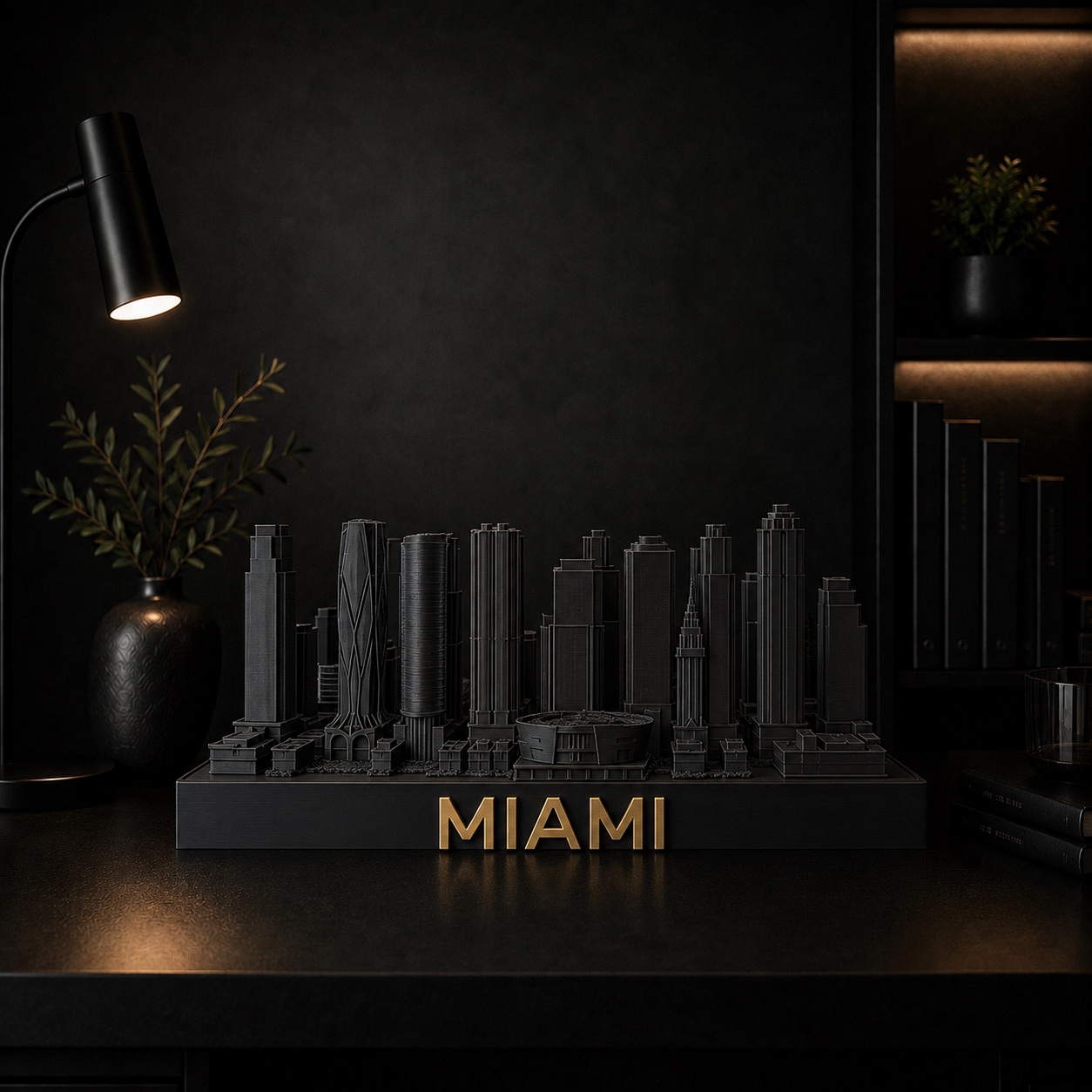
This guide is for people who want to read the Miami skyline buildings on the Miami skyline model and understand what they are looking at. Six to eight towers, all built since 2000, almost all of them residential, almost all of them on a single mile of Brickell Avenue and the south end of Downtown. There is no slow accretion of decades here. There is no Beaux-Arts foreground stepping into a modernist mid-ground. There is one generation of speculation compressed into a single coastal frame, and that frame is the youngest of any major American city.
Our Miami model is roughly 9 inches across for the Large, 7.5 inches for the Medium, 6 inches for the Small. The buildings on it are the silhouettes that read from across a room as Miami and nothing else.
Here is what you are looking at, building by building.
Why Miami's towers all stand on the water
A foundation, because it explains the rest of this guide.
Miami had almost no skyline until the 1980s. The city was founded as a railroad terminus in 1896. For most of the twentieth century it was a low-rise winter resort, a coastal town of stucco hotels, Art Deco apartment buildings, and the occasional bank tower. The Freedom Tower, built in 1925, was the city's first significant high-rise at 17 stories, and for decades after it remained one of the tallest. Miami did not need supertall buildings because Miami was not a place where capital was kept. It was a place where capital came on vacation.
This began to change in the 1980s, slowly, with the cocaine economy of the early decade financing the first wave of Brickell Avenue banking towers, and then in the 1990s with Latin American capital flight pushing a new generation of condominium developers into the market. The real shift was the regulatory shift. In the early 1990s, Miami liberalized its real estate development rules. Zoning was loosened. Height limits were raised. Foreign-buyer financing structures, particularly the use of LLC purchases that obscure ultimate ownership, became routine. The city decided, in effect, to compete with New York and London for international real estate capital. And it largely won that competition.
Then add a second factor. After the 2008 financial crisis, when American buyers retreated and American credit froze, Miami real estate became the receiving market for a global wave of cash buyers from Latin America, Russia, the Middle East, and parts of Asia. The condo became a currency. The 80 story tower on Brickell was not a place to live. It was a place to park money in a city where the deed could be held in an LLC, the tax exposure was minimal, and the asset was liquid. Most of the towers built between 2010 and 2020 were not built for residents. They were built for owners. The distinction matters and the skyline shows it.
Then add a third factor. Chicago's skyline says industrial wealth. Steel, meat, railroad, insurance. The towers were built by people who made things and the towers were named after them. New York's skyline says financial wealth. Banks, brokerages, insurance, media. Walter Chrysler used his own money so his children could inherit a building. Miami's skyline says something different. Miami's skyline says international capital found a beach. The towers are not named after the men who made the money. They are named after fashion houses, hotel brands, and watchmakers. The Aston Martin Residences. The Porsche Design Tower. The Armani Residences. The Missoni Baia. The Waldorf Astoria. This is the first American skyline whose nomenclature is a luxury catalog rather than a roster of industrialists.
This is the thesis. Miami is the first American city whose skyline was built for the global rich rather than for industry, finance, or domestic ambition. Every other major American skyline is older than this idea. Miami's is the idea.
Add a fourth factor, because honesty requires it. The skyline sits on a barrier coastline that is one of the most exposed in the United States to sea-level rise. Most of Brickell is between 3 and 10 feet above mean sea level. The projected rise over the next 50 years, depending on the model, is between 1 and 4 feet. The towers will be standing. Whether the streets that serve them will be is a separate question. We will return to this honestly at the end of the post.
Brickell, Downtown, and the barrier island
These are the buildings we render, roughly in the order they appear when you read the silhouette from south to north across Brickell into Downtown.
Panorama Tower
Built 2018. Architect: Moshe Cosicher of CFE Architects in collaboration with the Florida East Coast Realty in-house team.
Panorama Tower is 868 feet, an 85 story mixed-use supertall on Brickell Avenue, and currently the tallest building in Miami and in the state of Florida. The tower is residential on its upper floors, a Hyatt Centric hotel on its middle floors, office and retail at the base. It opened in 2018 after a roughly four year construction process that was delayed twice by hurricane interruptions and once by foundation engineering revisions, when the original pile design proved insufficient for the limestone substrate at the base of Brickell.
The tower's silhouette is a single tapered glass shaft with a soft curvature at the top. There is no spire, no setback, no signature architectural gesture beyond the height itself. Panorama is the building that won because it was tallest. The developer, Tibor Hollo of Florida East Coast Realty, was 88 years old when the tower topped out. He had been buying Brickell land since the 1950s and this was the project he had been holding the land for. The story locals tell about Panorama is that it is one developer's career-long bet on a piece of dirt, and that the bet paid off only because he lived long enough to build it.
The unsung detail is the residential floor plate. Panorama has 821 rental units, which is unusual for a Brickell supertall. Most of the towers in this guide are condominiums sold to individual owners, often through LLC structures. Panorama is rental. It is the largest rental tower in the South. The decision was deliberate. Hollo did not want the building to be a place where money parked and the lights stayed off. He wanted the building lived in. Almost alone among the Brickell supertalls, Panorama has its lights on at night.
On our model, Panorama is the tallest building, set toward the southern half of the silhouette. The clean tapered profile reads cleanly at every size.
Four Seasons Hotel and Tower
Built 2003. Architect: Handel Architects, lead designer Gary Handel.
The Four Seasons Hotel and Tower at 1435 Brickell is 789 feet, 70 stories, and was the tallest building in Florida from 2003 until 2017, when the building that became Panorama topped out beside it. For 14 years, the Four Seasons was the answer to "what is the tallest building in the state." It is the tower that announced Brickell as a vertical address.
The building is mixed-use in a configuration that the Wilshire Grand in Los Angeles would later adopt at greater scale. The lower 22 floors are a Four Seasons hotel. The middle floors are office. The upper 35 floors are condominium residences. The vertical zoning is part of what allowed the tower to be approved and financed in 2000 and 2001, before Brickell had proven it could absorb a single-use supertall. Splitting the program meant the tower could open with three revenue streams, any one of which could carry the building through a soft cycle in the others. This is now the standard Miami supertall configuration. The Four Seasons established it.
The architectural language is conservative. A simple glass curtain wall, a slight setback at the upper third, a flat top. Gary Handel was not trying to make a statement here. He was trying to deliver a building that would let the hotel program operate at world class standards while the residential floors held value. The lobby and the public spaces are where the design budget went, not the silhouette. This is a tower built by people who understood that the address mattered more than the photograph.
The Four Seasons sold its tallest-in-Florida title to Panorama in 2017, which sold it briefly to other supertalls in negotiation, which holds it now. The title rotates in Miami in a way it has not rotated anywhere else in the country since the 1930s race between the Chrysler Building and the Empire State.
On our model, the Four Seasons is the second tallest building, immediately north of Panorama, with the slight upper setback that distinguishes it from the surrounding rectangular slabs.
Wells Fargo Center
Built 2010. Architect: Kohn Pedersen Fox.
Wells Fargo Center, formerly known as 333 Avenue of the Americas during planning, is 764 feet, 47 stories of office space, and currently the third tallest building in Downtown Miami. It is one of the few buildings in this guide that is not primarily residential. It is also one of the few that came out of the New York office tower tradition rather than the Brickell condominium tradition.
Kohn Pedersen Fox designed the building during the period when the firm was producing some of the most polished office towers in the world: 30 Hudson Yards, the Lotte World Tower in Seoul, the Heron Tower in London. The Wells Fargo Center is a Miami iteration of that vocabulary. A single glass shaft with a faceted crown that catches the South Florida light at certain angles in a way no other Downtown tower does. The crown is the part that reads. Without it, the tower would be one more rectangle. With it, the tower is the building that anchors the visual transition between Brickell and Downtown proper.
The tower was built speculatively, opening in 2010 in the depth of the post-2008 office market collapse. For two years it sat largely empty. By 2014 it was leasing. By 2019 it was nearly full. The Wells Fargo lease, signed in 2011, was the anchor that allowed the building to survive the years it could not fill its other floors. The tower is now considered one of the most successful speculative office buildings of the post-crisis period in any American city, a reputation it earned by surviving the years when no one believed it would.
On our model, Wells Fargo Center is the tower with the faceted crown, set north of the Four Seasons, marking the visual transition from Brickell to Downtown.
900 Biscayne Bay
Built 2008. Architect: Sieger Suarez Architectural Partnership.
900 Biscayne Bay is 650 feet, 63 stories, a residential tower at the northeastern edge of Downtown Miami immediately across from the Adrienne Arsht Center for the Performing Arts. It opened in late 2008, weeks after the Lehman Brothers collapse, into a market that had essentially ceased to function. For most of 2009 and 2010, the building's developer was in active litigation with original purchasers who were trying to escape pre-construction contracts at pre-crash prices. Multiple units sat empty for years.
The tower survived. The lawsuits were settled, the inventory was reissued at lower prices, and by 2013 the building was substantially occupied. It is now considered one of the more successful Downtown residential towers of its generation, partly because of the location near the cultural campus, partly because the units are larger than the Brickell supertall norm, and partly because the architecture is restrained. There is no signature crown. There are no balconies that distinguish the tower from its neighbors. The building does its job and does not announce itself.
The Sieger Suarez firm is one of the most prolific residential architecture practices in South Florida. They have designed dozens of towers across Brickell, Downtown, and Sunny Isles. Their work is conservative by design. The firm understands that South Florida condominium architecture is real estate first and architecture second, and they have built a practice on delivering buildings that lease and resell well. 900 Biscayne Bay is one of their better commissions.
On our model, 900 Biscayne Bay is the rectangular tower at the northern edge of the silhouette, anchoring the Downtown side of the frame.
Marquis Miami
Built 2009. Architect: Arquitectonica.
The Marquis Miami at 1100 Biscayne Boulevard is 679 feet, 67 stories, a hotel-and-residential mixed-use building that opened in 2009, the same year as 900 Biscayne and into the same broken market. The tower is the work of Arquitectonica, the Miami-based firm founded by Bernardo Fort-Brescia and Laurinda Spear that more or less invented what is now recognized as the Miami architectural style.
Arquitectonica is the firm that drew the post-modern color blocks and cutouts of the Atlantis Condominium on Brickell, the building with the palm-tree-in-a-hole that appeared in the opening credits of Miami Vice. They drew the American Airlines Arena, now called the Kaseya Center. They drew the Westin Diplomat in Hollywood, the Cipriani Residences, the Bronx Museum of the Arts, the Microsoft European headquarters in Paris. They are the most internationally influential architecture firm to come out of Miami. The Marquis is one of their later, more restrained Miami towers.
The building's signature is a single architectural cutout near the top, a recessed band of mechanical floors expressed as a void rather than concealed behind a screen. The detail is small. It reads at our scale only on the Large. But it is the kind of decision Arquitectonica is known for, the move that takes a conventional residential tower and gives it a single architectural moment that distinguishes it from the rectangular neighbors.
The Marquis Hotel program at the base of the building struggled through several brand changes and is now operated as a JW Marriott. The residential floors stabilized faster than the hotel and have been substantially occupied since 2014.
On our model, the Marquis is the tower with the upper-band cutout, set north of the Wells Fargo Center.
Aston Martin Residences
Built 2024. Architect: Revuelta Architecture International with Bodas Miani Anger.
The Aston Martin Residences at 300 Biscayne Boulevard Way is 818 feet, 66 stories, and is the most recent significant addition to the Downtown Miami skyline. The tower topped out in 2022 and the first residents moved in during 2024. The building's silhouette is a sail-shaped curved tower that tapers from a wider base to a narrow top, a profile designed to reference the sail of a yacht on Biscayne Bay immediately to the east.
The Aston Martin brand licensing on this tower is the purest example of the Miami condominium-as-luxury-product phenomenon. The actual Aston Martin company designed nothing structural. Their licensing covers the interior finishes, the lobby, the residents' lounge, the gym, the spa, and the brand integration throughout the building's marketing. The penthouse, when sold in 2021 for 59.5 million dollars, came with a custom Aston Martin Vulcan supercar. The buyer was anonymous, the LLC was offshore, the press release named no individuals. This is the modern Miami transaction.
The architecture itself, leaving the branding aside, is the most distinctive new addition to the Miami skyline in the past decade. The sail shape required a structural engineering solution that is not standard. The building's curve is achieved through a slip-formed concrete core surrounded by floor plates that vary in width at every floor, with the widest floors near the middle and the narrowest at top and bottom. The result is a tower that reads as a single coherent gesture rather than as a stack of standard floor plates. Most of the other supertalls on Brickell are stacked rectangles. The Aston Martin is one of the few that is genuinely sculpted.
On our model, the Aston Martin Residences is the curved sail-shaped tower in the central portion of the silhouette. The taper reads even at the Small size.
One Thousand Museum
Built 2019. Architect: Zaha Hadid Architects.
One Thousand Museum at 1000 Biscayne Boulevard is 707 feet, 62 stories, and is the only major Zaha Hadid tower in the Western Hemisphere. The building completed construction in 2019, three years after Hadid's death in 2016. It is one of the last residential buildings she personally designed before her death, and the only one of her late residential commissions to be built in the United States.
The exterior of One Thousand Museum is the part everyone notices and almost no one understands correctly. The white curving forms that wrap the tower are not a screen. They are not a sun shade. They are not decorative. They are the structure. The exoskeleton is a glass-fiber-reinforced concrete frame that does the work of carrying the building's gravity and lateral loads from the outside. There are no interior columns on the residential floors. The exoskeleton is why. This is structurally unusual at this height and was technically difficult to fabricate. The molds for the exoskeleton panels were CNC milled from drawings produced by Hadid's office and shipped to a Dubai manufacturer that specializes in complex precast forms.
The exoskeleton design has a functional purpose beyond aesthetics. By moving the structure to the exterior, Hadid was able to give every unit an unobstructed full floor plate with no interior columns or shear walls. The penthouses, which sold for between 14 and 49 million dollars, have wraparound views with no structural interruption at all. This is the kind of move only Hadid would have made, and it is the kind of move that almost no developer would have allowed had Hadid not been one of the few architects in the world whose name could carry the marketing.
The building is the architecture-school favorite of the Miami skyline. Every other tower in this guide is an architecture-of-real-estate decision. One Thousand Museum is one of the rare Miami towers where the architecture preceded the deal.
On our model, One Thousand Museum is the tower with the visible exoskeleton silhouette, set in the central cluster. The curving exterior reads at every size.
Freedom Tower
Built 1925. Architects: Schultze and Weaver.
The Freedom Tower at 600 Biscayne Boulevard is 289 feet, 17 stories, and is the oldest building on our model. It is the historic shorter foreground that anchors the silhouette in actual Miami history rather than only in the post-2000 development boom. The tower was originally built as the headquarters of the Miami News and Metropolis newspaper. The architecture is Mediterranean Revival, modeled on the Giralda bell tower of the Cathedral of Seville, with a terra cotta and limestone facade and an ornate copper-roofed cupola at the crown.
The building's name comes from its second life. From 1962 to 1974, the tower served as the Cuban Assistance Center where over 400,000 Cuban refugees fleeing the Castro government were processed into the United States. The federal government leased the building from its private owners and used it as the intake center for the Cuban Refugee Program. For two generations of Cuban Americans in Miami, the Freedom Tower is the building where their family first arrived. The civic significance for the Cuban American community is comparable to the significance of Ellis Island for earlier waves of European immigrants. The building is sometimes called the Ellis Island of the South for exactly that reason.
The Freedom Tower has been a National Historic Landmark since 2008. It is owned by Miami Dade College and houses an art museum and cultural exhibition space. Of every building on our model, this is the one that means something to the city beyond its real estate value. The supertalls of Brickell are towers. The Freedom Tower is a monument.
On our model, the Freedom Tower is the shorter ornate building in the foreground at the base of the silhouette, immediately recognizable by its bell tower crown.
The Brickell and Downtown Distinction
A note that matters for reading this model correctly.
Most of the towers in this guide are on Brickell Avenue, not in Downtown Miami proper. Brickell is the financial district that runs south of the Miami River. Downtown is the older commercial district that runs north of the river toward the bay. Geographically they are about half a mile apart and the Miami River is the dividing line. Functionally they are different districts. Brickell is younger, denser, more residential, more international. Downtown is older, more institutional, more municipal, more diverse.
Our model frames the silhouette as a single combined view because that is how the skyline reads from Biscayne Bay, the most common photographic and visual vantage. From the water, Brickell and Downtown read as a single dense vertical cluster, with the Miami River disappearing between them. From the street, they are entirely separate neighborhoods. If you grew up in Miami or live in Miami, you know the distinction. If you do not, the model presents the city the way visitors see it.
This is a deliberate framing decision. We chose the bay view because it is the canonical Miami silhouette. The view from Brickell Avenue itself, looking north into Downtown, is a different piece. The view from the MacArthur Causeway looking south is another. The view from Key Biscayne is another. The bay view is the one that reads as Miami to the broadest audience.
What Our Model Does Not Include
A skyline model has to make choices. Miami has built so many supertalls in the past 15 years that rendering all of them at 9 inches would produce illegible visual noise. A few worth naming.
The Porsche Design Tower (2017, the residential tower in Sunny Isles with the car elevators that lift residents' vehicles to their condominium garages). It is in Sunny Isles, twelve miles north of Downtown. The car elevators are real and they work. The building is one of the more architecturally honest expressions of the Miami condominium-as-product phenomenon. It is outside our geographic frame.
The Setai, the Faena, the Edition Miami Beach, the Fontainebleau. These are Miami Beach buildings, across Biscayne Bay from the mainland skyline. Miami Beach is its own urban form. The Art Deco district, the South Beach hotels, the Faena cluster on Mid-Beach. None of these are on the mainland silhouette. They are a different model entirely. We may make it.
The Brickell City Centre towers (2016, the mixed-use cluster including the Reach, the Rise, and the SLS hotel). They are visible from the bay but they cluster densely at the base and do not produce distinctive supertall silhouettes. Including them would crowd the foreground without adding readable shapes.
The Waldorf Astoria Hotel and Residences (currently under construction, expected to top out around 1,049 feet, projected to become the tallest building in Miami when completed in late 2027 or 2028). The Waldorf is the next chapter of this skyline. It will appear on a future revision of our model when it is structurally complete. For now, it is scaffolding.
1428 Brickell, the Citadel, the Mercedes-Benz Places tower (all in advanced planning or early construction). Same logic. We model what is standing, not what is renderered.
The PortMiami cranes (the gantry cranes at the cruise port that are sometimes visible in Miami skyline photographs). They are industrial infrastructure, not architecture. We are a tower studio.
These are choices we made deliberately. The result is a model that reads as Miami from across a room. Adding everything proposed or under construction would have made it read as a city we have not finished building.
The Sea Level Question
The honest paragraph, because no honest writeup of the Miami skyline can omit it.
Miami is the only major American skyline with an explicit projected lifespan question. The towers themselves are engineered for storm surge, hurricane wind loads, and seismic considerations that exceed most other coastal building codes. The structures will be standing in 2075. The structures will be standing in 2125 if they are maintained. The question is not the towers. The question is the streets and the infrastructure and the urban fabric that serves them.
Brickell Avenue at street level is between 4 and 6 feet above mean sea level. The conservative projection for sea-level rise by 2075 is between 1.5 and 2.5 feet. The aggressive projection is between 3 and 4 feet. The city has been investing significantly in sea walls, pump systems, and elevated street infrastructure. The supertall foundations themselves are pile-driven into bedrock and are not at structural risk from rising water. But the question of whether the ground floor retail, the parking garages, the utility infrastructure, and the transportation networks will remain functional under high-tide flooding is a live engineering and policy question that Miami planners are working on now.
We are not saying the skyline is doomed. We are saying the Miami skyline is the first in the country with a planning horizon shorter than its construction lifespan, and that the conversation about how to extend that horizon is an active one. The towers will be there. What changes is the relationship between the tower and the ground.
This is part of why a Miami skyline gift carries a slightly different weight than a Chicago or a New York gift. The piece commemorates a city whose silhouette may look different in 50 years not because the buildings will have been replaced, but because the city itself is in the middle of redesigning its relationship to the water. The model freezes a moment. That moment may matter more than usual.
Miami is younger than its skyline suggests
The thing that surprises people about the Miami towers is their age. Most of the vertical mass on this model went up after 2000, and a large share of it after 2010. Brickell in particular was low-rise residential within living memory and is now one of the densest high-rise districts in the United States.
That recency shows in the silhouette. Older American skylines are layered — a 1930s setback tower next to a 1970s slab next to something glass from last year. Miami's cluster is unusually even in height and uniform in period, because nearly all of it was built in one go under one set of codes and one architectural fashion.
So the model reads smoother than Chicago's or New York's, with fewer steps and spires. That evenness is the accurate portrait, not a simplification.