Boston Skyline Buildings: Two Towers Over a Low City
Boston's skyline is two tall buildings and almost nothing else. Why the Hancock and the Prudential stand alone, and what the empty space between them means.
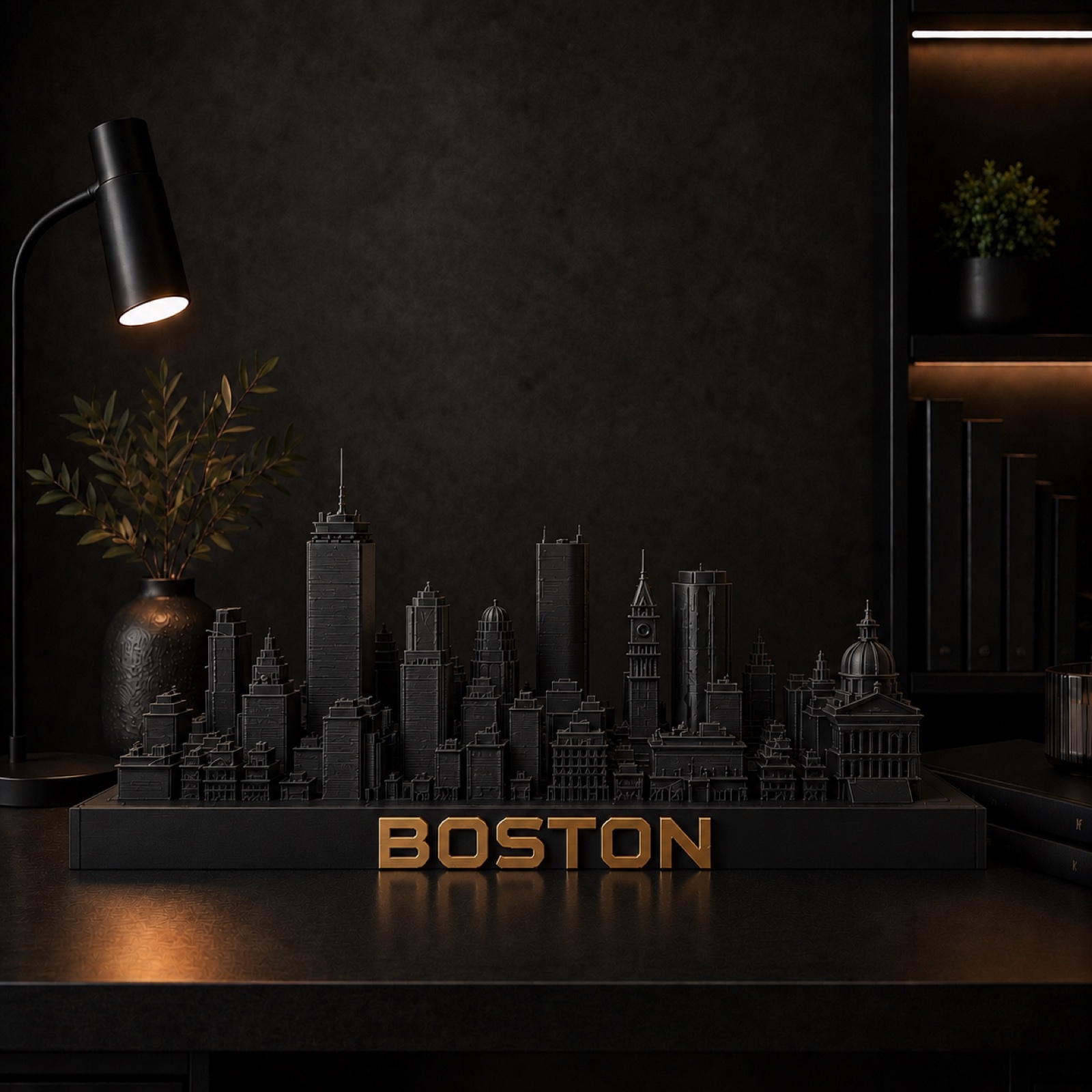
Boston Skyline Buildings: Two Towers Over a Low City
Every American city has a skyline that is the residue of its own ambition. Boston's skyline is the residue of its restraint. The buildings you see on the silhouette of the Back Bay and the Financial District are not the buildings that developers wanted to build. They are the buildings that the city, the state, the FAA, the neighborhood associations, the shadow ordinances, the Logan Airport glide-path overlays, and a hundred and ninety years of historic preservation litigation allowed to be built. The Boston skyline is the most constrained skyline in the United States. Every tower on it is a negotiation, not an ambition.
This guide is for people who want to read the Boston skyline on the model we print and understand what they are looking at. Seven buildings, give or take, all of them the survivors of an unusually adversarial planning process, several of them the subject of architectural lawsuits that became case studies in graduate schools. The skyline you see across the Charles is the skyline that survived its own approval process.
Our Boston model is roughly 9 inches across for the Large, 7.5 inches for the Medium, 6 inches for the Small. The buildings we render are the silhouettes that read across a room as Boston and nothing else. Here is what you are looking at.
Why the Back Bay got the towers
A foundation, because nothing else in this guide makes sense without it.
Boston was the largest city in the British colonies of North America. The street grid you walk today in the North End, Beacon Hill, and the Financial District is older than the United States. The city built the first subway in America in 1897. The city built one of the first public parks in America when the Common was set aside as a cattle commons in 1634. By the time other American cities were thinking about going vertical, Boston was already a city, already proud of its low brick and granite skyline, and already organized into neighborhood political blocs that did not want to see that skyline change.
The result was a long stretch of the twentieth century when Boston enforced a 125-foot height limit on commercial construction in the central downtown. The limit was not absolute. There were narrow exemptions, conditional grants, special zoning overlays. But the rule was real, it held, and it produced a Boston in which the Custom House Tower built in 1915 was the only building over 500 feet for almost fifty years. The city's silhouette in 1950 was flatter than the silhouette of Hartford or Providence. This was deliberate.
The 125-foot limit broke in the 1960s when the Prudential Insurance Company built its tower in the Back Bay and then again in 1976 when the John Hancock Insurance Company built theirs immediately next door. Both projects required state legislative action, special zoning overlays, and protracted negotiations with residents of Beacon Hill, the Back Bay, and the Old North Church congregation. Boston did not lift its height limit. Boston permitted a small number of exceptions, building by building, after a public fight each time. That is still essentially how it works.
Then add the Logan Airport problem. Logan International sits in East Boston, less than two miles from the Financial District across the Inner Harbor. The FAA glide paths for Logan's runways constrain how tall any building in the downtown core can be. Every supertall proposal in Boston since 1965 has had to clear the FAA before it could clear the city. The vertical envelope is not architectural. It is aviation. The skyline you see is the skyline that does not interfere with an Airbus on final approach.
Then add the shadow ordinances. Boston has explicit municipal shadow laws that protect the Common, the Public Garden, and Copley Square from being darkened by new construction during specific morning and afternoon hours on specific calendar dates. Any building tall enough to cast a shadow on these protected spaces must demonstrate, in modeled simulation, that the shadow stays within tolerated limits. This is not metaphor. This is ordinance. Developers retain shadow consultants the way they retain structural engineers. A tower that pencils financially can be denied because it would put the Frog Pond in shade at 9:15 on a Wednesday in April.
Then add the 1.5 to 1 parcel-width rule that has constrained Boston tower massing since the 1980s, intended to keep buildings from rising as thin shafts that pinch the street wall. Then add the neighborhood opposition from Beacon Hill, the Back Bay, and the North End, all of which have organized residents associations with active legal counsel and a long memory. Then add the Old North Church congregation, which has historically objected to any new construction visible from its steeple. Then add the Massachusetts Bay Transportation Authority right-of-way constraints, the harbor easements, the airport rail tunnel below the Financial District.
Boston's skyline is what you get when you stack all of that on top of a parcel and ask an architect to make something rentable. The towers that survived this process are not the towers a free-market regime would have produced. They are the towers Boston permitted. The skyline reads as a deliberate, considered, fought-over collection of approvals, and that is exactly what it is.
The two that matter, and the spine beneath them
These are the buildings we render. The Boston silhouette is shorter than the silhouettes of New York, Chicago, or Miami. It also reads more clearly. Fewer towers, more space between them, each one with its own argument.
Prudential Tower
Built 1964. Architect: Charles Luckman.
The Prudential Tower at 800 Boylston Street is 749 feet, 52 stories, and was the first building in Boston to exceed the city's longstanding 125-foot height limit by an order of magnitude. The project required a special state legislative grant, the Prudential Center Act of 1960, which created a special development zone over the air rights of the former Boston and Albany Railroad yards in the Back Bay. The state authorized the project. The city accepted the state's authorization. Beacon Hill objected. The Back Bay objected. The project went forward anyway.
The Prudential is the tower that broke the taboo. Before 1964, Boston's silhouette was flat. After 1964, the Back Bay had a tower visible from forty miles away. The architectural community at the time was divided on whether the project was a triumph or a transgression. The building's design is a straightforward Charles Luckman exterior, a cross-shaped floor plate with limestone and glass cladding, a flat top, a public observation deck on the 50th floor. Luckman was a corporate architect, not a visionary. The Prudential was not asking to be a masterwork. It was asking to exist.
The tower has had two significant interventions in its history. The first was the addition of the Prudential Center retail complex at its base in the 1980s, which transformed the building from an isolated tower into the anchor of a mixed-use urban district. The second was the addition of an antenna and broadcast equipment to the roof, which extends the tower's effective height to 907 feet and makes it the visual high point of the Back Bay from most viewing angles.
The Prudential is the building that made every other tower in this guide possible. Without the 1960 legislative carve-out, the Boston skyline would still be flat. Locals call it the Pru.
On our model, the Prudential is the tallest building in the western half of the silhouette, with the broadcasting antenna at the crown.
John Hancock Tower / 200 Clarendon
Built 1976. Architect: I.M. Pei & Partners, lead designer Henry N. Cobb.
The John Hancock Tower, now formally known as 200 Clarendon Street, is 790 feet, 60 stories, and is the tallest building in Boston and in New England. The tower is a rhomboidal glass shaft that reflects the Back Bay sky on its mirrored facade and effectively disappears into the weather. The design intent was for the tower to refuse to compete with Trinity Church directly across Copley Square, by becoming a sky-mirroring volume rather than a stone-faced presence. The intent worked. The Hancock is one of the most successful tall buildings in the country at the question of how to coexist with a historic civic landmark.
That is the architectural reading. The construction reading is one of the most notorious building scandals in American history.
The Hancock's original facade was clad in 10,344 panels of mirrored blue glass, each panel 4 feet by 11 feet, double-glazed with a sealed gap between the inner and outer panes. The panels were manufactured by the Libbey-Owens-Ford glass company according to specifications developed for this specific building. The first panels were installed in 1972. Within months, panels began to fail. The outer pane would crack at the perimeter where it met the sealant, the seal would fail, and entire 500-pound panels of glass would fall from the tower into the streets below. By the end of 1973, the building had lost over a hundred panels. Copley Square was cordoned off. Plywood was installed in the empty window openings, giving the tower its infamous appearance of a half-completed building with plywood teeth. The lawsuits commenced. Libbey-Owens-Ford sued the architect. The architect sued the glass company. The Hancock Insurance Company sued both. The Massachusetts Institute of Technology was retained to study the failure mode. The investigation took years.
The eventual finding was that the failure was a function of the sealed double-pane construction itself. The thermal expansion of the outer pane, combined with the constraint of the metal frame at the perimeter, created stress concentrations at the seal that exceeded the glass's tensile strength under specific wind and temperature conditions. The failure mode was not predicted by the glass company's testing because nothing this large had been built this way before. Every panel of the building was replaced between 1973 and 1976 with single-pane tempered glass that weighed substantially more than the original blue glass. The replacement glass is what you see on the tower today. The original blue glass is gone, except for a few panels preserved by collectors and architecture archives.
The reputation damage to I.M. Pei and Henry Cobb was severe. Pei was, at the time, one of the most celebrated American architects of his generation. The Hancock scandal nearly ended his firm. For years, Pei's office had difficulty winning commissions. The firm survived because the work that was already in progress, including the East Building of the National Gallery in Washington, opened to strong critical reception. Pei's reputation was rehabilitated. Henry Cobb, the lead designer on the Hancock specifically, carried the scandal less easily. Cobb went on to design other significant buildings but the Hancock was the project that defined his career, and not in the way he had hoped.
The tower also developed a separate structural problem during its early years. Engineers discovered that the building exhibited a tendency to twist under specific wind loads, a phenomenon that caused noticeable discomfort on the upper floors. The fix was a tuned mass damper installed in the upper structure, a 600-ton steel and concrete block on a hydraulic mount that counter-oscillates against the building's natural twisting frequency. The damper was one of the first installations of the technology in any American building. It is still in operation.
The Hancock is the building that nearly ended a Pritzker Laureate's career, that revolutionized facade engineering, that introduced tuned mass damping to American skyscrapers, and that produced the most-litigated piece of architecture of the 1970s. Locals call it the Hancock or 200 Clarendon. Both are correct.
On our model, the Hancock is the tower with the slim rhomboidal silhouette, set just east of the Prudential, with the unmistakable angled footprint that distinguishes it from every other tower in Boston.
One Federal Street
Built 1976. Architect: The Architects Collaborative.
One Federal Street is 572 feet, 38 stories, and was one of the first towers in the Financial District to follow the height precedent set by the Prudential. The Architects Collaborative was the Cambridge firm founded by Walter Gropius, the former Bauhaus director who had spent the second half of his career at Harvard. By the time One Federal Street was designed, Gropius was dead and the firm was led by his former colleagues, but the Bauhaus modernist sensibility is visible in the tower's clean lines, rectangular massing, and absence of decoration.
The building is a stepped granite-clad shaft with a single setback at the upper third. The cladding is a warm pinkish granite quarried in New Hampshire, a deliberate regional sourcing decision that distinguishes the tower from the white limestone and dark glass of its neighbors. The Architects Collaborative was attentive to materials in a way that most corporate offices of the period were not, and One Federal Street is one of the more carefully detailed downtown towers of its generation.
The tenant base has rotated several times since opening. The original anchor tenant was the First National Bank of Boston, which merged into Fleet Financial in 1995, which was absorbed by Bank of America in 2004. The building is currently owned by a private equity ownership group and leases to a mix of financial services, law, and consulting tenants. The Boston Financial District does not produce iconic buildings the way the Back Bay does, partly because the parcels are smaller and the planning constraints are tighter, but One Federal Street is one of the better products of the district.
On our model, One Federal Street is the stepped granite tower in the eastern half of the silhouette, with the warm tonal contrast to the glass and limestone of its neighbors.
One International Place
Built 1987. Architect: Johnson/Burgee Architects, lead designer Philip Johnson.
One International Place at 100 Oliver Street is 600 feet, 46 stories, and is one of the most distinctive corporate towers in the Financial District. The building is a postmodern composition by Philip Johnson, designed during the period when Johnson had moved away from the strict modernism of his early career and was producing buildings that incorporated historicist details, classical references, and decorative elements that the modernist generation had rejected. One International Place is Johnson in his Palladian phase.
The tower's signature element is the series of large arched window openings that frame the building's facade in vertical bands, recalling the proportions of Renaissance palazzo architecture rather than the steel-frame modernism that preceded it. The cladding is light gray granite with bronze-tinted glazing. The crown is a four-sided pyramid roof that distinguishes the tower's profile from a distance. The whole composition is heavier and more decorative than what would have been built in the same parcel ten years earlier, and lighter and more restrained than what Johnson was producing in New York at the AT&T Building or in Pittsburgh at PPG Place.
The tower is connected to its slightly shorter sibling, Two International Place, by a common base. The two towers were planned together and developed by the same firm, Chiofaro Company, on a Financial District parcel that had been assembled over years of patient land acquisition. The Chiofaro Company has been one of the more active commercial developers in Boston since the 1980s and One International Place is their best-known project.
Philip Johnson's relationship to Boston was complicated. He was a Cambridge product, a Harvard graduate, and a longtime member of the New England professional architectural establishment. He was also openly contemptuous of Boston's planning culture and made his views public on multiple occasions. One International Place is the building of a man who understood Boston, did not entirely like Boston, and chose to design something for Boston that would last.
On our model, One International Place is the tower with the arched window bays and the pyramidal crown, set in the eastern cluster of the Financial District silhouette.
Custom House Tower
Built 1915 (tower addition to 1849 base). Architects: Peabody and Stearns (tower addition).
The Custom House Tower at 3 McKinley Square is the building this entire skyline is anchored on, even though it is shorter than every other tower in this guide. The Custom House is Boston's first skyscraper. It predates the Empire State Building by sixteen years. For almost fifty years after its completion in 1915, it was the only building in Boston taller than 500 feet. It was, for half a century, the entire vertical skyline of the city.
The history is unusual. The Custom House had originally been built in 1849 as a granite Greek Revival temple-form federal building at the foot of State Street, with a low dome and a colonnaded portico. The structure served as the customs collection office for the Port of Boston throughout the second half of the nineteenth century, when Boston was one of the major commercial harbors of the East Coast. By the early twentieth century, the customs function had outgrown the original building, and the federal government commissioned the firm Peabody and Stearns to add a tower to the existing structure to provide additional office space.
The tower addition was completed in 1915 at 496 feet, making the combined building 30 stories tall. Because the building was federally owned, it was exempt from the Boston municipal height limit. This was the loophole. The city's 125-foot ceiling did not apply to federal property. The Custom House Tower could be built at any height the federal government chose because the federal government was not subject to the municipal ordinance. For fifty years, this was the only tower in Boston taller than seven or eight stories, and it was the only one because it was the only one that was allowed.
The architecture is a peculiar marriage. The 1849 granite Greek Revival base remained intact at the bottom of the building. On top of that base, Peabody and Stearns set a tall narrow tower with a distinctive Italian campanile profile, terminating in a steeply pitched square cap with a clock face on each of the four sides. The clock has been one of the most photographed features of the Boston skyline since the day it was installed. The campanile profile is unmistakable from any vantage in the harbor.
The Custom House was decommissioned as a federal building in 1986. The federal government sold it. It was converted to a Marriott Vacation Club timeshare hotel in the 1990s and has operated as a hotel ever since. The dome of the original 1849 building is preserved as an interior feature in the hotel lobby. The clock still keeps time. The building is a National Historic Landmark.
On our model, the Custom House Tower is the shorter, more ornate building in the foreground of the silhouette, with the unmistakable campanile profile and the four-sided clock crown. It is the historic anchor of the skyline.
100 Federal Street
Built 1971. Architect: F. A. Stahl + Associates.
100 Federal Street is 591 feet, 37 stories, and is one of the more architecturally distinctive office towers in the Financial District. The building is best recognized by an unusual structural gesture at its base. Rather than terminating at the sidewalk in the conventional way, the tower's facade flares outward at the lower floors, expanding the floor plate at street level to wrap around a column-supported atrium. The flared base is structural, not decorative. The building's load is transferred from the rectangular shaft above to a wider base through diagonal trusses that are concealed behind the cladding but expressed visually in the geometry of the lower floors.
The original tenant was the First National Bank of Boston, which used the flared base for its banking floor. The bank wanted a large open trading floor at the bottom of the tower and the structural solution was to design the building to widen rather than to extend horizontally into a separate base structure. The result is one of the more memorable architectural moves in the Financial District. The tower silhouette from a distance reads as a slim shaft with a flared foot, distinguishing it from its rectangular neighbors.
The building has undergone significant interior renovation over the decades but the exterior gesture remains essentially as built. The cladding is a warm-toned aluminum panel system with bronze-tinted glazing, similar in palette to the neighboring towers from the same period. The tower is currently owned by a private equity group and leases to a mix of financial services tenants, the typical Financial District composition.
On our model, 100 Federal Street is the tower with the flared lower facade in the central Financial District cluster, distinguished from its neighbors by the widening at the base.
State Street Bank Building (One Lincoln Street)
Built 2003. Architect: Skidmore, Owings & Merrill.
The State Street Bank Building at One Lincoln Street is 503 feet, 36 stories, and is one of the more recent significant additions to the Financial District. The building was developed as a build-to-suit headquarters for State Street Corporation, the asset management and custodial banking firm that is one of the largest financial institutions headquartered in Boston. SOM was retained for the design.
The building is a clean rectangular glass shaft with a stepped crown and a horizontal banding pattern on the facade. The architectural language is restrained, befitting the conservative institutional culture of the building's tenant. SOM produced a tower that reads as a trustworthy corporate headquarters rather than as a signature architectural statement. State Street did not want a building that drew attention to itself. They wanted a building that looked like a bank custodian for institutional money.
The building is also notable for being one of the earliest major office towers in Boston to pursue LEED certification, achieving Gold status under the 2003 standard. The sustainability features included high-efficiency glazing, a green roof system on the lower setbacks, and HVAC zoning that allowed individual floor environmental control. By 2003 standards this was advanced practice. By 2026 standards it is unremarkable. The building was an early entrant in what is now standard institutional construction.
State Street has since reduced its occupancy in the building as the firm has shifted toward distributed work, and parts of the tower lease to other financial services tenants. The building is the youngest major tower on the Boston silhouette, marking the entry point of the post-2000 era into a skyline that is otherwise predominantly a product of the 1965-to-1990 period.
On our model, One Lincoln Street is the rectangular tower with the stepped crown in the southern Financial District cluster.
A skyline that is mostly sky
Most city models are a problem of crowding. Boston is the opposite. The 200 Clarendon tower and the Prudential rise out of the Back Bay with very little around them, and everything else on the model sits low and long. The result is a silhouette with more empty air in it than built form.
That is not an omission, it is Boston. The city filled the Back Bay in the nineteenth century and built it low and dense in brick, and the two towers that later went up there had no neighbours to compete with. Boston never grew a cluster the way Chicago or Houston did.
It changes where the piece looks right. A crowded skyline survives being pushed into a corner. Boston needs the horizontal run to stay unbroken, because the long low stretch either side of the towers is the part that says Boston rather than anywhere else. Give it a shelf it can span.