Nashville Skyline Buildings: A Guide to Every Tower You Recognize
Nashville skyline buildings guide: the Batman Building origin, the Pinnacle's concrete spire, and why Nashville's silhouette is one of the youngest in America.
Nashville Skyline Buildings: A Guide to Every Tower You Recognize
The Nashville skyline is barely thirty years old, and most of it is younger than the people who first arrived to build it. If you walk out onto the John Seigenthaler Pedestrian Bridge on a clear evening and look west across the Cumberland, you are looking at a vertical city that did not exist in 1990. The AT&T Building, the silhouette everyone recognizes, broke ground in 1992. Almost everything taller than ten stories visible from that bridge was built after the AT&T Building topped out. The Nashville skyline is younger than the Miami skyline by only a decade, and the comparison matters. These are the two American skylines that were built for outsiders. Every other major silhouette in the country was a record of industry that the residents already had. Nashville's silhouette is a record of who arrived.
This guide is for people who want to read the Nashville skyline on the model we print and understand what they are looking at. Six to eight towers, almost all of them less than thirty years old, anchored by a single historic mid-century skyscraper that the rest of the silhouette gradually rose to meet. The Nashville skyline buildings on our model are the silhouettes that read across a room as Nashville and nothing else.
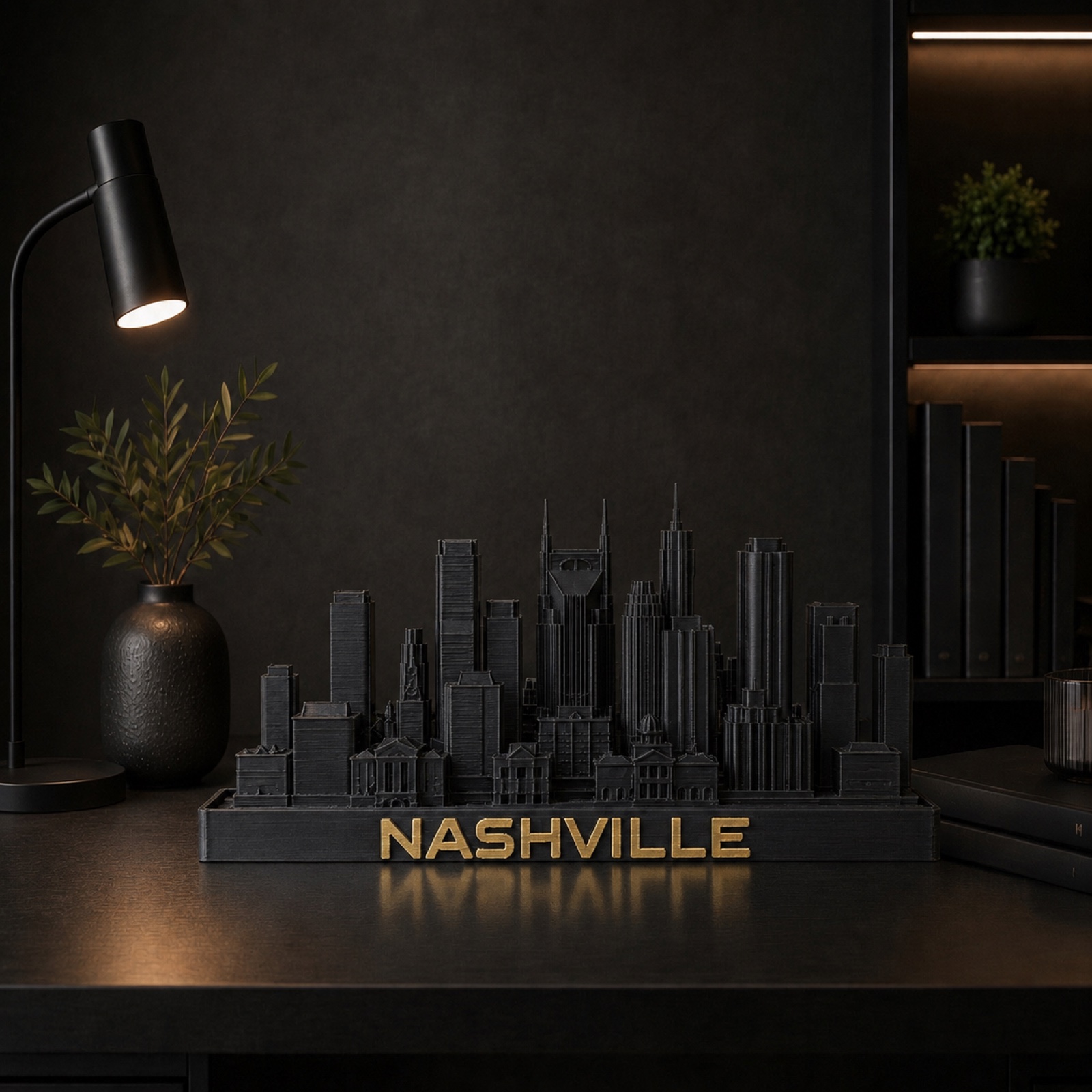
Our Nashville model is roughly 9 inches across for the Large, 7.5 inches for the Medium, 6 inches for the Small. Hand-printed in the USA in matte black with brushed gold lettering. Here is what you are looking at, building by building.
Why Nashville Has the Skyline It Has
A foundation, because nothing else in this guide makes sense without it.
For most of the twentieth century, Nashville was a mid-sized Southern state capital with a low brick downtown, a state-government employment base, the Grand Ole Opry as a regional cultural draw, and a population that grew steadily but unspectacularly. The city's tallest building from 1957 until 1994 was the Life and Casualty Tower at 409 feet. That building, a sleek International Style shaft in the Financial District, was the entire vertical Nashville skyline for almost forty years. Below it, the city was a horizontal place. Bank towers in the eight-to-fifteen-story range. The State Capitol on its hill at the north end of downtown. The Ryman Auditorium two blocks east of the Capitol, three stories, the room where country music had its first national broadcast home.
This held until 1992, when BellSouth, the regional telecommunications operator that emerged from the AT&T breakup, broke ground on a new headquarters tower at 333 Commerce Street. The tower was 617 feet, twin spires at the crown, finished in 1994. It was almost two hundred feet taller than anything Nashville had ever built. It changed the entire visual identity of the city in the span of a single construction cycle. Locals named it the Batman Building immediately on completion in 1994, before the broader culture had even fully absorbed the post-Tim-Burton Batman aesthetic. The nickname was a Nashville invention, not a borrowed one. It stuck because it was obvious. The twin spires read as the cowl of Batman's mask from almost any angle in the city.
The AT&T Building broke the city's height inertia. After 1994, every developer in Nashville understood that a building taller than 500 feet could be approved, financed, and absorbed. The market had been reset. But the next major addition did not arrive for fifteen years, because Nashville was not yet generating the kind of capital that supports speculative supertall construction. The 2000s built the healthcare base. HCA Healthcare, headquartered in Nashville since 1968, grew through that decade into the largest for-profit hospital operator in the country. Vanderbilt University Medical Center expanded its campus into a regional medical economy. The healthcare cluster did not produce signature skyline towers directly, but it produced the high-income professional base that the next wave of residential development would serve.
Then came the 2010s, and three things compounded at once. The first was the cultural designation, when a January 2013 New York Times Magazine cover essay anointed Nashville as the moment's preferred American city. The phrase the magazine used was not a Nashville invention, but it landed. Tourism numbers tripled within five years. The bachelorette party economy on Lower Broadway, the dual phenomenon of expanded country music tourism and the rise of Nashville as a non-traditional bachelorette destination, became a measurable component of the city's economy. The second was the migration of corporate headquarters from higher-tax states. Bridgestone Americas relocated its corporate headquarters from Nashville's suburbs into a new 506-foot downtown tower that opened in 2017, becoming one of the most visible signals that Fortune 500 capital was now willing to anchor itself in downtown Nashville. The third was the arrival of Amazon, which announced in 2018 that its Operations Center of Excellence, the company's largest east-of-Seattle corporate location after the failed HQ2 search, would occupy two new towers in the Nashville Yards development at the western edge of downtown.
By 2020, the vertical Nashville was a different city than the vertical Nashville of 2010. The Pinnacle at Symphony Place had opened in 2010 and become the tallest building in the city, narrowly exceeding the AT&T Building. The 505 Nashville residential tower opened in 2018 at the southern edge of the SoBro district. Multiple residential and mixed-use supertalls were in advanced planning. By 2026, the skyline visible from the Pedestrian Bridge is a record of three compounding factors: the 1994 BellSouth bet that opened the vertical envelope, the 2013 cultural designation that opened the capital flows, and the 2018 Amazon arrival that opened the corporate relocation pipeline.
The honest reading is that the Nashville skyline is the first American skyline built primarily for tourists and transplants, not for residents. The buildings are not named after the industrialists who made the city, because the city was not built by industrialists in the modern era. The towers are named for telecommunications mergers, healthcare operators, tire manufacturers headquartered elsewhere, and Swiss banks. The residential towers serve a buyer base that is dominated by recent arrivals from higher-cost states. The cultural infrastructure at the base of the skyline serves a tourist base from out of state. This is a different kind of skyline than Chicago's industrial silhouette or Boston's institutional restraint. This is a skyline whose purpose is to be seen by people who have arrived recently or have not yet arrived. The thesis is uncomfortable but it is accurate.
The Towers on Our Model
These are the buildings we render, in roughly the order they appear when you read the silhouette from north to south across downtown.
AT&T Building (the Batman Building)
Built 1994. Architect: Earl Swensson Associates.
The AT&T Building at 333 Commerce Street is 617 feet, 33 stories, and is the silhouette that anchors the entire Nashville skyline. The tower was developed as the regional headquarters for BellSouth, the Atlanta-based telecommunications company that had emerged from the 1984 AT&T breakup as one of the seven Regional Bell Operating Companies. The building was renamed for AT&T after BellSouth was reabsorbed into AT&T in 2006. The locals still call it the Batman Building.
The nickname is older than people think. The building topped out in late 1994. The twin spires at the crown, two slim antenna-bearing pinnacles flanking the main mass, read as the cowl of Batman's mask from the moment the cladding was installed. Local newspaper columnists and radio personalities started calling it the Batman Building in 1994, immediately on completion. This is two years before Tim Burton's run on the Batman film franchise ended and a decade before Christopher Nolan's Batman Begins reset the visual culture of the character. The Nashville nickname predates the Batman aesthetic the rest of the country thinks of. It is one of the rare cases of a popular building nickname that was coined the moment the cladding was finished and never displaced by an alternative.
The architecture is a competent regional commercial composition by Earl Swensson Associates, a Nashville-based firm that had built much of the city's previous generation of mid-rise commercial work. Swensson had the local credentials and BellSouth wanted a Nashville architect for what was, at the time, the largest construction project the city had ever produced. The tower is a stepped pinkish granite shaft with the twin spires at the crown, a banded fenestration pattern on the office floors, and a flat top deck between the spires. The composition is more conservative than what New York or Chicago was producing in 1994, but the spires are the architectural decision that made the building's silhouette permanent in the city's visual identity. Without those spires, the AT&T Building would be one more rectangular regional headquarters. With them, it became the building Nashville is now identified by.
The AT&T Building was the tallest building in Tennessee from 1994 until 2010, when the Pinnacle at Symphony Place exceeded it by a single foot. The race for tallest building in the state has rotated since, but the AT&T Building remains the building outsiders recognize as Nashville, regardless of which tower currently holds the height title. This is the difference between height and silhouette. The AT&T Building lost height in 2010 and did not lose anything else.
On our model, the Batman Building is the tower with the twin spires at the crown, set toward the northern half of the silhouette. The spires read at every size, including Small.
Pinnacle at Symphony Place
Built 2010. Architect: Gresham Smith and Partners.
The Pinnacle at Symphony Place at 150 Third Avenue South is 618 feet, 29 stories, and is currently the tallest building in Tennessee by a single foot over the AT&T Building. The tower was developed as a build-to-suit headquarters for Pinnacle Financial Partners, the Tennessee-based regional bank that had grown through the 2000s into one of the major commercial lenders in the Southeast. The tower opened in 2010, in the middle of the post-2008 commercial real estate freeze, and was one of the few significant office towers anywhere in the country to be financed and completed during that cycle.
The architecture is dominated by a single decision at the crown. The tower is topped by a slim concrete spire that extends the structural height by approximately 100 feet beyond the occupied roof. The spire is not a steel antenna. It is reinforced concrete, poured in slip-formed sections in a continuation of the building's structural core. This is the tallest concrete spire on any building in the United States. The detail is small in the public mind and large in the engineering community. Concrete spires at that height are difficult to construct because the slip-form must rise from a stable platform, the curing must be controlled at heights subject to significant wind exposure, and the lateral loads on the spire itself become non-trivial as height increases. Gresham Smith and Partners produced a structural solution that became a reference case in the discipline.
The eventual finding among Nashville locals was that the spire was added to win the height title from the AT&T Building. This is partly true. The occupied floors of the Pinnacle are shorter than the occupied floors of the Batman Building. The spire is what produced the one-foot margin. The developer would have accepted a shorter spire if the BellSouth-era height did not exist, and the tallest-in-Tennessee designation is largely a function of that single architectural decision. The Pinnacle is the tallest building in the state because someone decided it had to be.
On our model, the Pinnacle is the tower with the slim concrete spire crown, set immediately south of the Batman Building's twin spires. The two crowns read together as the high point of the central silhouette.
Bridgestone Tower
Built 2017. Architect: Perkins and Will.
Bridgestone Tower at 200 4th Avenue South is 506 feet, 30 stories, and is the corporate headquarters of Bridgestone Americas, the North American subsidiary of the Japanese tire manufacturer Bridgestone Corporation. The tower opened in 2017 as the centerpiece of a strategic corporate consolidation. Bridgestone Americas had been headquartered in the Nashville suburbs at a corporate campus in Brentwood since the 1990s. The 2017 move into downtown was a deliberate choice by the company's leadership to relocate its executive and administrative workforce into the urban core, on the theory that the next generation of corporate talent wanted to work in walkable downtowns rather than office park campuses.
The decision was a signal. When a Fortune 500 corporation moves its headquarters from a suburban campus into a new downtown high-rise, the market reads it as confirmation that the city is now legitimate for corporate occupancy at the highest level. The Bridgestone move was one of the loudest such signals in the South in the 2010s, and it was followed within two years by the Amazon Operations Center of Excellence announcement at Nashville Yards. The two decisions are linked. Amazon's site selection process explicitly considered the presence of other Fortune 500 corporate operations in the downtown core. Bridgestone's relocation made Amazon's relocation easier to justify internally.
The architecture is restrained corporate modernism by Perkins and Will, with a clean glass curtain wall, a vertical fin pattern that animates the facade in changing light, and a flat crown with a roof terrace for corporate functions. The tower does not compete with the AT&T Building or the Pinnacle on signature crown design. It does not need to. Bridgestone Tower is the building that proved Nashville was a corporate city, not the building that announced an architectural ambition. The aesthetic is appropriate to the corporate program.
On our model, Bridgestone Tower is the slim glass tower set south of the Pinnacle, distinguished from its neighbors by the vertical fin pattern and the flat clean crown.
505 Nashville
Built 2018. Architect: Gresham Smith and Partners.
505 Nashville at 505 Church Street is 545 feet, 45 stories, and is the residential tower that marked the arrival of the supertall condominium era in downtown Nashville. The building opened in 2018 with 545 condominium and apartment units on its residential floors, a hotel program on its lower floors operated under the Mint House extended-stay brand, and ground floor retail at street level. It was the first significant residential supertall in the city and the building that established the price points the rest of the residential market has since pursued.
The development story is one of patient capital. The site at 505 Church had been assembled by Tony Giarratana, one of the more active downtown Nashville developers since the 1990s, over a period of years. Giarratana had attempted multiple times to launch supertall residential projects on the site, including the proposed Signature Tower in the mid-2000s, which would have been the tallest building in Nashville. The 2008 financial crisis killed the Signature Tower project. The Giarratana firm rebuilt its capital base over the next decade and returned to the 505 Church site with a scaled-down but still significant project. The 505 Nashville that opened in 2018 is the residue of that long-running development sequence. It is the building Giarratana finally got built after the project he had originally wanted did not pencil.
The architecture is competent regional residential work by Gresham Smith, the same firm responsible for the Pinnacle's concrete spire. The building's silhouette is a single tapered glass shaft with a stepped crown and a residential balcony pattern on the upper floors. The tower does not have a single signature gesture in the way the Batman Building has its twin spires or the Pinnacle has its concrete pinnacle. What it has is presence. At 545 feet and immediately south of the central skyline cluster, 505 Nashville reads as the tower that opens the southern half of the silhouette. It is the first building in the SoBro district that approaches the height of the central downtown cluster.
The cultural significance of the building is that it changed the demographic of the downtown population. Before 505 Nashville opened, downtown Nashville had a working population during business hours and a hospitality population during evening hours, but it did not have a significant residential population. 505 Nashville and the wave of residential supertalls that followed it produced a downtown that now has people living in it at night and on weekends. This is a substantial urban transformation in the span of seven years.
On our model, 505 Nashville is the tapered residential tower at the southern edge of the silhouette, marking the SoBro district boundary.
UBS Tower (formerly Nashville City Center)
Built 1988. Architect: HKS Architects.
The UBS Tower at 511 Union Street is 402 feet, 27 stories, and is the youngest of the pre-AT&T Building generation of Nashville commercial towers. The building was originally known as the Nashville City Center and was developed as a speculative office tower at the end of the 1980s commercial cycle. It was renamed for UBS, the Swiss bank, after UBS established its Nashville operations in the building as part of a workforce expansion in the 2010s.
The architecture is solid late-1980s commercial work by HKS, the Dallas-based firm that built much of the Sun Belt office tower stock of the period. The tower is a stepped granite-clad shaft with a sloping crown and a banded fenestration pattern, restrained in palette and conservative in massing. The building is the bridge between the older Life and Casualty Tower era and the newer BellSouth era. It was built when the AT&T Building was still on the drawing board, and it represented the cautious upper limit of what the Nashville market would absorb before the BellSouth project reset the height expectations of the city.
UBS's presence in the building since the 2010s is a useful data point for understanding the modern Nashville economy. Swiss banking and wealth management infrastructure is now placed in Nashville because Nashville has accumulated enough high-net-worth residents to support the staffing of those functions. The Nashville-based wealth advisor is a recognizable category of professional in 2026 in a way that was not true in 1988 when the tower was built. The building's name change tracks the shift.
On our model, UBS Tower is the stepped granite tower in the central cluster, distinguished from its glass-clad neighbors by the warmer tonal palette of its cladding.
Fifth Third Center
Built 1986. Architect: Earl Swensson Associates.
Fifth Third Center at 424 Church Street is 490 feet, 31 stories, and was the tallest building in Nashville for the eight years between its opening in 1986 and the AT&T Building's completion in 1994. The tower was developed as a build-to-suit corporate headquarters for the Third National Bank, a long-running Nashville commercial bank that was eventually absorbed by Fifth Third Bancorp of Cincinnati through a series of mergers in the 1990s and 2000s. The building was renamed for Fifth Third when the parent bank consolidated its branding in the early 2000s.
The architecture is another Earl Swensson Associates composition, by the same firm that would later design the AT&T Building. Fifth Third Center is the rehearsal for the Batman Building. The crown is a stepped pyramidal cap rather than the twin spires that distinguish the later project, but the overall massing, the stepped granite shaft, and the conservative regional palette are the same architectural vocabulary. If you read Fifth Third Center first, you can see the architectural ideas that Swensson would refine into the more memorable silhouette of the AT&T Building eight years later.
The building was significant in Nashville's banking consolidation history. The Third National Bank had been one of the major regional commercial lenders in the South. Its absorption into Fifth Third Bancorp in 1998 was part of the broader 1990s consolidation of regional Southern banking into a smaller number of large multi-state operators. The tower outlasted the bank whose name it carried. This is a common Nashville pattern in the period, where the buildings remained and the institutions named on them changed.
On our model, Fifth Third Center is the stepped tower with the pyramidal crown, set just north of the Batman Building's spires.
Life and Casualty Tower (the L and C Tower)
Built 1957. Architect: Edwin A. Keeble.
The L and C Tower at 401 Church Street is 409 feet, 31 stories, and is the building this entire skyline is anchored on, even though it is shorter than every other tower in the post-1980s cluster. The L and C Tower is Nashville's first skyscraper. It predates every other building in this guide by almost thirty years. From its completion in 1957 until the Fifth Third Center topped out in 1986, the L and C Tower was the tallest building in Nashville. For twenty-nine years, it was the entire vertical skyline of the city.
The tower was developed as the headquarters of the Life and Casualty Insurance Company of Tennessee, a Nashville-based insurance operator that was one of the largest commercial enterprises in the state at mid-century. The architecture is a refined International Style composition by Edwin A. Keeble, a Nashville-trained architect who had studied at the University of Pennsylvania under Paul Cret and who became one of the most accomplished mid-century modernists working in the South. The tower is a clean glass and aluminum shaft with horizontal banding, a flat top, and a base that opens to a small public plaza at the corner of Church Street and Fourth Avenue. The cladding has been refurbished multiple times but the original architectural intent is intact.
The L and C Tower is significant for Nashville the way the Custom House Tower is significant for Boston. It is the historic anchor, the building that means something to the city beyond its real estate value, the building that establishes the line between the pre-modern Nashville and the modern Nashville. Every other tower in this guide rose to meet a height that the L and C Tower set in 1957. The L and C Tower is also one of the more architecturally distinguished buildings in the city, more carefully detailed than its much taller modern neighbors, by an architect whose work is more highly regarded in the discipline than the corporate firms that built the 1980s and 1990s towers.
The building was converted from primarily office use to mixed residential and office use in the 2010s, in part of the broader downtown residential conversion wave that has reshaped the Nashville downtown over the past decade. The observation deck on the upper floors was closed for many years and has been reopened as a private amenity. The tower is in active use.
On our model, the L and C Tower is the shorter modernist tower set toward the eastern edge of the silhouette, with the clean horizontal banding pattern that distinguishes it from the taller stepped towers around it. It is the historic foreground of the Nashville skyline.
What the Nashville Skyline Does Not Include
A skyline model has to make choices, and Nashville has a few specific omissions that locals will look for.
The iconic neon honky-tonk strip on Lower Broadway, the row of three and four story bars stretching from Fifth Avenue to the river, with the Tootsie's Orchid Lounge purple facade and the Robert's Western World sign and the John Rich's Redneck Riviera and the rest of the strip, is not in the skyline silhouette. The honky-tonk strip is street-level architecture. It is two to four stories of historic commercial buildings that the modern bar economy has filled. The signage is the cultural signature of Nashville for most visitors, but the silhouette of those buildings is below the foreground of the skyline model. The honky-tonk strip is what you see when you are walking on Broadway. It is not what you see when you are looking at Nashville from the Pedestrian Bridge at dusk.
The Nashville Yards development at the western edge of downtown is rising fast and is not fully represented on our current model. Amazon's two towers at Nashville Yards opened in stages through 2024 and 2025 and are now functional, but the broader development including the planned residential supertalls is still in active construction. Within five years the Nashville Yards cluster will substantially expand the western half of the silhouette. We will revise the model when the development reaches its stable form. For now, the western half of the silhouette is the central downtown cluster.
The State Capitol on its hill at the north end of downtown is not on the model. The Capitol is a 1859 Greek Revival masterwork by William Strickland, one of the finest pre-Civil War public buildings in the country, but it is north of the downtown core and outside the canonical skyline view. The Capitol reads from many vantages in the city but not from the Pedestrian Bridge in the way the downtown towers read. We may produce a separate Nashville view that includes the Capitol if there is sufficient demand.
The proposed One Park residential tower, which has been in advanced planning for a supertall on the east bank of the Cumberland, is not on the model because it is not built. If approved and constructed it will become the tallest building in Tennessee and a substantial addition to the silhouette. We will revise.
These are the deliberate omissions. The result is a model that reads as Nashville from across a room, the central downtown silhouette as seen from the Pedestrian Bridge or from a clear vantage on the west bank of the river. Adding the honky-tonk strip or the Capitol or the in-progress Nashville Yards cluster would crowd the foreground without changing what the silhouette communicates as Nashville.
Why Nashville Sells as a Gift in a Specific Niche
The Nashville skyline gift has three distinct buyer profiles, and the differences matter for sizing and framing.
The transplant gift is the largest category. Nashville absorbed one of the largest internal migrations of high-income American households in the post-pandemic period, with significant inflows from California, New York, Illinois, and the broader high-tax-state cluster. The transplant who arrived in 2021 or 2022, who has now bought a house in East Nashville or 12 South or Sylvan Park, who has accepted Nashville as the city their family lives in, is the most common gift recipient for the Nashville model. The piece commemorates the choice. It says, this is the city we picked. It is gifted by a parent in the city the transplant left, or by a spouse, or by the transplant themselves for their own bookshelf. The transplant gift reaches a recipient pool that no other Southern skyline in our catalog reaches in the same proportion. Atlanta has its own transplant flow but the Atlanta skyline does not yet carry the same cultural weight as a gift. Nashville does.
The music industry alum gift is the second category and the most particular. Nashville is the capital of the country music industry by every measurable metric, including label headquarters, recording studio square footage, songwriter residency, music publishing revenue, and live touring infrastructure. The music industry professional who worked in Nashville for ten or twenty years and has now retired, or moved laterally into another music market, or returned to a home state, retains a strong affinity for the city. The Nashville skyline gift commemorates the years on Music Row, the contracts negotiated in the buildings on the silhouette, the careers built in the city. The music industry alum is often a specific recipient profile and the piece is correct for them in a way it is not for a generic Nashville visitor.
The healthcare executive gift is the third category. HCA Healthcare, Vanderbilt University Medical Center, the broader hospital management and healthcare technology cluster headquartered in Nashville, produces a senior professional population that is one of the highest-income concentrations in the city. The healthcare executive who has spent a career in the Nashville cluster, whose office is on a senior floor of one of the towers on the silhouette, whose career is recognizable to other senior professionals in the same industry, is the recipient for whom the Large is correct. The Nashville healthcare gift is more frequently corporate-occasion appropriate than the transplant gift, because the recipient pool is at a more senior career stage.
The Nashville skyline does not have a fourth-generation native gift category in the way Chicago does. The city is younger as a high-rise place and the multi-generational native population is concentrated outside of the downtown skyline's professional class. This is not a criticism. It is a structural fact about how the Nashville gifting market works. The Nashville gift is for someone whose Nashville chapter is more recent, more chosen, more particular to the post-1994 vertical city.
Sizing for Nashville Specifically
The Medium at 49 dollars is the right answer for most Nashville recipients. It reads as a real gift, it anchors a bookshelf, every tower reads cleanly including the Batman Building's twin spires and the Pinnacle's concrete spire and the L and C Tower's modernist banding. For the transplant who arrived in 2022, for the housewarming, for the milestone birthday, for the holiday gift between family members where one party is in Nashville and the other is not, the Medium is the answer.
The Large at 69 dollars is correct in two specific scenarios. The first is the East Nashville or Sylvan Park or 12 South homeowner at a milestone. The mid-career professional who bought a house in one of the desirable inside-the-Briley neighborhoods in 2019 or 2020, who has lived in the city long enough for it to feel like home, who is at a career stage where the home library or the mantel wants a statement piece. The Large is the gift that matches the moment. The second scenario is the country music executive at a major label, the producer with credits on the past decade of country chart toppers, the publishing executive at a Music Row firm, the senior recording engineer with a corner office. For these recipients the Large is correct because the gift matches their actual address in the city's professional architecture. The Music Row professional whose career is recognizable to other Music Row professionals wants the Large.
The Small at 29 dollars is correct for the Nashville-leaver. The transplant who moved to Nashville, lived in the city for five or seven or ten years, and has now left, for a return to a home state, for a different career city, for a quieter retirement somewhere outside the country music cluster. The Small is the discreet desk piece. It marks the Nashville chapter without overstating it. The country music intern who has now graduated to a Los Angeles role at a major label, the early-career healthcare executive who has been promoted to a national role outside Nashville, the law school graduate who clerked in Nashville and has now joined a New York firm, the Vanderbilt graduate who is starting a career somewhere else. The Small fits a desk and remembers the city.
For corporate gifting in Nashville, the Medium handles most cases and the Large is the upgrade for senior recipients. The Music Row alumni gifting, the healthcare executive retirement gifting, and the law firm and consulting firm anniversary gifting all default to the Medium, with the Large reserved for the genuinely senior recipients whose offices and homes can carry the larger piece.
If you are unsure, default to the Medium. The Medium is the size that does not require the giver to know exactly which Nashville the recipient inhabits. The Medium is welcoming.
What Will Be Standing in 50 Years
The honest closing question, the same one we ask about every city in this series.
Certain to endure: the L and C Tower, because of its historic status, its civic significance as the city's first skyscraper, and the cultural protection that comes with being the building Nashville was for almost three decades. The AT&T Building, because the silhouette is too embedded in the visual identity of the city for the building to be replaced even if the tower's commercial viability shifts. The Pinnacle at Symphony Place, because of the height title and the newness of the structure. These three towers will be on the Nashville skyline in 2076 with high confidence.
Likely to endure: the Bridgestone Tower, the 505 Nashville, and the UBS Tower. The first because the Bridgestone corporate occupancy anchors the building's revenue. The second because the residential conversion of downtown Nashville is structural and the supertall residential stock will hold value. The third because the older granite-clad office tower is at a height and price point that does not invite redevelopment.
Question marks: the Fifth Third Center. The mid-1980s mid-rise office tower stock in downtown Nashville is the most likely category to be redeveloped as the city's land prices continue to rise and as the Nashville Yards and other new developments shift the center of gravity of the downtown commercial market. Fifth Third Center is in a redevelopable category. The building could be standing in 2076 or it could be replaced. The fifty year horizon is genuinely uncertain.
What gets added: the One Park supertall, if approved, will reset the height title and the eastern half of the silhouette. The remaining Nashville Yards supertalls will reshape the western half of the silhouette over the next decade. The Reed District redevelopment north of the Capitol may produce additional residential supertalls. The Nashville skyline of 2050 will likely include three to five new entrants that have not yet broken ground in 2026. We will print a revised model when the new generation reaches stable form.
If we revisit this model in 30 years, two or three buildings may have been replaced and four or five new buildings may have joined the silhouette. The Nashville skyline is in the middle of its growth phase. The 2076 silhouette will not look like the 2026 silhouette in the way that the 2076 Boston silhouette will look like the 2026 Boston silhouette. Nashville is still in motion. The model freezes a moment in a city that is still moving. That is part of the point.
How to See It Right
When your Nashville skyline arrives, take it out of the corrugated mailer and place it on a dark surface. A walnut bookshelf, a slate console, a black mantel. The matte black of the model wants context that absorbs light. White surfaces wash the silhouette.
Step back to six to eight feet. That is the distance from which the model reads correctly. Closer than that you see the build texture. Farther than that the twin spires of the Batman Building and the concrete pinnacle of the Pinnacle begin to compress against the neighboring crowns.
Aim a single warm light at the base from one side, not above. The brushed gold lettering on the base catches the light and glows. The silhouette sits above in slight shadow, which is how the actual Nashville skyline reads from the Pedestrian Bridge at dusk in October. The lights come on across the river. The honky-tonk neon flickers below the silhouette but not into it. The Pinnacle's spire and the AT&T spires catch the last of the western light. That is the view the model wants to evoke.
The piece is not a photograph. It is sculptural. The buildings are themselves but smoothed, the way a city sits in your memory after you have lived it for years. The way Nashville looks when you have not been back in three years is closer to this model than the way it looks in a daytime postcard.
Order Yours
The Nashville skyline is in active production. Three sizes, hand-printed in the USA in matte black with brushed gold lettering, ships in 3 to 5 business days within the continental United States.
If a different city is the right one, the full collection has eleven other US cities, each with its own architectural story. We have already written up the Chicago skyline and the Miami skyline at the same depth, both useful companion reads to this one. If you are still deciding whether the skyline gift is the right gesture for the recipient, read our guide to skyline gifting.
The right city, in the right size, on the right shelf, lasts longer than the moment that prompted the order. Nashville, given to the right transplant or the right music industry alum or the right healthcare executive at the right milestone, is one of the most particular gifts in the catalog. It commemorates a chapter in a city whose silhouette is younger than the recipient. That is its own kind of accuracy.