Philadelphia Skyline Buildings: A Guide to Every Tower You Recognize
Philadelphia skyline buildings guide: the Curse of Billy Penn, the William Penn statue, One Liberty Place breaking the gentlemen's agreement in 1987.
Philadelphia Skyline Buildings: A Guide to Every Tower You Recognize
The Philadelphia skyline buildings you see from across the Schuylkill on a clear evening carry something no other American skyline carries. They carry a curse. Or they carried one, depending on which side of 2008 your loyalties sit on, and depending on whether you believe a championship trophy can break a hex that a 548-foot bronze statue spent ninety-four years protecting. The Philadelphia silhouette is the most architecturally contested in our catalog. Every tower on it is the result of an agreement breaking, a feud over a hat, a small bronze figurine bolted to a steel beam, and one of the most theatrical pieces of civic folklore in the history of American cities.
This guide is for the people who want to read the Philadelphia skyline on the model we print and understand what is actually carved into the silhouette. Seven structures, give or take, all of them participants in a single architectural argument that ran from 1894 to 2008. The buildings are not interchangeable. They are the record of a city that spent a century refusing to grow taller than the brim of a Quaker's hat, and then could not stop growing once it started.
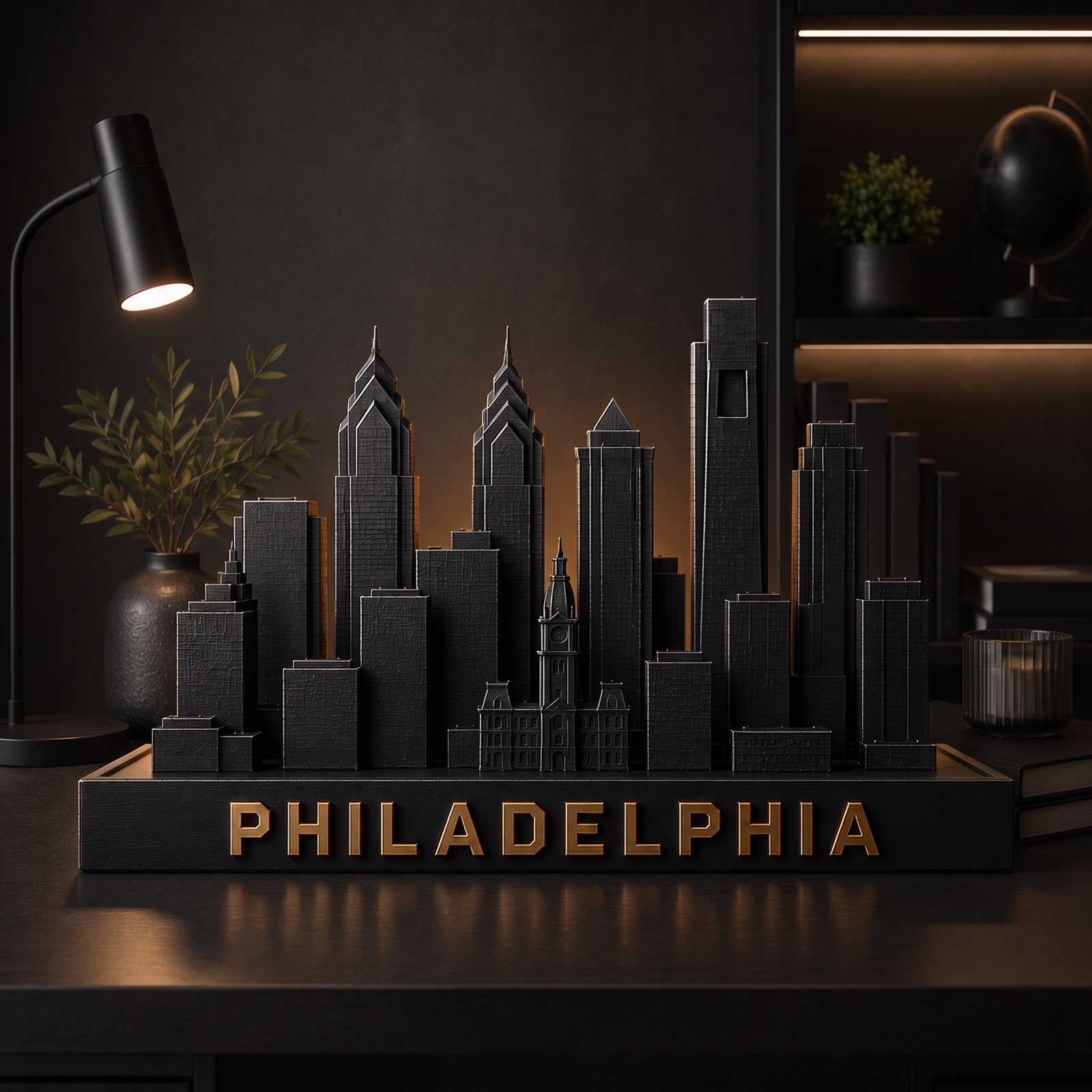
Our Philadelphia model is roughly 9 inches across for the Large, 7.5 inches for the Medium, 6 inches for the Small. The buildings we render are the ones that read across a room as Philadelphia and no other city. Here is what you are looking at, tower by tower.
Why Philadelphia Has the Skyline It Has
The foundation matters, because without it nothing in this guide makes sense.
Philadelphia was the largest city in colonial America, the seat of the Continental Congress, the city where the Declaration of Independence was signed and the Constitution drafted. The street grid William Penn laid out in 1682 with Thomas Holme is still the street grid you walk today in Center City. The five public squares Penn designated, Washington, Franklin, Logan, Rittenhouse, and the central square that became the site of City Hall, are still the five public squares. Philadelphia is one of the few American cities where the founding plan survived contact with three centuries of development.
In 1894, the city completed its new City Hall at the intersection of Broad and Market streets, on the site of Penn's original central square. The building was the largest municipal building in the United States and one of the largest masonry buildings in the world. The architect, John McArthur Jr., topped the structure with a 548-foot tower, and on top of the tower he placed a 37-foot bronze statue of William Penn himself, sculpted by Alexander Milne Calder. The statue faced northeast toward the Treaty Elm, where Penn was said to have made his agreement with the Lenape in 1683. The combined height of building, tower, and statue was 548 feet to the top of Penn's hat. For nearly a century afterward, no building in Philadelphia was permitted to rise taller than that hat.
The rule was not law. It was an agreement. The city's planning establishment, the major developers, the architectural community, and the civic leadership all understood, without anything being written down, that City Hall and its statue defined the maximum acceptable height for any new construction. The agreement was called the gentlemen's agreement, and it held. Through the Great Depression, through the Second World War, through the postwar period when other American cities built upward aggressively, Philadelphia kept its silhouette below William Penn's hat. The Penn Mutual Tower, the PSFS Building, the Suburban Station Building, the Centre Square Towers, all of them stayed below 548 feet. The skyline that defined Philadelphia for ninety years was a skyline anchored by a Quaker statue, with everything else respectfully shorter.
Then in 1984, the developer Willard Rouse III announced One Liberty Place. The proposed tower would rise 945 feet, nearly four hundred feet taller than the statue. Rouse argued that the gentlemen's agreement was a relic, that the city's economic future required taller buildings, that the major American cities Philadelphia competed with for corporate headquarters had skylines twice Philadelphia's height, and that the agreement was holding the city back. The architectural community was divided. The civic establishment was furious. The mayor, Wilson Goode, supported the project. The Philadelphia Inquirer's architecture critic, Thomas Hine, supported it with reservations. Edmund Bacon, the legendary planning director who had shaped postwar Philadelphia, opposed it publicly and at length. Bacon argued that the agreement was the soul of the city, that breaking it would unleash an arms race of vertical construction, and that the William Penn statue's symbolic primacy was not a constraint on the city's future but a defining feature of its character.
The project was approved. Construction began. One Liberty Place topped out in 1987 at 945 feet.
And then the curse began.
The Philadelphia Phillies had last won the World Series in 1980, four years before One Liberty Place was announced. They did not win another World Series, did not even reach another World Series, for twenty-eight years after the tower's completion. The Philadelphia Eagles had last won an NFL championship in 1960. They did not win another major championship for forty-five years after One Liberty Place opened. The Philadelphia 76ers had won the NBA championship in 1983, one year before the tower was announced, and did not win another for forty-plus years and counting. The Philadelphia Flyers had won back-to-back Stanley Cups in 1974 and 1975, before the tower era, and did not win another in the four decades after. By the early 1990s, Philadelphians had a name for the pattern. They called it the Curse of Billy Penn.
The lore was specific. By breaking the gentlemen's agreement, by allowing One Liberty Place to rise above William Penn's hat, the city had insulted the founder, blocked the statue's sight line over the city, and brought down on itself a championship drought that would not lift until the insult was repaired. The argument was made seriously by some, half-seriously by most, and entertained by every Philadelphia sports fan who lived through the 1990s and early 2000s. The curse was discussed on talk radio, written about in the Inquirer and the Daily News, debated in barrooms across the Delaware Valley. It was both a joke and not a joke. It was the kind of folklore that organized a city's understanding of why nothing was going right.
In 2007, when Comcast Center was topping out at 974 feet, surpassing One Liberty Place as the tallest building in the city, the ironworkers on the project decided to address the problem. They acquired a small replica of the William Penn statue, a six inch bronze figurine, and bolted it to the highest structural beam on the top of the tower. The intent was explicit. By placing a William Penn higher than the City Hall statue, the workers would restore the founder's symbolic primacy, undo the insult of One Liberty Place, and lift the curse. The figurine was bolted to a steel beam in the upper structure. The project was photographed, written up, and reported across the city. The Phillies were in a strong position in the 2008 season. By late October 2008, they had won the World Series. Their first championship in twenty-eight years. The first championship for any Philadelphia major sports team since 1983.
The Philadelphia 76ers fans and the Eagles fans waited. In 2018, the Eagles won the Super Bowl. The Comcast Technology Center was topping out at the same time, and by then a second William Penn figurine had been bolted to its highest structural beam, doubling the insurance. The Eagles won. The Curse of Billy Penn was either over or had been negotiated into manageability, depending on which corner of the city you asked. The 76ers and the Flyers were still waiting, but the championship dry spells that had defined the post-1987 decades had been broken.
The William Penn figurines are still up there. Both of them. Bolted to structural beams on Comcast Center and Comcast Technology Center, seven and a half inches tall, almost certainly not visible from the ground at any vantage point in the city. They are there because the workers who built the towers put them there, and because nobody who could remove them has any interest in removing them. The Philadelphia skyline today is anchored by the original William Penn statue on City Hall, and it is also anchored by the two miniature William Penn statues on the highest beams of the Comcast towers, doing folklore-level structural work that no other piece of municipal art in any American city has ever been asked to do.
This is the foundation. Without it the rest of the towers do not make sense.
The Towers on Our Model
These are the buildings we render. The Philadelphia silhouette reads cleanly because the city built relatively few supertall buildings even after the gentlemen's agreement broke, and the towers that did go up tended to be architecturally distinct rather than interchangeable corporate volumes.
City Hall
Built 1901. Architect: John McArthur Jr. and Thomas U. Walter.
Philadelphia City Hall at the intersection of Broad and Market streets is 548 feet to the top of the William Penn statue, 511 feet to the tower observation level, and was the tallest occupied building in the world from its completion in 1901 until the Metropolitan Life Insurance Company Tower in Manhattan surpassed it in 1908. It remains the tallest masonry building in the United States, meaning the tallest building that does not use a structural steel frame, the tallest building that supports itself through the load-bearing capacity of its own brick and granite walls. The walls at the base of the tower are 22 feet thick. The structure is mass and gravity, not steel and tension. There is no other building of comparable height in the country built this way.
The architecture is French Second Empire with mansard roofs, dormers, and ornate sculptural articulation across every facade. Alexander Milne Calder, the Scottish-born sculptor who emigrated to Philadelphia and spent his career producing the building's exterior decoration, designed and installed over 250 sculptural elements, including the William Penn statue at the tower's crown, allegorical figures representing the seasons and the arts at the cornice level, and dozens of smaller sculptural compositions across the facade. The building is, sculpturally, one of the most heavily decorated municipal structures in the United States. Calder's son, Alexander Stirling Calder, and his grandson, Alexander Calder of mobile fame, both became significant sculptors in their own right. The Calder dynasty traces its origins to City Hall.
The William Penn statue itself is 37 feet tall, weighs 53,348 pounds, and is the largest bronze sculpture on top of any building anywhere in the world. The statue faces northeast toward Penn Treaty Park, the site where William Penn was said to have signed his peace agreement with the Lenape leader Tamanend. Penn's right arm is extended in greeting. His left hand holds the original charter of the Pennsylvania colony. The statue is hollow, accessible from inside the tower through a maintenance hatch in the base, and has been periodically restored and recoated through its history. The most recent major restoration was completed in 2007, in time for the height-blocking dispute over Comcast Center to come to a head.
The building's interior includes the Philadelphia Mayor's office, the City Council chambers, the courts of common pleas, and the observation deck at the top of the tower below the statue's base. The observation deck is accessible by elevator and is one of the more dramatic vantage points in Center City, offering a 360-degree view of the city directly under the feet of the founder. The building is the seat of municipal government and remains in active daily use 125 years after its completion.
On our model, City Hall is the central anchor of the silhouette, distinguished by the tall central tower with the William Penn statue at the crown. The mansard-roofed massing reads at every size. At Small size the statue is a small but visible silhouette at the apex. At Medium and Large sizes the sculptural detail of the upper tower becomes legible.
One Liberty Place
Built 1987. Architect: Helmut Jahn.
One Liberty Place at 1650 Market Street is 945 feet, 61 stories, and is the building that broke the gentlemen's agreement. Helmut Jahn, the Chicago-based German-American architect who had become one of the leading designers of postmodern American skyscrapers in the early 1980s, was retained by the Rouse Company for the project. Jahn's design was a deliberate homage to the Chrysler Building in New York, with a stepped pyramidal crown clad in stainless steel, distinct setbacks on the upper floors, and a vertical articulation that recalled the streamlined Art Deco silhouettes of the early twentieth century. The tower is one of Jahn's most prominent commissions and one of the defining American postmodern skyscrapers of the 1980s.
The Chrysler Building reference was not incidental. Jahn argued in interviews at the time of the project that Philadelphia deserved a tower with the same architectural seriousness as the great Manhattan towers of the 1920s, that the city's silhouette had been held back too long, and that One Liberty Place was the tower that would let Philadelphia take its place among the major American skylines. The argument was both architectural and political. The tower's design was meant to make the case that breaking the gentlemen's agreement was justified because the resulting building was worthy of breaking it for.
The construction story is the political story. The tower's announcement in 1984 produced months of public debate, planning commission hearings, op-eds, and civic rallies. Edmund Bacon led the opposition with a series of public lectures and Inquirer essays arguing that the agreement protected something the city would lose if the tower went up. The mayor and the city council supported the project. The Philadelphia Historical Commission was consulted but did not have authority to block private construction outside designated historic districts. The project advanced through approval. Construction began in 1985. The topping-out ceremony in 1987 was attended by a crowd that included both supporters celebrating the city's vertical ambition and opponents protesting the desecration of the founder's silhouette.
The tower's commercial performance was strong. Major law firms, financial services tenants, and corporate offices filled the building within a year of opening. The tenant base has remained stable through subsequent decades. One Liberty Place is one of the more successful Class A office towers in Center City, and the tower's market success was used by subsequent developers as evidence that the gentlemen's agreement had been worth breaking on commercial grounds.
The architectural community has come, in the decades since, to recognize One Liberty Place as one of the more accomplished postmodern skyscrapers in the United States. Jahn's stepped crown is one of the most photographed building tops in the country. The tower is on the standard list of significant 1980s American architecture taught in architecture schools.
On our model, One Liberty Place is the tower with the stepped pyramidal crown set just west of City Hall, instantly recognizable by its silhouette.
Two Liberty Place
Built 1990. Architect: Helmut Jahn.
Two Liberty Place at 50 South 16th Street is 848 feet, 58 stories, and was completed three years after its taller sibling. The tower was designed by Helmut Jahn as part of the original Liberty Place master plan, intended to function as a paired composition with One Liberty Place. The two towers share a single ground-level retail concourse, the Shops at Liberty Place, which connects them through a glass-domed atrium that was, at the time of its completion, one of the more architecturally ambitious retail spaces in the city.
The architecture is a more restrained version of the One Liberty Place language. The stepped pyramidal crown is present but smaller. The vertical articulation is similar but less assertive. The cladding is a related but distinct palette of granite and glass. The intent was for Two Liberty Place to function as the supporting element in a duo, deferring to One Liberty Place's primacy while completing the architectural gesture. The pairing is one of the more successful two-tower compositions in the country, comparable to the original World Trade Center pairing in Manhattan or the more recent Petronas Towers in Kuala Lumpur, though smaller in absolute scale.
The tower's tenant mix has rotated over the years, with the upper floors converted to luxury residential condominiums in the late 2000s. The lower and middle floors remain commercial office space. The residential conversion was one of the early Center City projects to demonstrate that high-rise residential demand could support tower-scale construction in Philadelphia, a thesis that has since been validated by subsequent residential developments along the Schuylkill and in Rittenhouse Square.
On our model, Two Liberty Place is the slightly shorter pyramidal-crowned tower set immediately adjacent to One Liberty Place, completing the duo that broke the agreement.
BNY Mellon Center
Built 1990. Architect: Kohn Pedersen Fox.
BNY Mellon Center at 1735 Market Street is 792 feet, 53 stories, and was completed in the same year as Two Liberty Place. The tower was originally branded as the Mellon Bank Center, renamed BNY Mellon Center after the 2007 merger of the Bank of New York and Mellon Financial Corporation. The building remains one of the major Class A office towers in Center City and one of the more architecturally significant towers of the post-agreement era.
Kohn Pedersen Fox, the New York firm that designed Seattle's 1201 Third Avenue and dozens of other significant American skyscrapers, produced for Philadelphia a tower that contrasts deliberately with the Jahn-designed Liberty Place pair. Where the Liberty Place towers reference the Chrysler Building's Art Deco crown, BNY Mellon Center references the more austere modernism of the postwar period, with a clean rectangular massing, a stepped flat top, and granite and glass cladding that emphasizes proportion over ornament. The two architectural approaches stood next to each other on the same block, in the same year, making opposite arguments about what a Philadelphia tower should look like. The fact that both arguments survived and both buildings remain leased speaks to the breadth of the architectural moment that followed the agreement's breaking.
The building's lobby includes a major public art installation, a monumental abstract composition by the painter Sol LeWitt, commissioned specifically for the space and one of the larger LeWitt works in any commercial building in the United States. The lobby is publicly accessible during business hours and the LeWitt installation is one of the under-publicized destinations for art-attentive visitors to Center City.
On our model, BNY Mellon Center is the rectangular tower with the stepped flat top set in the central Market Street cluster, distinguishable from its Jahn-designed neighbors by its restrained massing.
Three Logan Square
Built 1990. Architect: Kohn Pedersen Fox.
Three Logan Square at 1717 Arch Street, originally built as the Bell Atlantic Tower and for many years known as the Mellon Bank Center, is 739 feet, 53 stories, and was one of three significant towers completed in Philadelphia in 1990. The three-tower year of 1990 marked the peak of the post-agreement construction boom, with Two Liberty Place, BNY Mellon Center, and Three Logan Square all topping out within twelve months of each other. After 1990 the Philadelphia construction pipeline slowed, and no significant tower was completed in Center City for the next seventeen years.
Three Logan Square is a Kohn Pedersen Fox design that uses a red granite cladding with a tapered upper massing and a stepped crown. The red granite is distinctive in a city where most of the modern towers use gray or buff palettes, and the tower reads from a distance as the warm-toned building in the Logan Square cluster. The original anchor tenant was Bell Atlantic, the regional telephone company that became Verizon through subsequent mergers. The tower has since hosted a rotating mix of corporate offices and professional services tenants, consistent with the broader Center City Class A market.
The building sits on the eastern edge of Logan Square, the second of William Penn's five original public squares to anchor a major modern tower development. The pairing of historic public space with late-twentieth-century office construction is one of the more characteristic features of Center City Philadelphia, where the founding plan and the modern commercial development have coexisted across three and a half centuries.
On our model, Three Logan Square is the red-granite-toned tower with the stepped crown in the Logan Square cluster, distinguishable from the gray-toned majority of the silhouette.
Comcast Center
Built 2008. Architect: Robert A.M. Stern Architects.
The Comcast Center at 1701 John F. Kennedy Boulevard is 974 feet, 58 stories, and was the tower that ended the post-1990 construction pause in Center City. The building was developed as the corporate headquarters of Comcast Corporation, the cable television and broadband company that had grown from a regional Philadelphia operation into one of the largest media companies in the United States. The tower's completion marked Comcast's announcement of its civic identity as a Philadelphia institution rather than a publicly traded multinational that happened to be headquartered in the city.
Robert A.M. Stern, the New York architect and former dean of the Yale School of Architecture, designed a tower with a more classical sensibility than the postmodern Jahn or the modernist KPF towers of the previous generation. The building's massing is a tapered shaft with a distinctive crown, a stepped top with a tall obelisk-like termination that recalls the proportions of classical American skyscraper design rather than the European-influenced modernism that had dominated American office tower architecture for the previous fifty years. The cladding is silver-toned glass with a vertical articulation that emphasizes the tower's height. The building was, at the time of its completion, the tallest building in Philadelphia and the tallest building in the United States outside of New York and Chicago.
The Penn miniature is the story. As the tower was topping out in 2007, the ironworkers crew acquired a six inch bronze replica of the William Penn statue from City Hall and bolted it to the highest structural beam of the building. The placement was intended explicitly to address the Curse of Billy Penn. By placing a Penn higher than the City Hall statue, the workers would restore the founder's symbolic primacy and lift the championship drought that Philadelphia sports fans had attributed to the breaking of the agreement. The placement was documented in photographs, reported in the Inquirer and the Daily News, and became one of the more widely told stories in Philadelphia civic folklore. The Phillies won the World Series in 2008, the year of Comcast Center's opening. Philadelphia fans took the timing seriously.
The figurine is still up there. Bolted to the structural beam where the workers placed it. Not visible from the ground at any vantage point. Doing whatever symbolic work it is doing.
The tower's lobby is a major civic space. The lobby includes The Comcast Experience, a 2,000-square-foot LED video wall that displays high-resolution video art on a continuous loop during the workday. The installation has been one of the more visited destinations in Center City since its opening and has been periodically updated with new commissions from video artists. The lobby is publicly accessible.
On our model, Comcast Center is the tall silver-toned tower with the stepped obelisk crown, set just north of City Hall, identifiable by its proportional silhouette.
Comcast Technology Center
Built 2018. Architect: Foster + Partners.
The Comcast Technology Center at 1800 Arch Street is 1,121 feet, 60 stories, and is currently the tallest building in Philadelphia, the tallest building in Pennsylvania, and the tallest building in the United States outside of New York, Chicago, and Atlanta. The tower was designed by Foster + Partners, the London-based firm led by Norman Foster, as the second Comcast headquarters tower in Center City. The building's program is mixed-use, with Comcast's technology workforce occupying the lower and middle floors and a Four Seasons Hotel occupying the top twelve floors. The Four Seasons Comcast Center Philadelphia is the highest hotel in the United States, with rooms beginning at the 48th floor and the hotel's restaurant and bar program occupying the top three floors of the tower.
The detail people miss is the Four Seasons location. The hotel's public spaces, including the lobby on the 60th floor, the restaurant on the 59th floor, and the bar on the 60th floor's roof terrace, sit higher than any comparable hospitality space in the country. The views from the upper levels of the hotel are panoramic, looking south across Center City toward South Philadelphia, west toward the Schuylkill and Fairmount Park, north toward the suburbs, and east toward the Delaware River and New Jersey. The hotel opened in 2019 and has consistently been one of the highest-rated luxury hotel properties in the eastern United States.
The architecture is Foster modernism. The tower is clad in floor-to-ceiling glass with vertical aluminum mullions, with a tapered upper massing that narrows toward the crown. The crown itself is occupied by the hotel's mechanical floors and an observation level, and is articulated with a series of horizontal bands that distinguish the tower's silhouette from the rectangular slabs of the previous generation. The building includes a major art installation by the artist Jenny Holzer in the lobby, a long horizontal LED text installation that displays selected texts on a continuous program.
The second Penn miniature is on this building. As Comcast Technology Center topped out in 2018, the ironworkers crew again acquired a small bronze replica of the William Penn statue and bolted it to the highest structural beam of the tower. The placement was, again, explicit. By doubling the figurine count, the workers would provide additional insurance against any residual curse effects. The Philadelphia Eagles won the Super Bowl in 2018, the same year. The figurine's placement and the Eagles' championship are not causally connected by any reasonable analysis. They are connected in Philadelphia folklore by the same timing argument that connected the Comcast Center figurine to the 2008 World Series. The folklore is what it is.
On our model, Comcast Technology Center is the tallest building in the silhouette, distinguishable by its tapered upper massing and the slightly more horizontal banding at the crown. The hotel function at the top floors is not visible from the silhouette alone but is part of the building's story.
FMC Tower
Built 2016. Architect: Pelli Clarke Pelli Architects.
FMC Tower at 2929 Walnut Street is 736 feet, 49 stories, and is the only building in our Philadelphia model that sits west of the Schuylkill River, in University City rather than Center City. The tower was developed by Brandywine Realty Trust on the air rights over Cira South, a former rail yard parcel near 30th Street Station, and serves as the western anchor of the Philadelphia skyline as read from any vantage point in Center City looking west.
The architect was Cesar Pelli, the Argentine-American architect who designed the Petronas Towers in Kuala Lumpur, the World Financial Center in New York, and a body of work that defined a specific late-modernist American skyscraper sensibility. FMC Tower is one of Pelli's later commissions, completed in the year of his death, and represents the firm's continued evolution toward sustainable high-performance commercial architecture. The tower is mixed-use, with FMC Corporation's corporate headquarters occupying the lower office floors, an AKA luxury extended-stay hotel occupying mid-tower floors, and luxury residential condominiums on the upper floors.
The University City location matters. The tower is adjacent to the campus of the University of Pennsylvania, walking distance from Drexel University, and within the broader concentration of medical, biotechnology, and research institutions that anchor the western half of Philadelphia. The FMC Tower's tenant base and the surrounding development have been instrumental in the post-2010 transformation of University City from a primarily institutional district into a mixed-use neighborhood that includes corporate offices, residential, hospitality, and retail. The skyline of Philadelphia today reads as two clusters separated by the Schuylkill River, with Center City to the east and University City to the west, and FMC Tower is the dominant western element.
On our model, FMC Tower sits at the western edge of the silhouette, distinct from the Center City cluster, with the slim tapered massing that distinguishes Pelli's late work from the more massive towers of the 1990s.
The Curse of Billy Penn
A pause here, because the curse deserves a section of its own.
The Curse of Billy Penn is one of the more developed pieces of American civic folklore. It is comparable to the Curse of the Bambino in Boston, the Curse of the Billy Goat in Chicago, or the various championship-drought folklores that other American cities have constructed to explain why their teams underperform. The Philadelphia version has specific features that distinguish it.
The first feature is the precision of the timing. The agreement broke in 1987 when One Liberty Place topped out. The championship drought ran from 1987 to 2008 for the Phillies, from 1987 to 2018 for the Eagles, with the Sixers and Flyers staying in the dry zone substantially longer. The bookends are exact. The 1980 Phillies World Series win and the 1983 Sixers championship sit immediately before the agreement breaking. The 2008 Phillies World Series and the 2018 Eagles Super Bowl sit immediately after the figurine placements. The pattern is so clean that even Philadelphians who do not believe in curses can recite the dates.
The second feature is the structural intervention. Most championship-drought curses involve a single founding incident: the Curse of the Bambino was the sale of Babe Ruth, the Curse of the Billy Goat was the ejection of Billy Sianis from Wrigley Field. The Curse of Billy Penn was a sustained civic insult: the breaking of an unwritten agreement, the construction of a series of buildings that violated the agreement, and the implicit ranking of commercial real estate above founder reverence. The curse was not an event. It was a condition.
The third feature is the resolution method. The Curse of the Bambino was lifted, depending on the telling, when the Red Sox won the World Series in 2004 or when various rituals of expiation were performed. The Curse of the Billy Goat is, depending on the telling, still in effect or was lifted when the Cubs won the World Series in 2016. The Curse of Billy Penn was lifted through the specific intervention of bolting a six inch bronze figurine to a structural beam. The intervention was deliberate, performed by named individuals, photographed and documented, and intended explicitly to address the curse. The Phillies won the World Series within a year of the placement. The intervention worked, by the folklore's internal logic, and the workers received credit accordingly.
The fourth feature is the seriousness with which Philadelphians actually believed this. Talk radio hosts discussed the curse on air with callers across the 1990s and 2000s. The Inquirer and Daily News ran feature articles. The Philadelphia Magazine ran a cover story. Local academics weighed in. The placement of the Comcast Center figurine in 2007 was covered as legitimate news by local media outlets that would normally have treated such a story as a human-interest sidebar. The figurine was discussed seriously, in print, by reporters and columnists, as a possible solution to a real problem.
The curse is part of the skyline. The buildings on this model are the architectural record of a city that broke an agreement, then spent two decades watching its sports teams underperform, then found a way to bolt a bronze figurine to a steel beam and watched its team win the World Series. This is not architectural fact in the conventional sense. It is architectural folklore. It is the meaning that Philadelphians have laid on top of the silhouette in the years since 1987. The model carries the folklore whether it tries to or not.
Why Philadelphia Sells as a Gift in Specific Niches
The Philadelphia skyline outsells in several specific recipient categories. The pattern is structural and worth naming.
The first niche is the major-university alumni community. Philadelphia is home to the University of Pennsylvania, Drexel University, Temple University, Villanova University, Saint Joseph's University, La Salle University, and the Curtis Institute of Music, among others. The combined alumni base across these institutions is one of the larger concentrations of city-loyal college alumni in the United States. The Penn alum in Houston, the Wharton MBA in San Francisco, the Drexel engineer in Seattle, the Temple journalism graduate in New York, the Villanova lawyer in Washington, all of them maintain a relationship with Philadelphia that the skyline gift commemorates. The pattern is similar to Boston's alumni density, with the difference that Philadelphia's university community has a higher proportion of professional-school alumni, including the Penn Medical School, the Wharton School, the Penn Law School, the Penn Dental School, and the Penn Veterinary School, all of which produce graduates whose Philadelphia chapter was their professional formation rather than their undergraduate years.
The second niche is the corporate cohort. Philadelphia hosts the headquarters of Comcast Corporation, Aramark, Sunoco, Vanguard Group (in nearby Malvern), Lincoln Financial Group, and dozens of other major corporations. The senior executives, the long-tenured professionals, and the retirees from these companies form a recognizable gifting category. The Comcast executive at retirement. The Vanguard partner at a milestone. The Aramark vice president at a promotion. The Philadelphia skyline gift commemorates the years of work that built the career, with the actual towers the recipient walked past or worked in.
The third niche is the medical community. Philadelphia is one of the largest medical centers in the United States, with the Hospital of the University of Pennsylvania, the Children's Hospital of Philadelphia, Thomas Jefferson University Hospital, Temple University Hospital, Pennsylvania Hospital, the Wills Eye Hospital, and the Fox Chase Cancer Center all anchoring a regional medical economy that employs hundreds of thousands of clinicians, researchers, and administrators. Physicians, nurses, researchers, and hospital administrators whose careers were built in Philadelphia medicine form a substantial gifting category, often choosing the skyline as a recognition gift for retiring clinicians or for major academic milestones.
The fourth niche is the sports community. Philadelphia sports fandom is one of the most intense in the United States, with the Phillies, Eagles, Sixers, and Flyers all commanding deep multi-generational loyalty. The fans who lived through the post-1987 drought, who waited for the 2008 Phillies and the 2018 Eagles, who can recite the Curse of Billy Penn folklore from memory, are a distinct gifting category. The skyline gift, for these recipients, is not only a city decoration. It is a memorial to the curse-breaking, to the placement of the Penn figurines, to the long wait and the eventual relief. The buildings on the silhouette are the buildings that carried the curse and the buildings that ended it.
Sizing for Philadelphia Specifically
The Medium at $54.99 is the right answer for most Philadelphia recipients. It reads as a real gift, it anchors a bookshelf, every tower reads cleanly including the William Penn statue at City Hall's crown, the stepped pyramids of the Liberty Place pair, and the tapered crown of the Comcast Technology Center. For the Penn alum at five or ten years out, the Drexel engineer celebrating a promotion, the Temple graduate sending a housewarming gift, the Philadelphia-native couple receiving a wedding present, the Medium is the size that does most of the work.
The Large at $74.99 is correct for the Penn or Wharton alum at a major milestone, for the Comcast executive at retirement, for the Vanguard or Aramark senior partner at a career capstone. Tenure at the Penn Medical School. Partner at one of the major Center City law firms. Named chair at Temple. Senior vice president at Comcast crossing the twenty-year mark. The Large is the size that signals the giver took the moment seriously, that the recipient's relationship with Philadelphia is institutional rather than passing, and that the home mantel or the corner office can carry a statement piece without overstating the room. For these recipients, the Large is the right call.
The Small at $34.99 is correct for the Philadelphia leaver. The Penn alum who took the consulting job in New York and commutes back to Philadelphia for the holidays. The Wharton MBA who relocated to the Bay Area for the operating role. The Drexel engineer whose career took them to Texas. The Temple journalism graduate who moved to Washington for the political reporting beat. The Small at six inches is the discreet desk piece that marks the Philadelphia chapter without overstating the current relationship with the city. The William Penn statue at the City Hall crown reads cleanly at Small size. The stepped Liberty Place crowns read at Small size. The piece does its work.
For corporate gifting in Philadelphia, the Medium is the default and the Large is the upgrade for senior recipients. Comcast, Vanguard, Aramark, the major Center City law firms, the medical center foundations, and the universities all order in volume for retirement gifts, anniversary gifts, and milestone recognition. The Medium handles most cases. The Large is the right call for retirement gifts at the C-suite level, for named-chair recognition at the universities, and for the most significant client relationships.
What Will Be Standing in 50 Years
The honest closing question, the same one we ask about every city in this series.
Certain to endure: City Hall, One Liberty Place, Two Liberty Place, Comcast Center, Comcast Technology Center. City Hall is a National Historic Landmark, a designated Philadelphia landmark, and structurally permanent on a fifty-year horizon under any reasonable scenario. The Liberty Place pair is too architecturally significant and too commercially successful to be at risk of demolition. The Comcast towers are too new, too well-tenanted, and too closely tied to the city's largest corporate institution to be at any plausible risk in the timeframe.
Likely to endure: BNY Mellon Center, Three Logan Square, FMC Tower. The Class A office and mixed-use tower stock in Center City has been remarkably stable across the past forty years. None of these buildings is at structural or economic risk. The Class A office market in Philadelphia is mature and stable. The towers were built well, are leased well, and will remain in place.
What gets added: the SLS Hotel and Residences is planned for the eastern edge of Center City, a 590-foot mixed-use tower that will add a new vertical element to the skyline. The redevelopment around 30th Street Station, the Schuylkill Yards master plan, is producing a multi-decade development pipeline of office, residential, and lab buildings in the area immediately around the FMC Tower. Several of those buildings will eventually rise high enough to register on the silhouette and will be added to future revisions of the Philadelphia model. The corridor between FMC Tower and the rest of University City is the most active development zone in the city.
What may be replaced: unlikely. Philadelphia's downtown tower stock is too well-located, too well-leased, and too embedded in the city's commercial geography to be at risk of replacement on a fifty-year horizon. The City Hall and the William Penn statue are functionally immortal as civic objects. The model on your shelf in 2076 will look substantially like the model on your shelf today, with additions at the western edge as Schuylkill Yards builds out.
How to See It Right
When your Philadelphia skyline arrives, take it out of the corrugated mailer and place it on a dark surface. A walnut bookshelf, a slate console, a black mantel. The matte black of the model wants context that absorbs light. White surfaces wash the silhouette.
Step back to six to eight feet. That is the distance from which the model reads correctly. Closer than that you see the build texture. Farther than that the William Penn statue, the Liberty Place crowns, and the Comcast Technology Center taper begin to compress against their neighbors.
Aim a single warm light at the base from one side, not above. The brushed gold lettering on the base catches the light and glows. The silhouette sits above in slight shadow, which is closer to how the actual Philadelphia skyline reads from across the Schuylkill at dusk in early November than to how it reads in a noon photograph on a clear July day. Philadelphia at dusk in autumn, with City Hall's tower illuminated, the Liberty Place crowns lit, the Comcast towers picking up the warm glow of the Center City office lights, is one of the more atmospheric urban views in the country, and the model wants to evoke that view rather than the daytime postcard.
The piece is not a photograph. It is sculptural. The buildings are themselves but smoothed, the way a city sits in your memory after you have lived in it or worked in it for years. The way the Center City silhouette looks when you have not been back in three years, when you remember the William Penn statue and the Liberty Place pair and the Comcast crown but you have forgotten the specific corners, is closer to this model than the daytime photograph. That is intentional.
Order Yours
The Philadelphia skyline is in active production. Three sizes, hand-printed in the USA in matte black with brushed gold lettering, ships in 3 to 5 business days within the continental United States.
Order the Philadelphia skyline
If a different city is the right one, the full collection has eleven other US cities, each with its own architectural story. We have already written up the Chicago skyline and the Boston skyline at the same depth. If you are still deciding whether the skyline gift is the right gesture for the recipient, read our guide to skyline gifting.
The right city, in the right size, on the right shelf, lasts longer than the moment that prompted the order. Philadelphia, given to the right Penn alum at the right milestone, to the right Comcast executive at retirement, to the right physician at the end of a career at HUP or Jefferson or CHOP, to the right sports fan who lived through the curse and watched the figurines do their work, is one of the most historically specific gifts in the catalog. It commemorates a city that spent a century holding its skyline beneath a Quaker's hat, then spent forty years figuring out what to do once the hat was no longer the ceiling. The silhouette is the architectural record of that argument. The model carries the argument forward.