Seattle Skyline Buildings: The Dark Tower at the Centre
Columbia Center is far darker and far taller than people remember. A guide to the Seattle towers, and why the Space Needle is not among them.
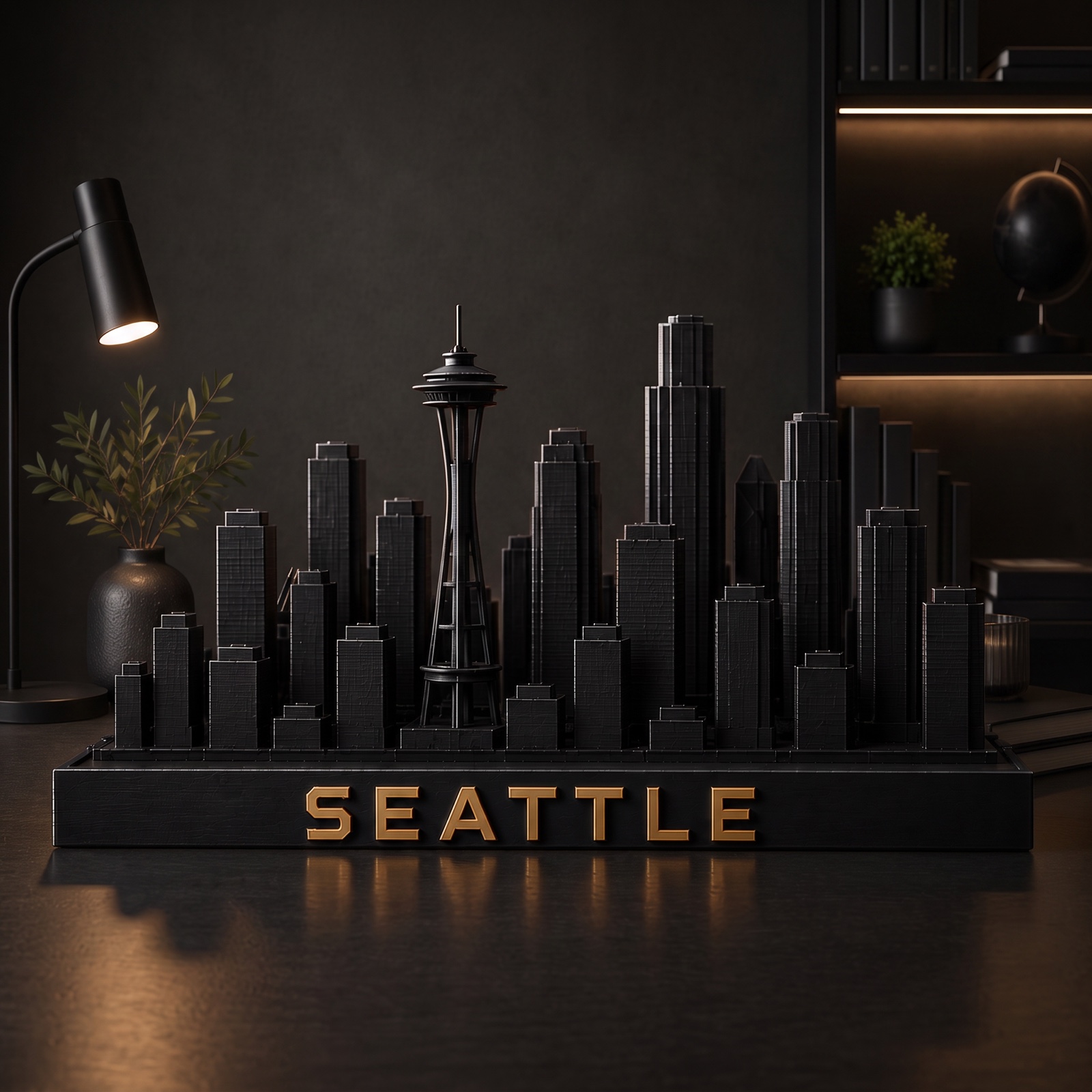
Seattle Skyline Buildings: The Dark Tower at the Centre
The Seattle skyline buildings you see from Elliott Bay on a clear morning are the most compressed historical timeline in our catalog. The frame holds 1914 to 2024 in one view. The Smith Tower, finished while the First World War was being declared in Europe, stands in the foreground. Behind it, the Columbia Center, finished while the Cold War was ending, holds the center of the silhouette. Above and to the right, the Space Needle, which is not a skyscraper at all but which anchors every recognizable Seattle photograph ever taken, sits where the city decided in 1962 that it ought to sit. Behind everything, in glass and steel that was extruded out of the ground in the last fifteen years, the Amazon-era towers complete the silhouette.
No other American city compresses this much architectural history into this small a vertical record. Chicago's skyline is 140 years of continuous building. Manhattan's is 120 years of relentless verticalization. San Francisco's is a 50-year political fight that produced a small, deliberate cluster. Seattle's is something different. Seattle built one significant tower in 1914 and then essentially nothing for 71 years. Then it built the Columbia Center. Then it paused again. Then Amazon happened, and the city built more vertical square footage in 15 years than it had built in the previous 90. The skyline you see today is the architectural record of a city that pivoted, pivoted again, and pivoted again, and built towers each time to mark the pivots.
This guide is for the people who want to read that silhouette correctly. The Seattle skyline on our model is built around seven structures, with the Space Needle included as the iconographic anchor even though it is not, strictly, a skyline building. Each piece on the silhouette carries a chapter of the city's history. The buildings are not interchangeable. They are the record of which industries built Seattle in which decades.
Our Seattle model is roughly 9 inches across for the Large, 7.5 inches for the Medium, 6 inches for the Small. Here is what you are looking at, building by building.
Why Seattle's downtown is so compact
The foundation matters. Without it the rest of this guide is a list.
Seattle was founded in 1851. For its first sixty years the city was a timber and maritime economy. The Puget Sound was a working harbor, the surrounding forests were a working timber economy, and the city itself was a port town that supplied Alaska during the Klondike Gold Rush. The wealth that built the first phase of Seattle was wealth made on lumber, shipping, fishing, and outfitting the prospectors heading north. The city was not a financial center. It was a frontier supply economy with a deepwater port.
Out of that wealth, in 1914, Lyman Cornelius Smith built the Smith Tower. Smith was a typewriter manufacturer in Syracuse, New York who had invested in Seattle real estate during the 1890s. The tower he commissioned at Second Avenue and Yesler Way was 462 feet tall, 38 stories, and was the tallest building west of the Mississippi River. It held that title for nearly fifty years. It was also, more remarkably, the only major office tower in Seattle for the better part of seven decades. The city built nothing taller, nothing comparable, and nothing meaningful from 1914 until 1985. Seventy-one years of architectural silence in the downtown core.
This pause is the central fact of the Seattle skyline. The reasons are layered. The 1916 zoning ordinance imposed a height limit. The 1929 stock market crash arrived shortly after a regional building boom in other Pacific cities and Seattle decided to sit it out. The Second World War turned the city into a Boeing aircraft factory, but Boeing did not produce office towers, it produced military aircraft and later commercial jets, and the wealth from the aerospace economy went into industrial buildings and engineering campuses, not into a downtown vertical statement. The postwar period saw modest mid-rise growth but nothing that challenged the Smith Tower's prominence. By 1962, when the Seattle World's Fair brought the Space Needle, the Smith Tower was still the tallest building in the city. By 1980, it still was. For most of the twentieth century, the recognizable Seattle vertical landmark was a 1914 building.
Then the pause broke. In 1985 the Columbia Center opened, at 933 feet, 76 stories, the tallest building west of the Mississippi at the time of its completion. It surpassed the Smith Tower's record on the same coast by a factor of two. The opening of the Columbia Center was Seattle's announcement that the city was no longer a regional timber and aerospace town but an emerging financial and corporate center in the Pacific. The building was leased to a banking consortium, to law firms, and to the headquarters operations of regional companies. The 1985 opening also coincided with the founding of Microsoft in Bellevue and the early growth of a regional technology industry that would, two decades later, fundamentally rewrite the economy.
After the Columbia Center, another pause. The 1990s were a period of modest infill construction. Two Union Square went up in 1989. The Washington Mutual Tower at 1201 Third Avenue went up in 1988. Russell Investments Center, originally built as Washington Mutual's headquarters, went up in 2006. But the pace was measured, the towers were significant rather than supertall, and the silhouette did not change dramatically from the shape it had taken in the late 1980s.
Then Amazon. The founding of Amazon in 1994, the company's quiet growth through the 2000s, and the explosive expansion of its corporate headquarters in the South Lake Union district from roughly 2010 onward fundamentally reshaped the city's vertical growth pattern. Amazon did not build in the traditional downtown core. The company assembled a campus of office towers in South Lake Union, a former industrial neighborhood north of downtown that the city rezoned in the early 2000s to allow high-density mixed-use development. The Amazon campus, designed in part by NBBJ and including landmark structures like the Day 1 tower and the Spheres, produced what is now functionally a second downtown skyline north of the original Financial District silhouette. From certain angles across Elliott Bay or from Queen Anne Hill, the South Lake Union cluster reads as part of the same silhouette as the original downtown. From other angles it reads as a separate vertical mass to the north.
Then the 2020 pause. The pandemic halted office construction across most American cities, and Seattle was no exception. Several proposed towers were delayed, redesigned, or cancelled. The remote work shift threatened the demand for downtown office space. For three years the Seattle skyline grew slowly.
Then the 2024 AI resumption. The growth of generative AI as a commercial industry, with Microsoft as a major capital partner to OpenAI, with Amazon as a major capital partner to Anthropic, and with the Seattle metro area as the geographic center of the cloud computing infrastructure that runs the entire industry, has restarted the city's vertical growth. New tower proposals are again advancing through approval. The South Lake Union expansion continues. The Lower Queen Anne neighborhood is seeing significant new construction. The skyline of 2026 is different from the skyline of 2020 and the skyline of 2030 will be different again.
This is the thesis. Seattle's skyline is the architectural record of the city's pivots. Timber and maritime built the Smith Tower. The 1985 banking and corporate moment built the Columbia Center. The Amazon and Microsoft era built South Lake Union and the modern downtown supplements. The AI moment is now building the next layer. Each pivot left a tower or a cluster, and the silhouette you see is the cumulative record of all of them.
The towers between Fifth and the waterfront
These are the structures we render. The Seattle silhouette is read from south to north, beginning with the historic Pioneer Square anchor and rising into the modern central business district and the Lower Queen Anne edge where the Space Needle sits.
Smith Tower
Built 1914. Architects: Gaggin and Gaggin of Syracuse, New York.
The Smith Tower at 506 Second Avenue is 462 feet, 38 stories, and was the tallest building west of the Mississippi River from its completion in 1914 until the Kansas City Power and Light Building briefly surpassed it in 1931, and then again until the Space Needle topped it in 1962, depending on how strictly the regional definition is drawn. By any reasonable measure, the Smith Tower held the regional crown for nearly half a century. It was, simply, the tallest thing west of Missouri for the working lifetime of a generation.
The architecture is Beaux-Arts neoclassical. The base is granite. The shaft is faced in terra cotta with white glazed surfaces. The crown is a pyramidal cap of glazed terra cotta tiles with a steel and copper observation level at the upper floors. The 35th floor houses the Chinese Room, an elaborately decorated reception hall that for most of the twentieth century was one of the most photographed interior spaces in the Pacific Northwest. The room is named for an extensive collection of carved blackwood furniture gifted to the Smith family by the Empress of China in the early twentieth century. The room is still extant. It is still visitable as part of the building's observation deck program.
The elevators are the detail people miss. The Smith Tower's elevators are still manually operated. There are professional elevator operators on duty during business hours, in uniform, who close the brass gates by hand and operate the controls. The system is original to 1914 with periodic mechanical refurbishment. There is no automated control. There are no buttons in the cab the way there are in modern elevators. You tell the operator the floor you want and the operator runs the elevator. This is one of the last commercially operating manual elevator systems in the United States, and the Smith Tower's continued use of it is partly preservation, partly habit, partly a deliberate signature of the building. The brass cab fittings are original. The polished marble landing thresholds are original. The acoustics inside the cabs are unlike anything else in a working American building.
Lyman Cornelius Smith died in 1910, four years before his tower was completed. The building was finished by his son. The Smith family retained ownership for decades. The building changed hands in the mid-twentieth century and went through periods of underuse and disrepair in the 1970s and 1980s, when the surrounding Pioneer Square neighborhood was at its lowest point. The tower was restored and revitalized through the 2000s and is now in active commercial use with a strong tenant base, an active observation deck program, and ongoing preservation work on the interior public spaces.
On our model, the Smith Tower is the foreground tower in the southern half of the silhouette, with the unmistakable pyramidal terra cotta crown that distinguishes it from every other Seattle building. At Small size the pyramidal crown still reads cleanly. At Large size the detail of the upper-floor articulation is visible.
Columbia Center
Built 1985. Architect: Chester L. Lindsey Architects.
The Columbia Center at 701 Fifth Avenue is 933 feet, 76 stories, and is currently the tallest building in Seattle, the tallest building in the Pacific Northwest, and was, at its completion in 1985, the tallest building west of the Mississippi River. The Library Tower in Los Angeles surpassed it in 1990, taking the regional crown south. The Columbia Center remained the tallest building in Seattle, and remains so to this day, with no building in the city since its completion having challenged its height.
The architecture is late modernist commercial. The exterior is dark gray reflective glass and dark gray steel mullions, set in a three-lobed cloverleaf floor plate that produces a distinctive silhouette from any angle. The three lobes are not decorative. They are structural, dividing the lateral wind load across three core elements rather than concentrating it in a single core. The building is engineered for Pacific Northwest seismic conditions, which are less severe than San Francisco's but more demanding than Manhattan's, and the three-lobed massing is part of the seismic engineering solution.
The tower's observation deck on the 73rd floor was, for many years, the highest publicly accessible observation deck in any American building west of the Mississippi. The deck has views of Elliott Bay, the Olympic Mountains, the Cascade Range, Mount Rainier on clear days, and the downtown silhouette below. The Sky View Observatory operates as a paid public attraction and is one of the more visited tourist destinations in Seattle.
The tower was developed by the Wright family and the Martin Selig real estate organization, the same Selig firm that has been one of the dominant commercial developers in Seattle for four decades. The building was financed and built at a moment when Seattle's banking sector was expanding rapidly, when Boeing was still a major regional employer, and when the city's identity as a Pacific Rim financial center was just beginning to take shape. The Columbia Center's anchor tenants over the years have included Bank of America, the law firm Perkins Coie, and various major regional and national tenants. The building has remained close to fully leased for most of its existence.
The Columbia Center is locally controversial. Architectural critics at the time of its completion and since have argued that the building is too tall, too dark, and too disconnected from the historic scale of downtown Seattle. The tower casts a long shadow over Pioneer Square in the morning and over First Hill in the afternoon. Its dark exterior absorbs light in a city that already struggles with grayness for half the year. Whether the building is loved or merely tolerated depends on whom you ask. What is not disputed is that the Columbia Center is the building that defines the modern Seattle silhouette. Every photograph of the city from across Elliott Bay or from the I-5 northbound onramp at Mercer has the Columbia Center as its central vertical element. The skyline without it would be unrecognizable.
On our model, the Columbia Center is the tallest element of the silhouette, set centrally in the downtown cluster. The three-lobed massing reads at all three sizes.
Space Needle
Built 1962. Architects: John Graham Jr. and Edward E. Carlson.
The Space Needle at 400 Broad Street is 605 feet tall, and is not technically a skyscraper. It is an observation tower with a flying-saucer-shaped observation deck and rotating restaurant at the top, supported by a tripod structural core that flares outward at the base and narrows toward the deck. The structure has six occupied levels at the top, no occupiable floors in the supporting shaft, and no rentable office or residential space anywhere in its program. By standard definitions of what constitutes a tall building, the Space Needle is not one. It is a single-purpose observation tower.
By any iconographic definition, the Space Needle is the building that anchors Seattle. No silhouette of the city is recognizable without it. The Smith Tower is older. The Columbia Center is taller. Neither one is on the postcard. The Space Needle is on the postcard, in the logo, in the establishing shot of every movie set in Seattle, in the closing credits of every documentary about the Pacific Northwest, in the city's official seal. It is what Seattle looks like when Seattle is being shown to people who are not from Seattle.
The Needle was built for the 1962 Seattle World's Fair, formally known as the Century 21 Exposition. The Fair's theme was the future of science and technology, with a particular focus on space exploration during the early years of the American space program. The Space Needle was conceived as the centerpiece of the Fair, a structure that would announce the city's participation in the space age and serve as a visitor attraction during the six-month exposition. The site was a former military supply depot just north of downtown that was redeveloped into the Seattle Center fairgrounds, which still exist today and host the Needle, the Pacific Science Center, the Museum of Pop Culture, and various performance venues.
The architecture is Googie-era futurism with a serious engineering foundation. The flying-saucer deck is technically a top-house structure that contains the SkyCity restaurant, the public observation deck, and the mechanical systems that support both. The supporting core is a steel tripod that resists wind and seismic loads through a structural strategy more typical of broadcast antennas than of buildings. The Needle is engineered to withstand winds up to 200 miles per hour and earthquakes up to magnitude 9.1, which is roughly the magnitude of the anticipated Cascadia Subduction Zone event that seismologists expect will eventually strike the Pacific Northwest. The Needle's design was reviewed and updated multiple times during construction to incorporate the latest seismic engineering of the early 1960s, and it has been periodically reviewed and reinforced since.
The restaurant rotates. Once every 47 minutes the entire dining floor completes a full revolution, driven by a small motor at the base of the deck that turns the floor on a circular rail. The rotation is slow enough that diners barely notice except when they look at a fixed reference point on the horizon and realize that the reference point is no longer where it was. The 47-minute period was chosen by the original designers to allow a typical lunch or dinner reservation to experience a complete view rotation during the meal. The mechanism has been refurbished multiple times. The current rotation is electronically controlled and operates with a precision the original mechanical system could not have achieved, but the period is unchanged.
The Space Needle is a question for skyline modelers. Strictly, it is not a building. Iconographically, it is the city. We include it because no Seattle silhouette is recognizable without it, and a Seattle gift that omitted the Needle would be a Seattle gift that pretended the recipient did not know what the city looks like. The Needle is on the model because the city is the Needle, and the Needle is the city.
On our model, the Space Needle sits at the northern end of the silhouette, at the edge of the Lower Queen Anne neighborhood, distinct from the downtown cluster but visually inseparable from it. The flying-saucer profile reads at every size.
Rainier Tower
Built 1977. Architect: Minoru Yamasaki.
The Rainier Tower at 1301 Fifth Avenue is 514 feet, 41 stories, and is the most structurally counterintuitive building in the Seattle skyline. The tower stands on an 11-story tapered concrete pedestal that narrows from a square office floor plate at the top down to a much smaller footprint at the ground. The building looks, from the street, as though it is balanced on a pencil. From a distance the inverted pyramid base is the unmistakable signature of the tower, distinguishing it from every other rectangular shaft in the city.
The design is by Minoru Yamasaki, the Japanese-American architect who designed the original World Trade Center in Manhattan, the Pruitt-Igoe housing complex in St. Louis, and a body of work that defined a specific late-modernist sensibility in postwar American architecture. Yamasaki was known for unconventional structural massings and for a particular use of slender vertical articulation. The Rainier Tower is his most extreme statement of structural ballet. The pedestal taper is not decorative. It is the structural system. The lower 11 stories are a single tapered concrete core that carries the entire load of the office floors above. The wider floors at the top of the pedestal cantilever outward from the narrower core below them, a structural inversion of the conventional widening-toward-the-base pattern that most tall buildings use.
The engineering was contested at the time of construction. Critics argued that the building was inherently unstable and that the concentration of load into a tapered base created seismic vulnerabilities that conventional bases avoided. The engineers responded that the inverted pyramid actually concentrated structural mass low and central, which improved seismic performance, and that the building's overall mass distribution was more favorable than its appearance suggested. The argument was not resolved by the engineering community at large. The tower was built, has stood for nearly fifty years, has survived multiple regional earthquakes including the 2001 Nisqually quake, and has not exhibited structural distress. The engineering, in the end, was correct. The optics remain unsettling.
The tower's interior tenants have rotated over the decades. The Rainier Bank, for which the tower was originally built, was acquired in the 1990s. The Univeristy of Washington's MBA program operated executive education facilities in the building for many years. The current tenant mix is law, finance, and consulting, consistent with the broader downtown Seattle Class A office market.
Yamasaki died in 1986, nine years after the Rainier Tower opened. The tower is not as widely studied in architecture schools as the World Trade Center was before 2001, but it is one of the more distinctive late-modernist commercial buildings in the Pacific Northwest and represents Yamasaki's structural daring at its most public. The tower is a signature of his career.
On our model, the Rainier Tower is the building with the unmistakable inverted-pyramid base, set in the central downtown cluster, distinguishable from every other tower by its silhouette alone.
F5 Tower / 5th + Madison
Built 2017. Architect: Callison RTKL.
The F5 Tower at 801 Fifth Avenue, originally branded as the Fifth and Madison tower during planning and construction, is 660 feet, 44 stories, and is one of the more recent significant additions to the Seattle downtown skyline. The tower has a distinctive sloped roof that angles upward from the south side of the building to a higher point on the north side, producing a silhouette that reads as a wedge rather than a rectangle from any angle.
The building was developed by Daniels Real Estate as a Class A office tower in the post-recession period when downtown Seattle office demand was recovering. The anchor tenant is F5 Networks, the cybersecurity and application services company headquartered in Seattle, which signed a major lease that allowed the building to advance through construction financing. F5's name went on the building when the lease was finalized and the building reopened under the F5 Tower name. The naming arrangement is similar to the Salesforce Tower arrangement in San Francisco, where the anchor tenant's name became the building's public identity.
The sloped roof is the architectural signature. The slope produces a series of stepped setbacks on the upper floors, which give the tower one of the more distinctive crowns in the modern Seattle skyline. The cladding is glass with limited stone accenting at the base. The interior includes a sky lobby on a midlevel floor that provides shared common space for the building's tenants, a feature that has become standard in newer office towers and that the F5 building includes at scale.
The building is also notable as one of the larger new entrants to the downtown core in the post-2010 era. While the Amazon expansion was concentrated in South Lake Union, the F5 Tower demonstrated that demand for traditional downtown Class A office space was sufficient to support significant new construction. The tower's lease-up was relatively rapid, and the building has remained close to full occupancy since opening.
On our model, the F5 Tower is identifiable by its sloped roofline in the downtown cluster, distinguishing it from the rectangular and three-lobed silhouettes of its neighbors.
Two Union Square
Built 1989. Architect: NBBJ.
Two Union Square at 601 Union Street is 740 feet, 56 stories, and is the second-tallest building in Seattle. The tower was completed in 1989, four years after the Columbia Center, and shares with the Columbia Center the late-1980s wave of significant downtown construction that defined the city's modern skyline. Two Union Square has held the second-tallest position in Seattle for 35 years.
The building was designed by NBBJ, the Seattle-based architecture firm that has gone on to become one of the dominant designers of corporate office space in the Pacific Northwest and globally, including significant work on Amazon's South Lake Union campus. Two Union Square is one of NBBJ's earlier major commercial projects in the city and helped establish the firm's reputation as a serious designer of tall buildings.
The exterior is granite and glass, with a clean rectangular massing that contrasts with the Columbia Center's three-lobed silhouette and the Rainier Tower's inverted pyramid. The tower is connected at its base to One Union Square, a shorter office building, by a shared retail concourse that includes a public food court, ground-floor retail, and connections to the Westlake transit station underground. The Union Square complex is one of the more active street-level developments in the downtown core.
The anchor tenants have rotated over the years. The original anchor was the law firm Foster Pepper. The current mix is professional services, corporate offices, and a regional headquarters for several technology companies. The building has remained close to full occupancy since opening, consistent with the durability of Class A office demand in central Seattle.
The tower's structural engineering is conservative compared to the Columbia Center or the Rainier Tower. NBBJ chose a conventional rectangular massing with a centered core, which produces straightforward seismic and wind performance characteristics. The building has performed reliably through three decades of Seattle weather and several regional seismic events.
On our model, Two Union Square is the second-tallest building in the silhouette, set immediately adjacent to the Columbia Center, with a clean rectangular profile.
1201 Third Avenue
Built 1988. Architect: Kohn Pedersen Fox.
1201 Third Avenue, originally built as the Washington Mutual Tower, is 772 feet, 55 stories, and is currently the third-tallest building in Seattle. The building was completed in 1988 as the headquarters of Washington Mutual Bank, the regional savings institution that grew to become one of the largest mortgage lenders in the United States before its dramatic collapse in 2008. The tower retains its original architecture but the name has been changed since the bank's failure, and the building is now known by its address rather than its anchor tenant.
The architect was Kohn Pedersen Fox, the New York firm that has designed major office towers in dozens of American cities. 1201 Third Avenue is one of KPF's significant West Coast commissions and reflects the firm's signature approach to corporate office architecture in the late 1980s. The tower has a tapered upper massing, a stepped crown, and a granite-and-glass cladding that distinguishes it from the darker exterior of the Columbia Center. The building's silhouette from the south reads as a slim shaft with a distinctive stepped top, identifying it from any vantage point along Elliott Bay.
The Washington Mutual story is part of the building's history. The bank was founded in Seattle in 1889, grew through the twentieth century as a regional thrift institution, and expanded aggressively in the 1990s and 2000s through acquisitions of other West Coast savings banks. By 2007 the bank held over $300 billion in assets and was the largest savings and loan institution in the United States. The 2008 financial crisis exposed the bank's overconcentration in subprime mortgage exposure. Washington Mutual collapsed in September 2008 and was acquired by JPMorgan Chase in a transaction that remains the largest bank failure in American history. The tower's signage was removed within weeks. The building was rebranded by its address.
The tower is currently owned by a private equity ownership group and leases to a diversified tenant base including major law firms, financial services firms, and regional offices for national corporations. The building's history as a monument to a vanished bank is one of the quieter stories in the Seattle skyline, but it is part of why the silhouette reads as a record of a city that has cycled through industries.
On our model, 1201 Third Avenue is identifiable by its stepped crown and tapered upper massing, set in the central downtown cluster.
The Space Needle Question
A note worth pausing on, because every architectural reader of the Seattle skyline eventually arrives at it.
Is the Space Needle a skyline building? The strict answer is no. The Needle is not a tall building in the conventional sense. It is an observation tower with no occupiable office or residential floors in its supporting shaft. By the definitions used by the Council on Tall Buildings and Urban Habitat, by most architectural surveys, and by most professional skyline counts, the Space Needle is excluded from the category of skyscrapers.
The iconographic answer is yes, absolutely, and any skyline model of Seattle that omitted the Needle would be wrong. The Needle is the visual signature that identifies the city. Without it, the silhouette could be Portland, or Vancouver, or a generic Pacific Northwest cluster of dark glass towers. With the Needle, the silhouette is Seattle and only Seattle. The flying-saucer profile is unique to one building on one continent. No other city has it. No other skyline model needs it.
We include the Needle on our model for the reason every Seattle skyline image includes it. The city is identified by the Needle. The Needle is identified by the city. The two are inseparable as iconography even if they are separable as architecture. The Smith Tower preceded the Needle by 48 years. The Columbia Center surpassed the Needle in height by 328 feet. Neither one carries the city's visual identity the way the Needle does. The Needle is what your recipient will see first when they look at the model. The Needle is what they will remember.
This is not unique to Seattle. The Saint Louis Arch is not a building either, and yet no model of the Saint Louis skyline omits it. The Hollywood Sign is not a building, and yet no representation of Los Angeles iconography can leave it out. Some structures are skyline elements even though they are not skyline buildings. The Space Needle is one of them, and the model treats it accordingly.
Columbia Center is darker than you remember
Columbia Center is 933 feet, the tallest building in the Pacific Northwest, and it is clad in near-black glass. On the model it reads as the heaviest single object in the composition, which is accurate and which surprises people — the Seattle most of us carry in our heads is the Space Needle against Rainier, not a black tower.
The building is also curved in plan, three concave arcs rather than a rectangle, so it changes shape as you move around it. From due west it looks like a slab. From the southwest it narrows. That is worth knowing before you decide which way it faces on a shelf, because the slab view is the least interesting one and it is the one people default to.
Set it at a slight angle instead and the curve reads, and the tower stops looking like a generic dark box.