Skyline Gifts for Architects and Designers: The One Object That Lands
Why most gifts for architects fail, how to read a designer's taste from across the room, and when a hand-printed city skyline is the one architectural object that lands.
Skyline Gifts for Architects and Designers: The One Object That Lands
Choosing a gift for an architect is the hardest assignment in any holiday rotation. The recipient lives in a beautifully composed environment. They have walked through hundreds of buildings they admire and thousands they do not. They have specific, often quite stubborn opinions about scale, finish, and silhouette. They have already thrown away the candle you were thinking of buying.
Finding a gift for architect friends, partners, and clients is not difficult because architects are picky. It is difficult because they are correct. The categories that work for everyone else fail on contact with them. Branded merch fails. Coffee table books they already own fail. A picture frame with a meaningful photo in it fails, because a frame they did not choose is a frame they have to relocate.
This guide is for anyone trying to find architecture gift ideas that survive the first week on a designer's shelf. We will cover the five categories that always fail, why a hand-printed city skyline is one of the rare architectural objects that lands when the others do not, and how to map size and city to specific recipients. Architects, interior designers, landscape architects, industrial designers, principals, recent grads. We have shipped to every one of those. The patterns repeat.
Why Gifting an Architect Is Harder Than Gifting Anyone Else
The average gift recipient lives in a room they have not edited. There are objects on shelves they did not choose. There is a print on the wall their spouse picked. There is space, generally, for one more object to be added without disrupting anything.
An architect's room is not that. Every surface has been considered. The empty space on the shelf is empty on purpose. The composition on the console table is finished. The piece you are about to mail in a box is going to enter an environment that was designed without it.
This is the first reason gifting designers is hard. Their tolerance for additions is low.
The second reason is that architects read objects fluently. They can identify the era of a chair from across a room. They can spot a low-quality finish at three meters. They can tell the difference between a hand-finished surface and a CNC pass that pretended to be one. Generic decor objects, no matter how well-intentioned, fail their inspection in seconds.
The third reason is taste loyalty. Architects spent years training their eye. They are not casually open to new aesthetic categories. A gift that asks them to expand their taste is a gift that asks them to do work. The right gift confirms their taste rather than challenging it.
A good gift for design professionals is one they would have chosen themselves if they had thought of it. Nothing more, nothing less.
The Five Categories That Always Fail
We have heard enough stories about gifts architects received and then quietly disappeared. The categories repeat.
Branded merchandise. A pen with a vendor logo. A water bottle from a software company. A polo shirt from a building products manufacturer. These are not gifts. They are advertising costs that someone tried to expense as a gift. An architect knows the difference instantly. The pen goes in a drawer with the other pens. The polo never leaves the bag.
Generic art prints. A Frank Lloyd Wright quote in a black frame. A blueprint of the Eiffel Tower from a museum gift shop. A Mondrian poster from college that has been reproduced ten thousand times. Architects do not need someone else's idea of an architectural image. They have their own images. Their walls are either empty on purpose or curated to within an inch of their lives. There is no room for a print someone bought because they thought it looked architecty.
Books they already own. Towards a New Architecture. Delirious New York. S, M, L, XL. Pattern Language. The Eyes of the Skin. If you are thinking of a canonical architecture book as a gift, the recipient owns it. They probably own three copies, because their partner gave them one and then they bought a second one for the office. Books only work as gifts when they are obscure enough that the recipient has not heard of them, which means buying a book as a gift for an architect requires a level of research that most people do not put in.
Anything with a personalized photo. The wedding photo on a coaster. The travel photo on a canvas. The kids in a frame. The family pet on a mug. The architect's home is not where personalized photo merchandise goes to live. Photo gifts violate every taste rule the recipient has spent twenty years learning. They will be received politely and rotated out within the year.
Novelty architectural items. A small ceramic gnome dressed as Le Corbusier. A pencil shaped like a Doric column. A tea infuser in the shape of the Empire State Building. The novelty category is the worst category. It uses architecture as a punchline. An architect does not want their profession kitsched. The gift will be looked at once and put in the donate pile within an hour.
These five categories cover ninety percent of what people instinctively reach for when buying for an architect. All five fail. The category that works is narrower and quieter.
Why a Hand-Printed Skyline Lands Where Other Architectural Objects Do Not
A skyline is an architectural object. So is a model. So is a print. So is a sculpture. The category is crowded, and most of it is wrong for an architect. Here is why our pieces clear the bar when the rest of the category does not.
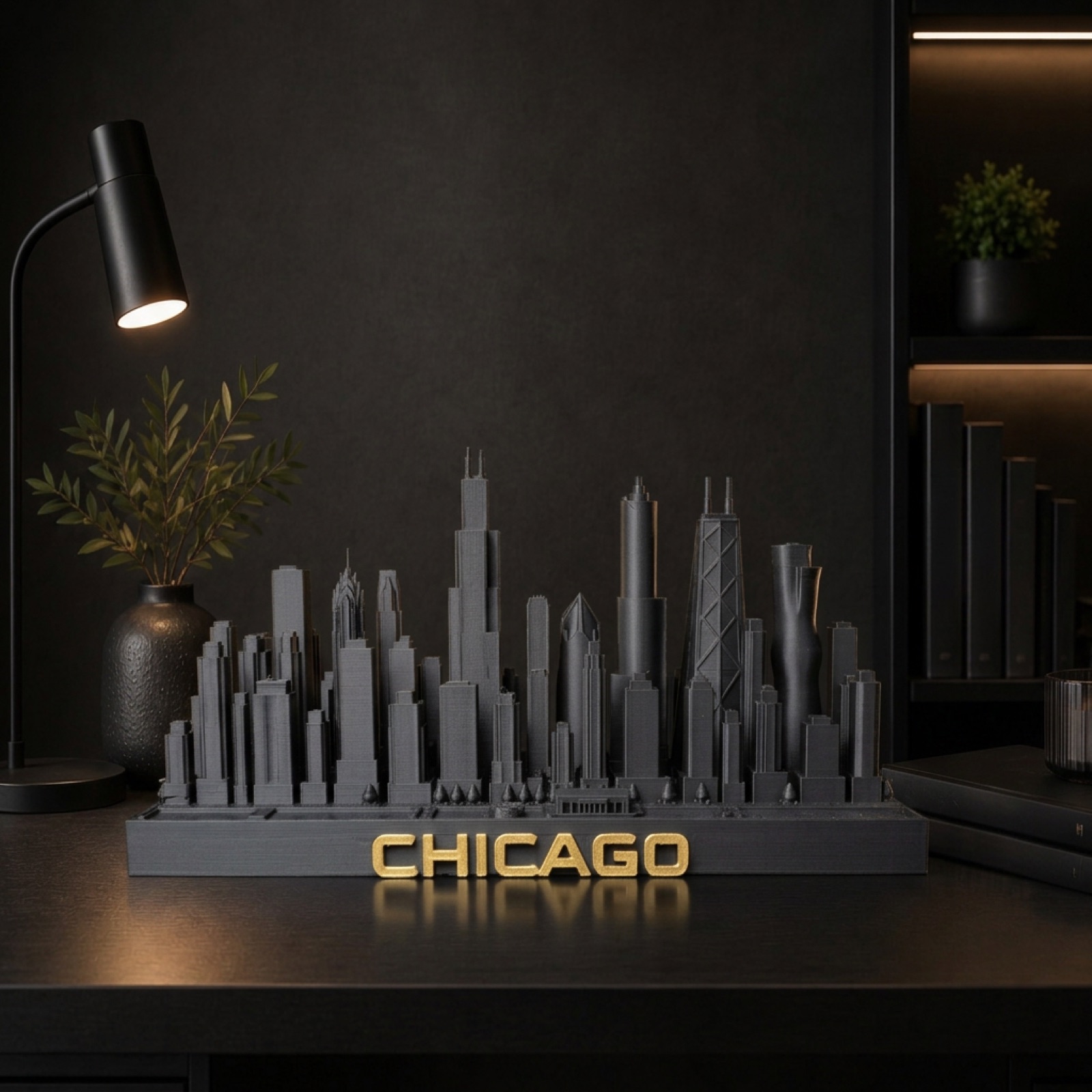
The aesthetic is precise scale model, not decor. Architects spend their lives looking at study models. Chipboard. Basswood. White card. A two-color study model of a city block sitting on a critique stand at a school of architecture is the visual reference for what our pieces look like, scaled down and finished. The matte black body and brushed gold band read as a finished study object, not as a souvenir.
There is no kitsch. No googly font. No "I Heart NY." No tourist signaling. The lettering is dimensional, clean, and limited to the city's name. The silhouette is geographically accurate. The form is reductive. Nothing in the object asks the recipient to laugh.
The palette is neutral. Matte black and brushed gold work in almost every interior an architect will assemble. They do not fight a Pierre Yovanovitch room. They do not fight a Vincent Van Duysen room. They do not fight a Kelly Wearstler room either, although that is a louder context. The piece slips into the existing composition rather than rewriting it.
It reads as an object of study. An architect looking at the piece sees a city studied at a particular scale. The eye traces the silhouette. The eye notices which buildings made the cut and how the proportions resolve. The piece invites looking, which is the highest function an object in an architect's home can perform.
This is the technical reason our pieces work as architecture gift ideas in a category that is otherwise full of failed attempts. We are not trying to make decor for people who like buildings. We are making a precise object that other precise people will recognize as having been made carefully.
The Recipient Personas
Architects and designers are not a single audience. The right gift depends on where the recipient is in their career and what subdiscipline they work in.
The Recent Architecture Grad
A first year out of an M.Arch from Yale, Harvard GSD, MIT, Columbia, or any other serious program. They are at a firm now, working sixty hour weeks for forty hour pay, learning Revit while pretending to already know it. Their apartment is small, their bookshelf is large, and their identity is still tied to the school they just left.
What they want: an object that signals their seriousness. Something they can put on their desk in the shared studio at the firm, where the senior staff will see it and register that the new hire has taste.
What to avoid: anything that reads as student. They are post-school now. They are trying to look like a professional, not like someone who just turned in their thesis. Avoid anything that screams M.Arch project.
The Medium at $54.99 of the city of the school they attended is the right call. New York for a Columbia grad. Boston for a GSD grad. Cambridge or Boston for an MIT grad. New Haven is not in our catalog, so for Yale grads pick a city that mattered during their thesis instead. The piece sits on their studio desk and marks where they came from without making it loud.
The Mid-Career Partner at a Small Firm
Fifteen to fifty person firm. Possibly a partner, possibly senior staff being groomed for partner. The firm is in the Diller Scofidio + Renfro tier or the Olson Kundig tier or the Annabelle Selldorf tier. Recognized but not yet famous. The recipient is forty-two, has two kids, and just got their first big competition win.
What they want: an object that acknowledges they have arrived at something. They are no longer the new hire and not yet the principal. The middle band of a career is the longest and the loneliest. A gift that says you see them in it works.
A Medium of the city the firm is located in, or the city of a building they are particularly proud of having designed, is right. They are proud of where they work and they want their objects to confirm it.
The Principal at a Starchitect Firm
Senior leadership at BIG, Foster + Partners, ZHA (Zaha Hadid Architects, posthumous but the firm continues under her successors), SOM, Gensler at the principal tier, KPF, Diller Scofidio + Renfro at the partner tier. These are people whose career arc is already public. They have buildings on three continents. They have been in Dezeen.
What they want: nothing they do not already have. This is the hardest recipient in the category. Their home is already perfect. Their office already contains a curated set of objects from buildings they admire. The gift has to slip into an environment that has been filtered hard.
The Large at $74.99 of a city they have a built building in, or the city of a building they wish they had designed, is the right call. The city's name in brushed gold is the only text on the piece.
The Interior Designer
Two main lineages to read first. Kelly Wearstler influenced interior designers work in bold color, mixed pattern, brass everywhere, a maximalism that is highly composed but reads loud. Pierre Yovanovitch influenced designers work in quiet palettes, hand-shaped furniture, restrained material variety, a minimalism that is warm.
A Wearstler designer can take a Large and put it on a console table with three other gold objects. The piece will hold its own in the composition. The brass nature of the brushed gold band reads as continuous with the rest of their palette.
A Yovanovitch designer wants the Medium and only the Medium. The piece will sit alone on a quiet shelf. The matte black reads as the dark accent in a room of bone and oat. The brushed gold is the only metallic note nearby.
Read the designer before choosing. Look at their Instagram if you have access. The taste lineage is usually obvious within thirty seconds.
The Industrial or Product Designer
A different aesthetic discipline. They work in plastic, metal, foam, fabric, increasingly in software. They are obsessed with materials, manufacturing tolerances, and the way an object feels in the hand.
What they want: an object whose making process they can read. A hand-printed sculpture, where they can see the layer lines on the close inspection that any designer will give it, is exactly the kind of object they want to study. They will appreciate that the piece is not injection molded. They will respect the process before they assess the finish.
A Medium works. For this recipient, the city of a manufacturing center they admire (Detroit if it ever returns to the catalog, Chicago for its industrial heritage, San Francisco for its current obsessions) is a sharper choice than the city they live in.
The Landscape Architect
A different aesthetic register entirely. Landscape architects spend their professional lives undoing the line that separates building from ground. They are skeptical of skyline imagery because skyline imagery typically erases everything below the building line.
This does not mean a skyline is wrong as a designer gift idea for them. It means the city you pick matters more than usual. Do not give them the city they live in, which they will read as decorative. Give them the city of a landscape project they admire, or, more elegantly, the city of a landscape they themselves designed in.
If they did the master plan for a park in Houston, give them a Houston Medium. They will read the gift as the city seen from above their work. The skyline becomes the context for the ground they shaped. This is the kind of move that lands hard with a recipient who is otherwise tough on skyline imagery.
Why the Medium Almost Always Wins for Architects
Across all of these personas, the Medium at $54.99 wins more often than the Small or the Large. Worth explaining why.
The Small at 6 inches reads as a desk piece. For an architect who already has a working desk with study models on it, the Small can disappear among other small objects. It is the right call for a recent grad with limited shelf space, but for most professional recipients it is undersized.
The Medium at 7.5 inches is the scale that reads as model. Not decor. Not desk object. Architectural study model. The proportions match what an architect's eye expects to see when a city is rendered at a tabletop scale. The piece sits well on a credenza, a bookshelf, a console table, or the edge of a desk. It does not demand a mantel.
The Large at 9 inches reads as a statement piece. For the principal at a starchitect firm or the senior partner at a top-tier interior design house, the Large is right. For everyone else it is slightly too much. An architect who has any minimalist tendency will be uncomfortable with the Large, where they would have welcomed the Medium.
If you are buying for an architect and not sure, the Medium is the answer. The scale is the scale of professional respect. We have shipped hundreds of these to design professionals and the Medium is the size that returns the warmest reactions.
Specific Occasions in the Architecture Calendar
Architects have their own gift calendar that runs alongside the standard one. Worth knowing the moments where a skyline lands particularly hard.
AIA national convention. Held in June each year in a different host city. Firms send delegations. Senior staff present at sessions. Recipients receive industry awards. A skyline of the host city, presented at the firm's closing dinner or pre-conference event, marks the year for the people who were there. The Medium works. Order at least three weeks ahead of the conference to be safe.
Firm anniversary. Five years, ten years, twenty-five years. A studio's anniversary is a quiet but significant moment for the principals who built it. A Large of the city the firm has been based in for that span, presented at the anniversary dinner, lands hard. Firms that have moved offices but stayed in the same metro should still pick the metro, not the address.
Partner promotion. When an associate becomes a partner or a senior associate becomes a principal, the moment deserves an object. A Medium with the firm's city, presented at the announcement dinner, is right. For partners being elevated at firms with multi-city offices, pick the office the partner has been working out of, not the firm's nominal headquarters.
Project completion. When a building the recipient designed actually finishes and opens, an object that marks the city the project is in works. If their building is in Houston, give them Houston. They will not have a model of their own building in their home (architects rarely do), but they will accept a city that includes their building in its silhouette.
Fellowship induction. FAIA, AIA Fellow designation, is a peer-elected honor that recognizes significant contribution to the profession. Recipients are typically in their fifties or sixties. The Large at $74.99 is correct. The city is either the metro the fellow has practiced in or the city of their most recognized work. Present it at the induction dinner.
Christmas and holiday gifts within the firm. The firm's principals giving to senior staff. The studio's holiday party gift exchange. These are moments where bulk orders make sense. See the section on bulk orders below.
The Building-Specific Question
The most common request we get from architecture-adjacent gifters is for an individual building. Can you make a Seagram Building? Can you make Fallingwater? Can you make a Bilbao Guggenheim? Can you make the Salk Institute?
The answer is no. We make city skylines, not individual buildings.
This is a deliberate constraint, not a manufacturing limit. An individual building rendered as a sculpture is in a different aesthetic category. It is closer to a presentation model, which is what architects use to sell projects, and the gifting calculus changes the moment you cross into that category. A presentation model of Fallingwater on someone's shelf reads differently than a Pittsburgh skyline does, and the difference is one that most architects will register as awkward.
If the recipient is a known Mies fan, give them Chicago. The Seagram Building is in New York but Mies is Chicago. The city of his career is the right object. If the recipient is a post-war modernist, New York or Chicago. If they are obsessed with Schindler or Neutra, Los Angeles. If Wright is their thing, Chicago. If they love Aalto, we are not in Helsinki yet but their nearest American sympathy is Boston or Seattle.
The right city is the city of the recipient's favorite building, not the recipient's favorite building itself. This is the move that turns the gift from generic into researched.
What Not to Do: Give the City They Live In
The biggest mistake people make when gifting designers is buying the city the designer currently lives in. This is the obvious choice and it is almost always wrong.
An architect in Chicago does not need a Chicago skyline. They live in Chicago. They see Chicago every day. They have walked under the buildings hundreds of times. A Chicago skyline on their shelf is a reminder of the room they are in, which is redundant.
What an architect in Chicago wants is the city of their favorite building. For a Mies fan that might still be Chicago, but for a Saarinen fan it is Detroit-area or St Louis. For a postwar New York modernist it is New York. For a Schindler fan it is Los Angeles. For a Robert Venturi fan it is Philadelphia.
The same logic applies to interior designers. Give the city of the project they wish they had landed. The hotel they would have killed to design. The restaurant whose lighting they study. Make the gift as researched as their taste. If they would not have made the decision casually, do not make it casually for them.
Lookup work matters here. Spend twenty minutes on the recipient's portfolio or their Instagram or their references-they-cite section in interviews. The city you arrive at will be more specific than where they live. The piece becomes a gift about their aesthetic identity rather than their postal address.
Bulk Orders for Firms
Firms that want to give skylines as holiday gifts or year-end appreciation pieces to senior staff fall into a workflow we have shipped many times.
The typical order is ten to thirty Mediums of the firm's primary city, given at the holiday party with a card from the partners.
For firms with multi-city offices, the call varies. Some send each office the skyline of its own city. Others send everyone the city of the firm's headquarters. The first approach reads as more thoughtful. The second approach reads as more unified. Both work. Pick based on the firm's culture.
Bulk pricing is available at ten pieces or more. Mixed cities are fine. Mixed sizes are fine. Reach out to hello@cityskylinedecor.com with your firm size, your office locations, and your timing window. We respond within one business day. For firms placing repeat annual orders, we set up a standing arrangement so the pieces go out the same week every year without re-quoting.
For firms with a closing gift or project completion gift program (the firm gives a skyline to clients when a project finishes), the bulk math is similar. The economics work well: a $54.99 Medium against a project fee in the high six figures is a rounding error, and the piece sits in the client's lobby for the next twenty years with the firm associated with it. We have shipped these arrangements for architecture practices and the dividend is the same one we describe in our corporate gifting guide.
Choosing the Right City
The city is the gift. Everything else is wrapping.
Spend the research time on the city before you spend the time on the size. The right city for the right recipient turns the piece from a generic decor object into a researched gift that the recipient will recognize as researched.
Browse the catalog by city and pick by aesthetic alignment, not by zip code. For Chicago-loyal recipients see the Chicago page and our Chicago buildings guide for context on which buildings the silhouette includes. For New York-loyal recipients the New York buildings guide covers the same.
For the broader question of when a skyline is the right gift and when it is not, the skyline gifts guide covers occasions, sizes, and timing across the full range of recipients.
Soft Close
The hardest gift recipient in your contact list is the architect. They live in rooms that have been edited. They read objects fluently. They have already thrown out the candle. Most of what gets sent to them ends up in a drawer.
A hand-printed skyline of the right city, sized correctly, lands in the small remaining gap where architects let new objects in. It reads as a study model. It does not introduce kitsch. The palette slips into the room they have already composed.
The Medium at $54.99, of a city that matters to the recipient's taste rather than their address, is the call for most architects most of the time. The Large is for senior principals and significant occasions.
If you are buying for one architect, browse the cities and pick the one their taste points to. If you are buying for many, email hello@cityskylinedecor.com with the order size. The pieces print in three to five business days in our US workshop and ship across the continental United States.
The right object for a designer is the one they would have chosen themselves. We have built ours to be exactly that.