Washington DC Skyline: The 1910 Law That Banned Towers
Washington has no skyscrapers, and that is a legal fact rather than an accident. How the Height of Buildings Act shaped a skyline made of monuments.
Washington DC Skyline: The 1910 Law That Banned Towers
The Washington DC skyline buildings you see across the Tidal Basin at dusk are doing something no other American skyline does. They are staying low. There are no skyscrapers. There is no Sears or Willis or Empire State or Salesforce. The tallest object in Washington DC is a 555-foot marble obelisk built in 1884, and federal law has held every other building in the city below it for 116 years. Washington's skyline is the only intentionally horizontal skyline in the United States. Every other American city competed to go up. Washington competed to keep itself flat enough that the Capitol Dome would still be visible from a row house in Brookland or a bench in Lincoln Park. This is not an absence of architectural ambition. It is one of the most disciplined urban design decisions in American history, and it is the reason the Washington DC skyline reads as monuments and domes rather than as towers.
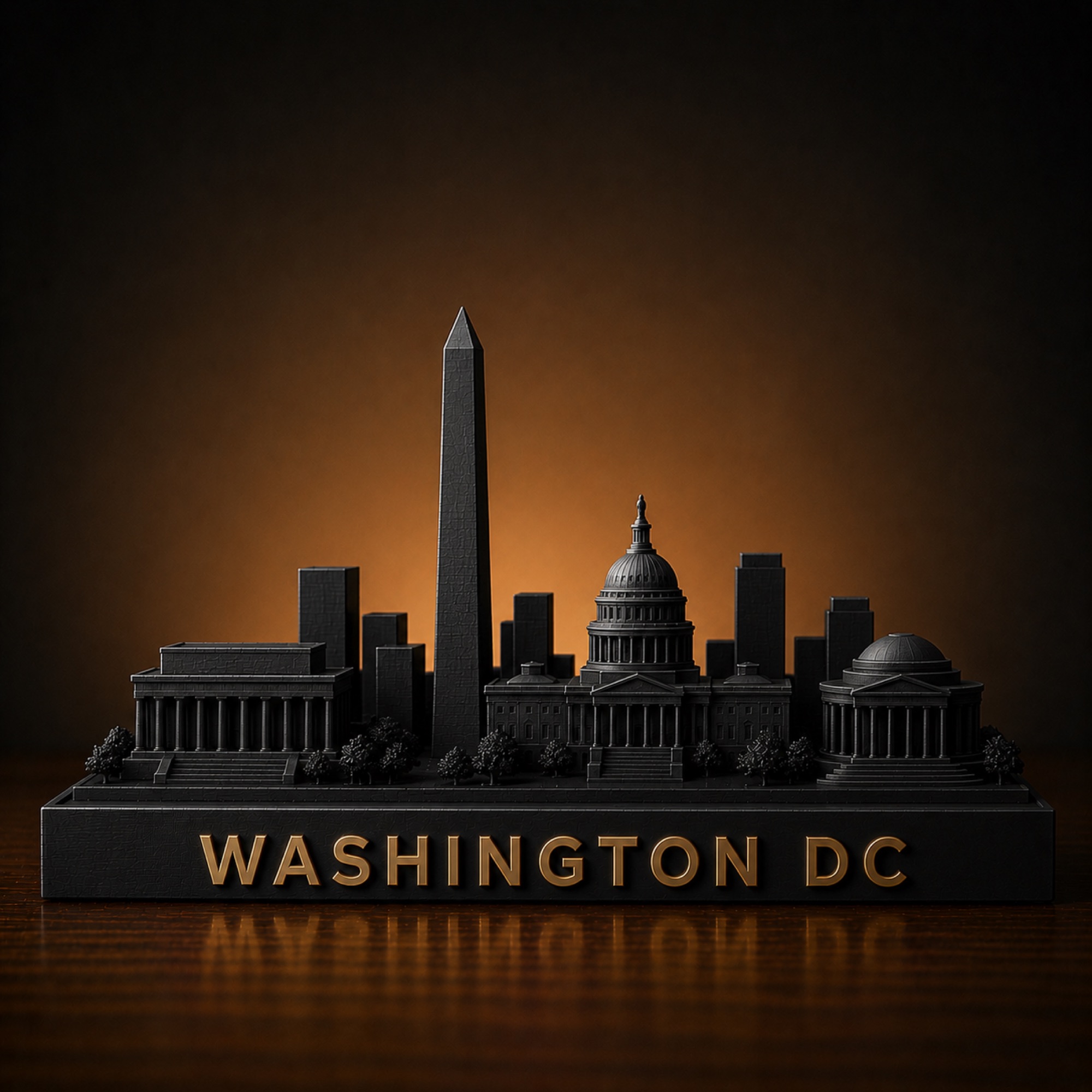
This guide is for the people who want to read the Washington DC skyline buildings on the model we print and understand what they are looking at. The model is different from every other city in our catalog. Where Chicago and New York and Philadelphia render as tall corporate masses with sculptural tops, Washington renders as a horizontal frieze of domes, obelisks, and classical pediments. There are eight structures, give or take, and not one of them is what most Americans would call a skyscraper. The skyline is a collection of monuments. It is what Washington chose to build instead.
Our Washington DC model is roughly 9 inches across for the Large, 7.5 inches for the Medium, 6 inches for the Small. The Small at $34.99, the Medium at $54.99, the Large at $74.99. Hand-printed in the USA in matte black with brushed gold lettering. Ships in 3 to 5 business days. Here is what is actually on it.
Why Washington looks like no other capital
The foundation matters more for Washington than for any other city in this series. Without it, the rest of the guide does not make sense.
Washington DC is the only major American city that was designed before it was built. The original plan, completed in 1791 by the French-born engineer Pierre Charles L'Enfant under commission from George Washington, established the diagonal avenues, the central east-west axis of the National Mall, the placement of the Capitol building on Jenkins Hill, and the placement of the President's House at the western anchor of what is now Pennsylvania Avenue. L'Enfant designed the city as a stage set for a republic. The avenues were meant to provide ceremonial sight lines. The squares and circles were meant to anchor monuments. The Mall was meant to be a great public promenade running between the Capitol and the river. The entire scheme assumed that the most significant buildings would be civic and that the rest of the city would be visually subordinate to them. This was not a preference. This was the operating premise of the plan.
L'Enfant was dismissed within a year of his commission, ostensibly for refusing to defer to the city's commissioners and for what later historians have characterized as an unmanageable personality. The plan survived him. Andrew Ellicott, who had served as L'Enfant's deputy, completed the surveying and the formal drawings, and the city was laid out on the ground according to substantially the design L'Enfant had drawn. The avenues, the squares, the placement of the Capitol and the White House, the orientation of the Mall, all of it descended from the 1791 plan.
The next major intervention came in 1901 with the McMillan Plan, named for Senator James McMillan of Michigan, who chaired the Senate committee that commissioned a comprehensive redesign of the central core of Washington for the city's centennial. The McMillan Commission was a four-member panel including the architects Daniel Burnham and Charles McKim, the sculptor Augustus Saint-Gaudens, and the landscape architect Frederick Law Olmsted Jr. The commission's mandate was to restore the L'Enfant plan, which had been substantially compromised over the nineteenth century by the construction of the Pennsylvania Avenue rail station on the Mall, the encroachment of commercial buildings on the planned ceremonial axes, and the general absence of architectural discipline that had accumulated across a century of incremental development. The McMillan Plan returned the Mall to its planned configuration, recommended the placement of new monumental buildings along its edges, established the design principles for what became the Federal Triangle, and called for the city to extend the L'Enfant ceremonial logic westward toward the Potomac. The Lincoln Memorial, the Jefferson Memorial, the reflecting pools, the Tidal Basin landscaping, the placement of the Smithsonian museums along the Mall edges, all trace back to the McMillan recommendations.
The McMillan Plan was a Daniel Burnham plan in important respects, and Burnham brought to Washington the same City Beautiful instincts that had shaped his work in Chicago and his recommendations for San Francisco, Manila, and Cleveland. The plan assumed a low, monumental, classical city. It assumed that the Capitol and the Washington Monument would remain visible from the principal vantage points. It assumed that new construction would defer to the existing civic landmarks. These assumptions were not legally binding when the McMillan Commission published its report. They became legally binding nine years later.
In 1910, Congress passed the Height of Buildings Act. The legislation was a response to a specific provocation. The Cairo Hotel, completed in 1894 at 14th and Q Streets NW, had risen to 164 feet and 12 stories, taller than anything else in the city and visible from the Mall in a way the McMillan Commission found objectionable. The Cairo was not strictly unusual by 1890s standards. Most American cities had buildings of comparable height. The objection was specifically to what such buildings would do to Washington if the practice continued. The 1910 Act imposed a federal cap on the height of all buildings in the District of Columbia. The cap was tied to the width of the street on which the building sat, with an absolute ceiling of 130 feet for most streets and a special exemption of 160 feet for buildings fronting on Pennsylvania Avenue between the Capitol and the White House. The exception for Pennsylvania Avenue was for the Federal Triangle buildings, which Congress wanted to be slightly more prominent than the surrounding commercial fabric. No exception was made for any building anywhere in the city to rise above this cap.
The 1910 Act has held for 116 years. It has been challenged repeatedly. The most recent serious challenge came in 2014, when a working group convened by the National Capital Planning Commission and the District government recommended that Congress consider modest relaxations in specific areas of the city outside the central core. Congress declined to act on the recommendation. The cap held. The cap holds today. It will almost certainly hold for the foreseeable future, because the political coalition that would be required to raise it does not exist. Members of Congress are protective of the city's visual identity for reasons that have nothing to do with their own districts. The Senate, which has authority over the District's affairs in ways the House does not, has shown no interest in relaxing the limit. The District's own elected leadership has shown periodic interest in growth but has not been willing to spend political capital on a fight Congress would win.
The consequence is the only horizontal major-city skyline in the United States. The Washington Monument at 555 feet has been the tallest object in the city since 1884. The Capitol Dome at 288 feet has been the second tallest structure visible from most parts of the city since 1866. The Old Post Office Tower at 315 feet, completed in 1899 before the height cap was enacted, was grandfathered in and remains the second tallest building in the city by virtue of having been built eleven years before the law that would have prevented it. Everything else built in the District in the past 116 years sits below 130 feet. The skyline you see across the Tidal Basin or from the Iwo Jima Memorial or from the Arlington side of the Potomac is the skyline that the 1910 Act produced. It looks like no other American city because it is the only American city legally required to look this way.
The symbolic meaning of the cap is worth naming. Washington is the seat of the federal government, the political capital of a republic, and the architectural decision to keep the Capitol Dome visible from every part of the city is a decision about what the city is for. The cap is the physical expression of the idea that the civic monuments should not be hidden behind commercial construction, that the citizens of the republic should be able to see the building where their laws are made from anywhere they happen to live, and that the symbolic ranking of public over private should be visible in the city's silhouette. Other cities have private skylines anchored by corporate towers. Washington has a public skyline anchored by monuments. This is the only American city for which that is true.
This is the foundation. Now the buildings.
The Monuments on Our Model
These are the structures we render. The Washington DC silhouette is shorter than any other major-city silhouette in our catalog. It reads as a horizontal frieze rather than a vertical cluster. The eye moves left to right across the model the way the eye moves across the city itself, picking up monument after monument, dome after dome, without any single vertical element pulling the gaze upward except the Washington Monument at the center.
The Washington Monument
Built 1848 to 1884. Architect: Robert Mills (original design), Thomas Lincoln Casey (completion).
The Washington Monument at the center of the National Mall is 555 feet and five-and-one-eighth inches tall, the tallest stone structure in the world, the tallest obelisk in the world, and the tallest object of any kind in the District of Columbia by a margin of more than 240 feet. From the day of its completion in 1884 until the opening of the Eiffel Tower in 1889, the Washington Monument was the tallest building in the world. This is a fact that almost no American knows, and it is worth pausing on. For five years, the tallest structure on earth was the marble obelisk on the National Mall. The Eiffel Tower opened in March 1889 and took the title at 984 feet, almost twice the Monument's height, and the Washington Monument has never again been the tallest anything except in the specific category of stone obelisks, where it remains unsurpassed.
The architecture is one of the more peculiar histories in American monumental construction. Robert Mills, the South Carolina-born architect who had designed the United States Treasury Building and the Patent Office Building, won the design competition in 1836 with a proposal that included a 600-foot obelisk rising from a circular colonnaded base. The base was meant to house statues of Revolutionary War heroes and was, in the original proposal, almost as elaborate as the obelisk itself. Construction began in 1848. Funds ran out in 1854. The base was never built. The obelisk had reached 152 feet when the Washington National Monument Society, which was managing the construction, exhausted its private funding and stopped work. The political situation deteriorated through the 1850s, the Civil War intervened, and the obelisk sat unfinished for twenty-five years.
Look closely at the Monument today and you can see the interruption. There is a horizontal band in the marble at 152 feet, a slightly different color and texture from the marble above and below it. The lower marble was quarried at a Maryland site that closed during the construction pause. When work resumed in 1879, the original quarry was no longer producing, and the upper marble was sourced from a different quarry with slightly different mineral content. The band marks the height the Monument had reached when the Civil War interrupted construction. The masonry below the band was laid by antebellum hands. The masonry above was laid by the generation that came after Reconstruction. The Monument is, in a literal architectural sense, two structures stitched together at the 152-foot mark, and the seam is visible from the Mall on any clear day.
Thomas Lincoln Casey of the Army Corps of Engineers took over the project in 1879 and finished it in five years. Casey reduced the height of the obelisk slightly from Mills's original proposal, eliminated the colonnaded base entirely, and produced the clean tapering shaft that the Monument is today. The capstone, a 100-ounce pyramid of cast aluminum, was set on December 6, 1884. The aluminum capstone was, at the time, the largest piece of aluminum ever cast. Aluminum in 1884 was more valuable than silver, and the choice to top the Monument with aluminum was a deliberate flourish, signaling that the structure represented the technological frontier of its moment. The capstone is still in place. The aluminum is still doing its work.
On our model, the Washington Monument is the dominant vertical element at the center of the silhouette, an unmistakable tapering obelisk that pulls the eye to the middle of the composition. At Small size the Monument reads cleanly. At Medium the proportions are exact. At Large the seam at 152 feet is not visible but the tapering is precise.
The United States Capitol Dome
Built 1855 to 1866. Architect: Thomas U. Walter.
The Capitol Dome at the east end of the National Mall is 288 feet from the ground to the top of the Statue of Freedom that crowns it, and it is the second tallest structure on the Washington skyline. The dome you see is not the dome the Capitol was originally built with. The original Capitol, designed by William Thornton and Benjamin Henry Latrobe between 1793 and 1826, had a much smaller wooden dome covered in copper, considerably lower than the current dome and proportionally modest by the standards of the building's later expansion. The current dome was built between 1855 and 1866 during the Capitol's major mid-century expansion under Thomas U. Walter, the Philadelphia-born architect who served as Architect of the Capitol from 1851 to 1865.
The dome is cast iron. This is the detail most visitors miss. The Capitol Dome looks like stone, painted white, and most photographs and most popular references treat it as if it were a masonry dome. It is not. The dome is built of approximately nine million pounds of cast iron, fabricated in plates and ribs at foundries in Baltimore and Brooklyn and shipped to Washington for assembly. Cast iron was, in the 1850s, the cutting-edge material for major structural work. It allowed Walter to build a dome substantially larger and lighter than any masonry dome could have been at the same proportions. The dome's inner shell and outer shell are separate cast iron structures, with the space between them used for ventilation, maintenance access, and the structural connections that hold the composition together. The Statue of Freedom on the crown was sculpted by Thomas Crawford and is itself cast in bronze. The whole composition is metal, painted to look like stone, and it has been doing this work for 160 years.
The interior of the dome is one of the most ambitious mural compositions in American public art. The Apotheosis of Washington, painted by the Italian-born artist Constantino Brumidi between 1865 and 1867, occupies the eye of the dome's inner shell at 180 feet above the rotunda floor. The fresco depicts George Washington ascending into the heavens, surrounded by allegorical figures representing the virtues, the arts, the sciences, and the trades. Brumidi painted the work on his back, in fresco, working from scaffolding that allowed him approximately a foot of clearance between his face and the wet plaster. The work is 4,664 square feet. Brumidi was 60 years old when he started and 62 when he finished. The fresco has been periodically conserved and is in substantially the condition Brumidi left it. Visitors to the Capitol Rotunda look up at it. Most assume it is much older than it is. It is younger than the Capitol Dome itself and was painted specifically to occupy the new dome's eye.
The construction of the dome continued through the Civil War. Abraham Lincoln, asked during the war whether the Capitol construction should be paused to conserve resources, declined. He is reported to have said that the continuing construction of the dome was a signal to the country and to the world that the Union would survive the war and that the government would continue. The dome topped out in December 1863, the Statue of Freedom was raised to the crown that same month, and the work was substantially complete by 1866. The cast iron survived the war. The country survived the war. The dome is what the country chose to finish during its worst crisis.
On our model, the Capitol Dome is the rounded crown at the eastern end of the silhouette, distinct from the rectangular masses of the rest of the Capitol building, with the small spike of the Statue of Freedom at the apex. At Medium size the proportions read precisely. At Large the inner-and-outer-shell composition of the dome is suggested in the silhouette.
The Lincoln Memorial
Built 1914 to 1922. Architect: Henry Bacon.
The Lincoln Memorial at the western anchor of the National Mall is a Greek Doric temple in form, 99 feet tall to the top of the attic story, set on a low rise that places it visually higher than its absolute height would suggest. The architect, Henry Bacon, was a Brooklyn-born classicist who had spent his career in the firm of McKim, Mead, and White before opening his own office in 1903. The Lincoln Memorial was his masterpiece and effectively his last major commission. Bacon died in 1924, two years after the Memorial's dedication, of complications from cancer that he had been managing through the latter years of the construction.
The temple form was a deliberate choice. Bacon argued that Lincoln, as the preserver of the Union, deserved a memorial in the architectural language of the classical republics that the American founders had taken as models. The Doric order was the choice. The Doric is the oldest and most austere of the Greek architectural orders, and Bacon used it without modification, producing a temple that resembles the Parthenon in its proportions while serving an entirely different function. The temple has 36 exterior columns, one for each state in the Union at the time of Lincoln's death. The names of the 48 states in the Union at the time of the Memorial's completion are inscribed on the attic story. Alaska and Hawaii were added later, with plaques on the approach steps after their admission as states.
The Daniel Chester French statue inside is the focal point. French was the leading American academic sculptor of his generation, the artist behind the Minute Man at Concord and the seated Lincoln at the dedication of the Lincoln Memorial in Lincoln, Nebraska. For the Washington memorial, French produced a 19-foot seated figure of Lincoln in white Georgia marble, the largest single figure he ever sculpted. The statue depicts Lincoln seated in contemplation, his hands resting on the arms of the chair, his gaze directed straight ahead and slightly downward at the visitors who approach. The composition is meant to read as the President in private thought during one of the wartime moments that defined his administration. French worked on the statue for four years, with assistants carving the rough mass and French himself finishing the surfaces, the face, the hands. The marble came from a quarry in Georgia that French had specifically scouted for the project.
The Memorial's role in American civic life has expanded since its dedication. The 1939 Marian Anderson concert on the steps after the Daughters of the American Revolution declined to allow her to perform at Constitution Hall. The 1963 March on Washington, where Martin Luther King Jr. delivered the I Have a Dream speech from the steps. The Memorial has functioned as the unofficial site of American civic gathering for the past century, a role Henry Bacon could not have anticipated when he designed it. The temple form has proven flexible. It accommodates the speeches, the marches, the silent visits at midnight when tourists climb the steps to read the Gettysburg Address inscribed on the wall of the south chamber.
On our model, the Lincoln Memorial is the temple-form mass at the western end of the silhouette, with the colonnaded facade clearly articulated and the low classical proportions distinguishing it from the obelisk to its east and the dome to its west across the Tidal Basin. The temple reads at all three sizes. The columns are visible at Small, distinct at Medium, and precisely articulated at Large.
The Jefferson Memorial
Built 1939 to 1943. Architect: John Russell Pope.
The Jefferson Memorial at the southern edge of the Tidal Basin is a circular domed pavilion in the form of the Roman Pantheon, 129 feet tall, with a classical Ionic colonnade surrounding a central rotunda. The architect, John Russell Pope, was the New York-based academic classicist who had designed the National Archives, the West Building of the National Gallery of Art, and the Constitution Avenue facade of the Federal Reserve Building. The Jefferson Memorial was Pope's last major project. He died in 1937, four years before the Memorial was dedicated, and the completion of the work was overseen by his partners in his firm and by Otto Eggers, his longtime design associate.
The architectural reference is the Pantheon in Rome, but the deeper reference is to Thomas Jefferson's own architectural taste. Jefferson had been an active amateur architect during his retirement at Monticello, and his designs for the rotunda at the University of Virginia and for Monticello itself drew heavily on the Pantheon's proportions and on the Palladian classical revival that Jefferson had encountered during his years in France. The Jefferson Memorial is the rare American memorial that uses the architectural language of its subject. Pope chose the Pantheon form because Jefferson would have approved of it, because Jefferson had himself worked in the Pantheon's idiom, and because the resulting building would feel like a logical extension of Jefferson's own aesthetic rather than a Beaux-Arts imposition.
The construction was politically contentious. The Tidal Basin site had been planted with Japanese cherry trees in 1912, a gift from the city of Tokyo to the United States, and the construction of the Memorial required relocating or removing some of the trees. Public opposition was substantial. A group of Washington women chained themselves to the threatened trees in 1938 in one of the early environmental protests of the period. The eventual compromise relocated rather than destroyed the trees, and the Memorial site was carved out of the Tidal Basin's southern edge with the cherry plantings restored around the new building's perimeter. The annual Cherry Blossom Festival continues to focus on the Tidal Basin walks, with the Jefferson Memorial as the southern visual anchor.
The 19-foot bronze statue of Jefferson inside the rotunda was sculpted by Rudulph Evans, who won the commission in a national competition. Jefferson is depicted standing, in the formal dress of his era, holding the Declaration of Independence in his left hand. The statue was originally rendered in plaster for the Memorial's wartime dedication in 1943 because metal was being conserved for the war effort. The bronze casting was completed and installed in 1947, four years after the dedication. The pedestal is granite. The interior walls are inscribed with selections from Jefferson's writings, including passages from the Declaration of Independence, the Virginia Statute for Religious Freedom, and his correspondence on the necessity of revolution and the obligations of self-government.
On our model, the Jefferson Memorial is the rounded dome at the southern edge of the silhouette, slightly lower than the Capitol Dome but with similar circular geometry, distinguishable from the Capitol by its proportions and by the colonnaded base. The two domes in the model are the Capitol Dome on the east and the Jefferson Memorial on the south, with the Lincoln Memorial's flat temple in the west completing the monumental composition around the central obelisk.
The Washington National Cathedral
Built 1907 to 1990. Architect: George Frederick Bodley (original design), Philip Hubert Frohman (completion).
The Washington National Cathedral on Mount St. Alban, a hill in the upper Northwest quadrant of the District, is 301 feet tall, the sixth tallest cathedral in the world, the second tallest church in the United States, and one of the few major monuments on the Washington skyline that is not located on or near the National Mall. The Cathedral sits at the intersection of Wisconsin and Massachusetts Avenues, on a hilltop site that the Episcopal Diocese of Washington acquired in 1896 specifically for the purpose of building a national cathedral. The site is, by virtue of its elevation, higher than most of downtown Washington, and the cathedral's central tower is visible from much of the western half of the city.
The construction took 83 years. Ground was broken in 1907. The final stone was set on the south transept's pinnacle in 1990. The intervening eight decades saw two world wars, the Great Depression, the Civil Rights Movement, the cathedral hosting funerals for four American presidents, and the architectural fashion of the country cycling through several complete revolutions. The cathedral was begun in the Gothic Revival style that George Frederick Bodley, the English architect retained for the original design, considered the only suitable language for a major American cathedral. The cathedral was completed in substantially the same Gothic Revival style, with Bodley's successor architects, principally Philip Hubert Frohman who served as the cathedral's architect from 1921 to 1971, adhering to the original aesthetic across decades during which architectural fashion had moved entirely past Gothic Revival into modernism and back out into postmodernism. The cathedral is the longest single-language construction project in American architecture, and the discipline of its design across 83 years is one of the more remarkable architectural achievements of the twentieth century.
The detail most visitors do not know: there is a Darth Vader sculpture on the north tower. In the 1980s, the cathedral held a national children's design competition for new gargoyles to be added to the building's exterior. The competition produced thousands of entries from children across the country. One of the winning entries, submitted by a teenager from Kearney, Nebraska, depicted Darth Vader. The cathedral's stone carvers translated the design into limestone and installed it on the northwest corner of the upper tower, where it has remained for forty years. The Darth Vader gargoyle is the cathedral's most-asked-about feature. Tours regularly include a stop to find it. The carving is small, difficult to see from the ground without binoculars, and located in a specific position that the cathedral's docents can identify. The figure is officially part of the cathedral's sculptural program. The decision to include a science fiction villain in the gargoyles of one of the country's major churches was made deliberately and has been treated with appropriate seriousness ever since.
The cathedral has also been the site of significant moments in American civic life. The state funeral of Dwight Eisenhower in 1969. The funerals of Ronald Reagan in 2004, Gerald Ford in 2007, and George H.W. Bush in 2018. The memorial service after the September 11 attacks. The cathedral functions as the national church of the United States in fact if not in formal designation, and the major civic mournings of the past half-century have taken place under its vaults. The building has standing in American civic life that exceeds its denominational role.
On our model, the National Cathedral is the towered Gothic mass set west of the central monumental cluster, distinguishable from the classical structures by its pinnacles, its pointed-arch vocabulary, and the verticality of its towers. At Medium and Large sizes the Gothic detailing reads clearly. At Small the towers register as Gothic without specific carving detail.
The Old Post Office Tower
Built 1899. Architect: Willoughby J. Edbrooke.
The Old Post Office Tower at the corner of 12th Street and Pennsylvania Avenue is 315 feet to the top of the tower, the second tallest occupiable building in Washington DC, and one of the few major Washington structures predating the 1910 Height of Buildings Act that would have prevented its construction. The building was constructed as the headquarters of the United States Post Office Department, completed in 1899 during the late phase of the Richardsonian Romanesque revival in American institutional architecture. Willoughby Edbrooke, the supervising architect of the Treasury Department, designed the building. The Romanesque mass, the rusticated stone, the corner clock tower, and the overall medieval-fortress vocabulary of the building are characteristic of the style that H.H. Richardson had established for major American civic buildings in the 1880s.
The tower itself is the building's defining element. The clock tower rises from the building's corner in a series of stages, terminating in a tall pyramidal cap with corner pinnacles. The tower is taller than any other building in Washington except the Washington Monument, and its observation level near the top is the highest publicly accessible viewpoint in the District. The Capitol Dome is taller as a structure but is not open as an observation deck. The Washington Monument is taller but the observation level inside the Monument is at a lower elevation than the Old Post Office Tower's observation deck because the Monument's deck is below the apex.
The building's history in the twentieth century is a sequence of preservation crises. The Old Post Office was scheduled for demolition multiple times. In the 1930s, the Federal Triangle development plan called for its removal to create a uniform classical facade along Pennsylvania Avenue. In the 1960s, the General Services Administration proposed demolishing the building to expand federal office space. In each case, preservation advocates organized to save the structure. The building survived as a federal office building through the late twentieth century, with the upper levels maintained as a National Park Service tour site and the lower levels housing various federal tenants.
In 2013, the federal government leased the building to the Trump Organization, which converted it into the Trump International Hotel Washington, D.C. The hotel opened in 2016. The conversion preserved the building's Romanesque exterior and most of the interior public spaces while adding hotel rooms in the upper office floors. The hotel operated from 2016 to 2022, during which period the building was a significant feature of the city's hospitality landscape and a focus of political controversy related to its proprietor's simultaneous service as the President of the United States. The lease was terminated in 2022 and the building was sold to a private equity ownership group, which has continued to operate the property as a hotel under the Waldorf Astoria brand. The clock tower's observation level reopened to the public after the brand transition. The hotel claim during the Trump era, frequently repeated by its proprietor, that the building offered the highest publicly accessible view in Washington was accurate. The observation level is in fact the highest publicly accessible viewpoint in the District.
The clock itself has been operating, with periodic restoration, since 1899. The bells, the Congress Bells, were cast in England in the 1980s as a gift from the Ditchley Foundation in commemoration of the bicentennial of American independence. The bells are rung by hand by the Washington Ringing Society on Sundays and special occasions, and the change-ringing peals are audible across several blocks of the surrounding city.
On our model, the Old Post Office Tower is the slim Romanesque tower with the pyramidal cap and corner pinnacles, set in the central cluster between the Capitol Dome and the Washington Monument. The tower's verticality is one of the few non-classical elements on the model and the silhouette is distinct from the obelisk, the domes, and the cathedral.
The Smithsonian Castle
Built 1855. Architect: James Renwick Jr.
The Smithsonian Institution Building, universally called the Castle, sits on the south side of the National Mall between 9th and 12th Streets and is the original home of the Smithsonian Institution. The building is 145 feet to the top of its tallest tower, predating the 1910 height cap by 55 years, and represents one of the earliest examples of high-style Gothic Revival architecture in the United States. James Renwick Jr., the New York architect who also designed Grace Church in Manhattan and St. Patrick's Cathedral on Fifth Avenue, produced for the Smithsonian a red sandstone confection of towers, turrets, gables, and pointed-arch windows that reads as an English collegiate Gothic structure transplanted onto the Mall.
The institution was founded in 1846 with a bequest from the English scientist James Smithson, who had never visited the United States and whose motivations for leaving his fortune to a country he did not know remain a subject of biographical speculation. The Smithsonian became the principal scientific and cultural institution of the United States government, and the Castle was its first and for many decades its only building. Subsequent Smithsonian museums, including the National Museum of Natural History, the National Air and Space Museum, the National Museum of American History, and the National Museum of African American History and Culture, were built along the Mall over the following 130 years. The Castle remains the symbolic and administrative center of the Institution. James Smithson himself is interred in a crypt inside the Castle, having been disinterred from his original grave in Genoa in 1904 and reburied at the institution that bears his name.
The Castle is the most distinctive non-classical structure on the National Mall. Where the surrounding museums conform to the Mall's Beaux-Arts and modernist palette, the Castle reads as Gothic, medieval, fortified. The contrast is deliberate and original. Renwick designed the building before the McMillan Plan had established the classical standard for Mall construction, and the Castle predates the design discipline that would later regularize the Mall's appearance. The result is a building that is more architecturally interesting than its larger neighbors, more idiosyncratic, more visibly the product of a single architect's imagination rather than the consensus of a planning committee.
On our model, the Smithsonian Castle is the smaller, more ornate structure with the towered Gothic silhouette near the central cluster, distinct from the classical pavilions of the rest of the Mall. At Medium and Large sizes the Castle's towers and gables are visible as separate elements. At Small the building reads as a Gothic mass.
The 1910 Act and Its Politics
A section of its own, because the height cap is the city's defining feature.
The Height of Buildings Act of 1910 has been the most politically stable piece of urban planning legislation in the United States across the past century. The Act has been challenged repeatedly. It has never been repealed. It has been modified once, in 1910 itself, after the original 1899 version of the Act produced inconsistent application, and the 1910 version has stood substantially unchanged for 116 years. The political coalition that maintains the cap is one of the more unusual configurations in American federalism.
The Act is federal law because Washington DC is a federal district, not a state, and the District's planning authority is shared between the elected District government and Congress. The District government cannot unilaterally raise the height cap. Congress would have to act. Congress has been asked to act on multiple occasions. In 2013 and 2014, the District government, working with the National Capital Planning Commission, prepared a study of potential modest relaxations to the Act, focused specifically on areas outside the central monumental core. The study recommended allowing buildings of up to 200 feet in specific transit-served areas in the outer quadrants of the District. The recommendation was sent to Congress. Congress declined to act. The cap remained in place.
The political dynamics are specific. Members of Congress who represent districts outside Washington have no constituency interest in raising the cap and have a generalized interest in preserving the symbolic visibility of the Capitol Dome from their visits to the city. The Senate, which has direct authority over the District's affairs under the Constitution, has been particularly resistant to any modification of the visual environment of the federal core. The District's own elected leadership has shown periodic interest in growth but has consistently calculated that the political cost of a fight with Congress over the cap exceeds the economic benefit of taller buildings. Real estate developers in the District have made the calculation that they can extract economic value from the existing cap by maximizing the buildable envelope under the existing rules rather than by pushing for changes that Congress will not approve.
The cap has held through 23 sessions of Congress, 19 presidential administrations, and the entire post-World War II expansion of American commercial real estate. It will almost certainly hold through the next 50 years. The Washington skyline of 2076 will look substantially like the Washington skyline of 2026, with modest additions at the edges and continued protection of the central core. This is one of the more remarkable durability records in American urban policy.
What the DC Skyline Does Not Include
A note worth making, because the Washington regional skyline extends beyond the District in ways the model does not capture.
The Pentagon is not in Washington DC. The five-sided headquarters of the Department of Defense sits across the Potomac River in Arlington County, Virginia, on land that was originally part of the District of Columbia but was returned to Virginia in 1846 during the retrocession of the southern portion of the original federal district. The Pentagon is not subject to the 1910 Height Act, is administered by Virginia jurisdiction in most respects, and is geographically separate from the city the model depicts. The Pentagon is part of the regional landscape. It is not part of Washington's skyline.
Ronald Reagan Washington National Airport is also in Virginia, not in the District. The control tower, the terminal buildings, and the airfield are all administered by the Metropolitan Washington Airports Authority but are physically located in Arlington County. The airport is visible from the southern portions of the District and is a feature of the regional landscape, but the model does not include it.
The Tysons Corner skyscrapers in Fairfax County, Virginia, are a separate matter. Tysons has emerged over the past two decades as one of the larger commercial centers in the Washington metropolitan region, with towers in the 400 to 500 foot range that would not be permitted in the District. Tysons is, in absolute height, significantly taller than central Washington. From certain vantage points in the western part of the District, the Tysons skyline is visible across the Potomac as a vertical cluster that contrasts sharply with the horizontal monumental silhouette of the District itself. Tysons is not in the District. The District has no jurisdiction over the height of buildings in Fairfax County. The result is a regional landscape in which the federal city stays low by federal law and the adjacent Virginia jurisdictions build to suit the market, producing an unusual juxtaposition that is visible only from specific viewpoints and that captures the structural fact of the District's height cap better than any other single observation.
The model on your shelf depicts Washington DC. Not Arlington, not Fairfax, not Tysons, not the Pentagon. The model is the District's silhouette, the federal city's monuments, the buildings that the 1910 Act produced and protects. The model is what the city chose to be, by federal law, for 116 years and counting.
A skyline with no skyscrapers
Every other city in this collection is a model of towers. Washington is a model of monuments, and the reason is a statute. The Height of Buildings Act of 1910 limits a building's height to the width of the street it faces plus twenty feet, which in practice caps most of the city somewhere around twelve storeys.
So the Washington silhouette is a low, even horizontal mass with a small number of tall vertical objects rising out of it — the Washington Monument above all, which at 555 feet remains the tallest structure in the District more than a century after it was finished.
That inverts how the model works. In Chicago or Seattle the eye goes to the tallest building and the rest supports it. Here the city is the flat ground and the monuments are the figures standing on it. Nothing in the collection looks like it, and nothing else is shaped by a single piece of legislation this directly.